
Blue Origin pushes New Glenn launch to January 2027 after May explosion
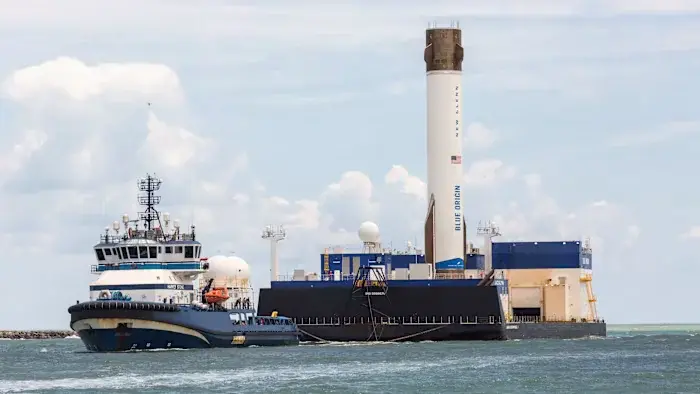
Jeff Bezos's Blue Origin has delayed its next New Glenn rocket launch until January 2027, following a major explosion in May that damaged its Florida launchpad. CEO Dave Limp told staff that severe weather and flash floods have slowed reconstruction efforts, pushing the company further behind rival SpaceX. The delay impacts Blue Origin's plans to launch Amazon satellites and compete for government contracts, including a $3.4 billion NASA deal for lunar landers.
Key points
- Blue Origin targets January 2027 for its next New Glenn launch, a shift from its previous end-of-2026 goal.
- A May explosion during a hot-fire test damaged the Cape Canaveral launchpad, triggering extensive repair delays.
- CEO Dave Limp cited severe summer weather and recent flash floods as factors hindering the rebuild.
- The delay exacerbates Blue Origin's lag behind SpaceX, which recently IPO'd and advanced its Starship program.
- Blue Origin holds a $3.4 billion NASA contract for Artemis lunar landers and 24 Amazon satellite launch contracts.
Background
In late 2026, NASA confirmed a 2027 low-Earth orbit test mission, Artemis III, to vet lunar landers from both SpaceX and Blue Origin before the 2028 crewed Moon landing. Officials noted that Blue Origin must recover from its rocket explosion to meet these deadlines, while supply chain challenges have already pushed the Artemis schedule behind target.
How outlets are covering it
The Financial Times and CNBC reported that Blue Origin CEO Dave Limp framed the delay as a 'small adjustment' in a memo to staff, emphasizing that the company had made significant progress in repairing its Florida site. CNBC noted that the new January 2027 target is only about 10 days later than the previous end-of-2026 goal. U.S. News & World Report, citing Reuters, highlighted that the New Glenn rocket has been grounded since the May explosion, which occurred days before a planned launch of 48 Amazon satellites. While all outlets agree on the January 2027 timeline, the Financial Times emphasized the competitive gap with SpaceX, noting that Blue Origin has had to rely on other vendors for Amazon's satellite launches. CNBC focused on the company's ambition to support multiple flights per week by the end of the decade, whereas the Financial Times pointed out that Blue Origin had previously planned for 12 flights this year and sought FAA permission for up to 50 launches annually.
Why it matters
The delay underscores the intense competition between Blue Origin and SpaceX for commercial and government launch contracts. As Blue Origin struggles to rebuild its launchpad, it risks losing market share to SpaceX, which has recently IPO'd and accelerated its Starship program. Furthermore, the delay could impact Blue Origin's ability to fulfill its $3.4 billion NASA contract for lunar landers and its 24 launch contracts with Amazon for its Leo internet service, potentially affecting the timeline for both commercial satellite deployment and NASA's Artemis program.
What to watch
Blue Origin aims to resume launches in January 2027, with the goal of ramping up its launch cadence to support multiple flights per week by the end of the decade. The company must also meet NASA's 2027 deadline for the Artemis III low-Earth orbit test mission, which is a prerequisite for the 2028 crewed lunar landing. Jeff Bezos has indicated that an IPO for Blue Origin could occur 'several years from now,' suggesting that the company is focusing on operational milestones before pursuing public listing.
- Blue Origin delays launches until 2027 Financial Times
- Blue Origin pushes launch to January 2027 as it races to rebuild damaged launch pad CNBC
- Bezos’ Blue Origin Delays Launching Rocket Again Until January Bloomberg.com
- Blue Origin Delays New Glenn Rocket Launch Into January, FT Reports U.S. News & World Report
- FILE PHOTO: A Blue Origin New Glenn rocket is prepared for launch at the Cape Canaveral Space Force Station in Cape Canaveral The Lufkin Daily News
Want the full story? Read the original reporting
Read on Financial Times