
Bitcoin ETFs Erase $5.8B Deficit as Institutional Inflows Surge
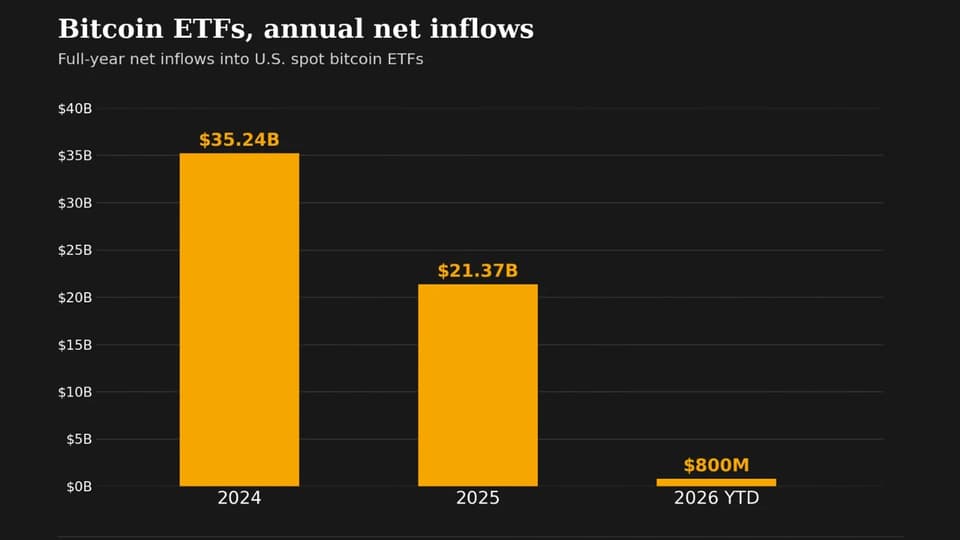
U.S. spot Bitcoin ETFs have reversed a $5.8 billion net outflow deficit from July to record nearly $800 million in net inflows for 2026. This turnaround coincides with Bitcoin’s price recovery to approximately $85,000 and a six-day inflow streak totaling $2.84 billion. While major funds like BlackRock’s IBIT lead the flow, ETF.com notes that privacy and DeFi tokens like Zcash and Hyperliquid have outperformed Bitcoin and Ether in percentage terms. Analysts attribute the surge to risk-on sentiment and Treasury liquidity measures, though year-to-date inflows remain far below 2024 and 2025 levels.
Key points
- U.S. spot Bitcoin ETFs shifted from a $5.8 billion net outflow low in July to nearly $800 million in net inflows for 2026, according to CoinDesk and SoSoValue.
- Bitcoin prices recovered from under $58,000 in June to approximately $85,000, with a six-day inflow streak bringing in $2.84 billion, though this is less than previous six-day records.
- BlackRock’s iShares Bitcoin Trust (IBIT) received $381.4 million in a single day, part of a broader $999 million daily inflow reported by Bitcoin Magazine, marking the largest daily inflow since October 2024.
- ETF.com highlights that while Bitcoin and Ether ETFs remain down year-to-date, the Grayscale Zcash ETF (ZCSH) is up 184% and the Bitwise Hyperliquid ETF (BHYP) is up 118% since launch.
- The inflow surge follows U.S. Treasury Secretary Scott Bessent’s August announcement of increased bond purchases, which lowered yields and boosted risk appetite, according to CoinDesk and Bitcoin Magazine.
Background
This recovery follows a period of volatility in August 2026, where Bitcoin briefly broke $80,000 amid fiscal fears and policy shifts. Earlier coverage noted that while the rally was stoked by lower yields and regulatory prospects, analysts cautioned that durability depended on sustained ETF buying. The current inflows represent a significant shift from the bearish sentiment seen in mid-2026, though they remain modest compared to the $35.2 billion in 2024 and $21.4 billion in 2025.
How outlets are covering it
CoinDesk and Bitcoin Magazine emphasize the magnitude of the recovery, framing the $800 million net inflow as a '180-degree turn' from the July deficit and a signal of a new bull run. They highlight the role of macro liquidity and Treasury actions in driving the price and flows. In contrast, ETF.com provides a more nuanced view, noting that while Bitcoin and Ether ETFs are still down year-to-date (IBIT -1.3%, ETHA -7%), alternative crypto ETFs like Zcash and Hyperliquid have significantly outperformed. ETF.com attributes the broader crypto surge to general risk-on appetite and relative valuation, rather than a specific catalyst, and points out that the CLARITY Act’s failure in the Senate did not deter the market. Bitcoin Foundation focuses on BlackRock’s strategic accumulation, suggesting that institutional buying during dips indicates a shift toward Bitcoin as a core portfolio asset rather than a speculative bet.
Why it matters
The reversal of ETF flows signals a potential shift in institutional sentiment, moving from risk-off to risk-on. While the absolute inflows are lower than previous years, the consistency of daily inflows and the recovery of Bitcoin’s price suggest that large allocators are accumulating despite volatility. However, the divergence between major coins and altcoins indicates that market leadership is fragmented, with investors favoring specific narratives like privacy and DeFi over broad market exposure. This dynamic could influence future price action and the structure of the next crypto cycle.
What to watch
Investors will watch whether the six-day inflow streak continues and if Bitcoin can sustain prices above $85,000. The success of the recovery will depend on sustained institutional demand and broader macro conditions, including interest rates and liquidity. If inflows persist during market weakness, it could confirm a new accumulation phase. Conversely, any reversal in flows or macro tightening could trigger a correction. The performance of outperforming ETFs like Zcash and Hyperliquid may also influence capital rotation within the crypto sector.
- Bitcoin ETFs have erased a $5.8 billion hole CoinDesk
- Crypto ETFs Are Surging, but Bitcoin & Ether Aren’t the Big Winners ETF.com
- Bitcoin Investors Buy Nearly $1B in BTC ETFs as Bull Market Returns Bitcoin Magazine
- BlackRock Is Buying the Dip: What Its $1 Billion Bitcoin Bet Says About the Crypto Market Bitcoin Foundation
- Charts of the Week: Bitcoin ETPs Return to 'Flow State'; Treasury Yields Soar galaxy.com
Want the full story? Read the original reporting
Read on CoinDesk