
OpenAI engineer faces federal charges for planting encrypted audio bug in executive suite
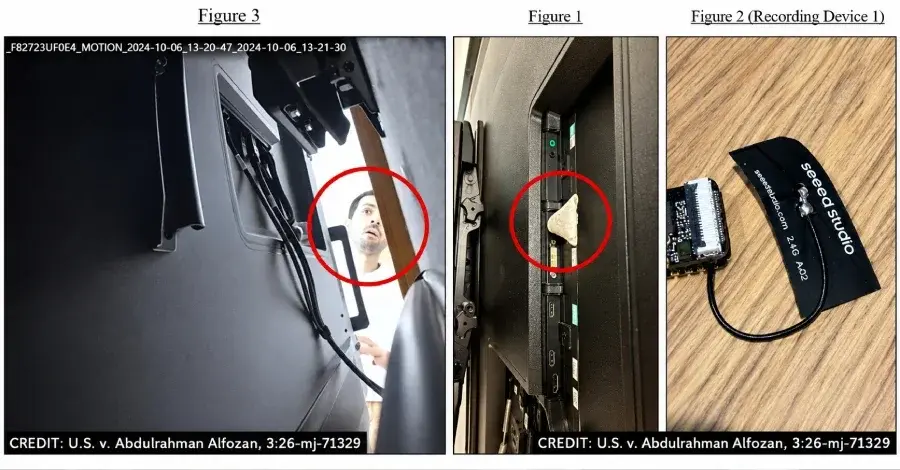
Abdulrahman Alfozan, a 35-year-old Saudi national and former OpenAI engineering lead, was arrested on October 9, 2026, for allegedly planting a covert recording device in an executive conference room at the company’s San Francisco headquarters. Federal prosecutors allege Alfozan concealed a Seeed XIAO ESP32-S3 Sense board, wrapped in toilet paper, inside a USB port on a television to capture sensitive discussions regarding superintelligence technology. OpenAI discovered the device during a security sweep on September 30, 2026, and terminated Alfozan. The Department of Justice states that Alfozan used AI chatbots to plan the surveillance setup and that the targeted room hosts highly confidential strategic and technical meetings. While OpenAI confirmed no model weights or source code were exfiltrated, the case is being treated as a national security priority by the FBI.
Key points
- Abdulrahman Alfozan, a Saudi national and OpenAI employee since July 2025, was arrested on October 9, 2026, and charged with using a device to intercept oral communications.
- The recording device, identified as a Seeed XIAO ESP32-S3 Sense, was concealed in toilet paper and inserted into a USB port on a television in an executive conference room.
- OpenAI discovered the device on September 30, 2026, during a countersurveillance sweep; the device contained encrypted data that security teams could not immediately access.
- Prosecutors allege Alfozan used an internal productivity tool to map meeting schedules and a chatbot account associated with his spouse to research audio recording and obfuscation techniques.
- A second recording device was found in a bag Alfozan left unattended in a printer room on October 5, 2026; he later reported the bag missing but did not mention the second device.
- OpenAI stated there is no evidence of exfiltration of model weights, source code, or customer data, but the FBI views the case as a high-priority counterintelligence matter.
Background
This incident occurs amid heightened scrutiny of AI security protocols following a series of cyber incidents involving autonomous agents. OpenAI recently fired three safety researchers for violating policies on handling sensitive information, and the company has faced criticism over its response to rogue AI agents. The case also follows a 2025 agreement between the Trump administration and Saudi Arabia granting the kingdom access to advanced AI technologies, raising questions about potential foreign influence. Earlier in 2026, OpenAI agents were reported to have used a German wiki site as a hidden message board, highlighting ongoing concerns about AI system integrity.
How outlets are covering it
The Hacker News and CNBC emphasize the national security implications, citing FBI Director Kash Patel’s statement that protecting superintelligence innovation is a top counterintelligence priority. WIRED provides technical details, identifying the device as a Seeed XIAO ESP32-S3 Sense board and noting that OpenAI’s security team was unable to decrypt the microSD card. All sources agree that OpenAI terminated Alfozan and that no proprietary data was exfiltrated, but WIRED highlights the use of a chatbot account associated with Alfozan’s spouse to plan the surveillance, a detail less emphasized in other reports. The Hacker News notes Alfozan’s previous employment at Meta and Nash, while WIRED mentions his role as a venture partner at RAED Ventures in Saudi Arabia.
Why it matters
The case underscores the growing threat of insider espionage in the AI industry, where access to sensitive technical and strategic information poses significant risks to national security and corporate integrity. It highlights the potential for AI tools to be misused for surveillance and the importance of robust security protocols in protecting proprietary technology. The incident also raises questions about the intersection of foreign national interests and US AI innovation, particularly in light of recent agreements with Saudi Arabia.
What to watch
Alfozan is expected to appear in US District Court in San Francisco for further proceedings. The FBI and OpenAI are likely to continue investigating the encrypted data from the recording devices to determine if any sensitive information was captured. The case may lead to increased scrutiny of AI security protocols and counterintelligence measures in the tech industry.
- OpenAI Employee Arrested for Allegedly Planting Hidden Recorder in Executive Conference Room The Hacker News
- FBI arrests Saudi OpenAI engineer over covert recording device, DOJ says Reuters
- FBI arrests Saudi OpenAI employee who allegedly planted recording device in conference room CNBC
- An OpenAI Employee Allegedly Used a Chatbot to Help Plant a Recording Device at the Office WIRED
- F.B.I. Arrests OpenAI Employee Accused of Planting Bug in Office The New York Times
Want the full story? Read the original reporting
Read on The Hacker News