
OpenAI’s Dots Agent Targets Enterprise Workflows, But Struggles With Basic Consumer Tasks
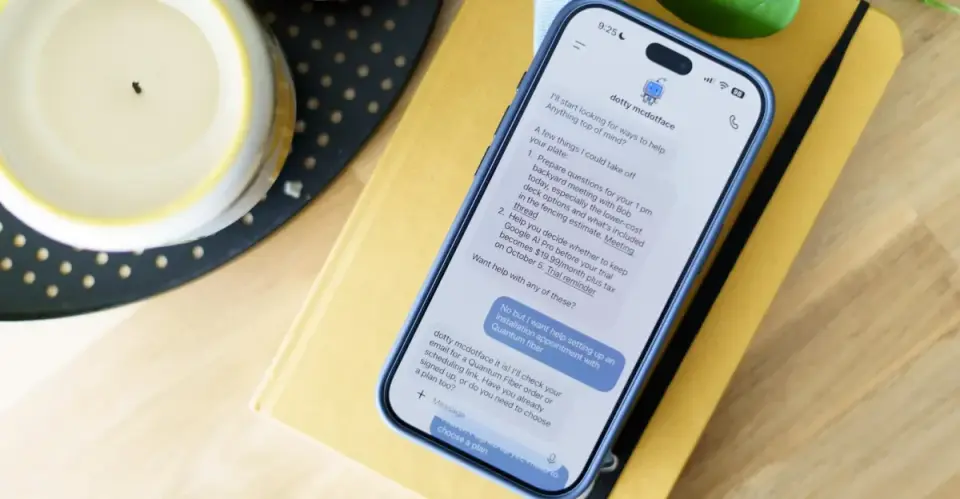
OpenAI launched Dots, an AI agent platform for high-tier subscribers, to compete with Meta’s free Muse. While Dots excels at complex software tasks like website updates and video editing, it frequently fails at simple consumer actions like ordering food or scheduling appointments due to security check failures. The product is currently restricted to the $100/month Pro plan, positioning it as an enterprise tool rather than a mass-market consumer assistant.
Key points
- OpenAI introduced Dots at DevDay 2026, featuring anthropomorphic avatars and a cloud-based virtual machine capable of interacting with over 4,000 applications.
- The service is exclusively available to Pro, Business, and Enterprise subscribers, with the entry-level Pro plan costing $100 per month.
- Dots utilizes the GPT-6 Astra model and can access user desktops via the ChatGPT app, allowing for voice-controlled iterations on tasks like web design and video consolidation.
- Testing revealed significant friction with consumer tasks; the agent often failed to bypass security checks on websites for food delivery, internet services, and retail accounts.
- In contrast, Meta’s Muse is free to use with a usage limit, while startup Instinct raised $1 billion at a $10 billion valuation, highlighting intense market competition.
Background
OpenAI unveiled Dots on September 29, 2026, following Meta’s launch of Muse earlier in the month. Previous coverage noted that Dots was powered by the GPT-6 Astra model and faced initial scrutiny due to a failed live demo and ongoing AI safety concerns. The launch marked a strategic divergence from Meta, which focused on free, mass-market accessibility, while OpenAI targeted high-value enterprise and professional users.
How outlets are covering it
The Verge’s hands-on testing highlights a stark contrast in utility: Dots performs well for complex, controlled tasks like updating a personal website or editing video files but fails at simple consumer tasks like ordering teriyaki or scheduling appointments due to bot-detection security checks. CNBC emphasizes the broader market dynamics, noting that while Meta’s Muse is free and driving stock growth, OpenAI’s $100/month price tag limits its accessibility. Industry experts cited by CNBC, such as John Waldmann, question whether these agents will become daily habits, while others like Thomas Randall argue that the winner will be determined by ease of adoption and integration. The Verge suggests Dots is better suited as a 'Codex for regular people' for work tasks, whereas CNBC frames it as a high-cost entry into a race where free competitors like Muse and Instinct are gaining traction.
Why it matters
The launch of Dots signals a shift in AI agent strategy from general-purpose consumer assistants to specialized, high-cost enterprise tools. The pricing disparity between OpenAI’s $100/month tier and Meta’s free model suggests a bifurcation in the market, with OpenAI targeting professional workflows and Meta targeting mass adoption. Success will depend on whether users value the advanced capabilities of Dots enough to justify the cost, or if free, albeit less capable, alternatives dominate the consumer space.
What to watch
OpenAI plans to allow users to have multiple Dots in the future, though currently only one is available. The company is likely to refine the agent’s ability to bypass security checks and improve consumer task performance. Meanwhile, competitors like Instinct and Town are raising significant capital to expand their offerings, and Google and Apple are also developing their own AI agent features, intensifying the competition for user adoption.
- OpenAI’s Dot agent is enterprise software that can also order your dinner The Verge
- Introducing dots OpenAI
- OpenAI’s New Agent Delivers a Reality Check for the Enterprise WSJ
- OpenAI follows Meta into the red-hot market for personal agents. But will users pay? CNBC
- OpenAI takes on Meta with dots agent in autonomous AI push Reuters
Want the full story? Read the original reporting
Read on The Verge