
YouTube Unveils AI-Powered Custom Feeds to Give Users Direct Control Over Recommendations
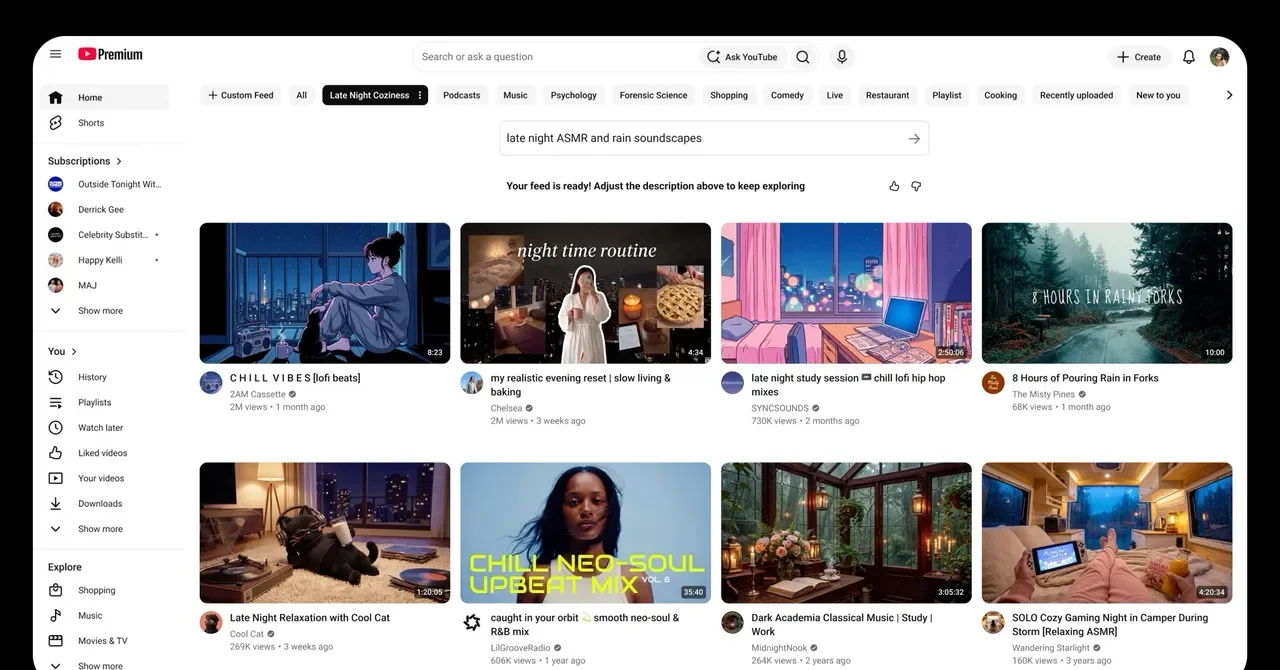
YouTube announced a new 'Custom Feeds' feature at its Made on YouTube 2026 event, allowing users to use natural language prompts to curate their homepage. The tool, powered by large language models, lets viewers request specific vibes or topics, such as 'rainy Shanghai cafe jazz,' without altering their main algorithmic profile. While YouTube tested a direct algorithm-steering tool earlier, it was scrapped due to user anxiety; Custom Feeds offers a low-stakes alternative. The feature is rolling out to US users across mobile, desktop, and TV, joining a broader industry trend of AI-driven personalization seen on Instagram and Spotify.
Key points
- YouTube introduced 'Custom Feeds' at the Made on YouTube 2026 event, enabling users to generate personalized homepages via natural language prompts.
- The feature uses large language models to process requests, allowing users to specify complex criteria like video length, topic, and mood without replacing their standard algorithmic feed.
- YouTube previously tested a direct algorithm-steering tool but abandoned it because users feared 'messing up' their recommendations; Custom Feeds is designed as a safer, experimental alternative.
- The feature is rolling out to all US users across mobile, desktop, and TV platforms, following an experimental phase earlier in 2026.
- This move aligns with industry trends, including Meta's 'Your Algorithm' on Instagram and Spotify's 'Prompted Playlists,' which use AI to let users adjust content recommendations.
Background
This development follows recent regulatory and industry shifts toward user control over algorithmic feeds. In early September 2026, Australia proposed the 'My Feed, My Way' rule, requiring platforms to offer users the option to disable algorithmic recommendations. Additionally, Microsoft recently enhanced user control in Windows 11 context menus, reflecting a broader tech industry focus on customization and user agency in digital experiences.
How outlets are covering it
WIRED emphasizes the utility of Custom Feeds for blending multiple preferences and capturing specific vibes, noting it is superior to standard search for complex requests. YouTube's official blog highlights the feature as part of a broader push to make the platform more personal and intuitive, alongside other AI tools like Ask YouTube. Google's blog summarizes the announcement as a key highlight of Made on YouTube 2026, focusing on making the platform more helpful and personal for viewers. All sources agree on the feature's AI-driven nature and its role in enhancing user control, but WIRED provides more detail on the user experience and the rationale behind scrapping the direct algorithm-steering tool.
Why it matters
The introduction of Custom Feeds marks a significant shift in how users interact with recommendation algorithms, moving from passive consumption to active curation. By leveraging AI to interpret natural language requests, YouTube addresses user demands for more control without the risk of disrupting their core viewing habits. This feature could set a new standard for user personalization in video platforms, potentially influencing competitors and shaping future regulatory expectations around algorithmic transparency and user agency.
What to watch
YouTube plans to roll out Custom Feeds to all US users across mobile, desktop, and TV platforms in the coming weeks. The company will likely monitor user adoption and feedback to refine the feature, potentially expanding it to other regions. Additionally, YouTube may integrate Custom Feeds with other AI tools, such as Ask YouTube, to create a more seamless and personalized user experience. The success of this feature could influence how other platforms approach user control over algorithmic recommendations.
- YouTube’s Custom Feeds Give You More Control Over the Algorithm WIRED
- YouTube unveils AI creator tools, shopping features at annual event Reuters
- Connect with creators on the biggest screen with YouTube’s latest features blog.youtube
- YouTube’s conversational video editing tool lets creators make edits in natural language TechCrunch
- Here’s what was announced at Made On YouTube 2026. blog.google
Want the full story? Read the original reporting
Read on WIRED