
California Ends 46-Year License Plate Era, Switching to Mirrored Format
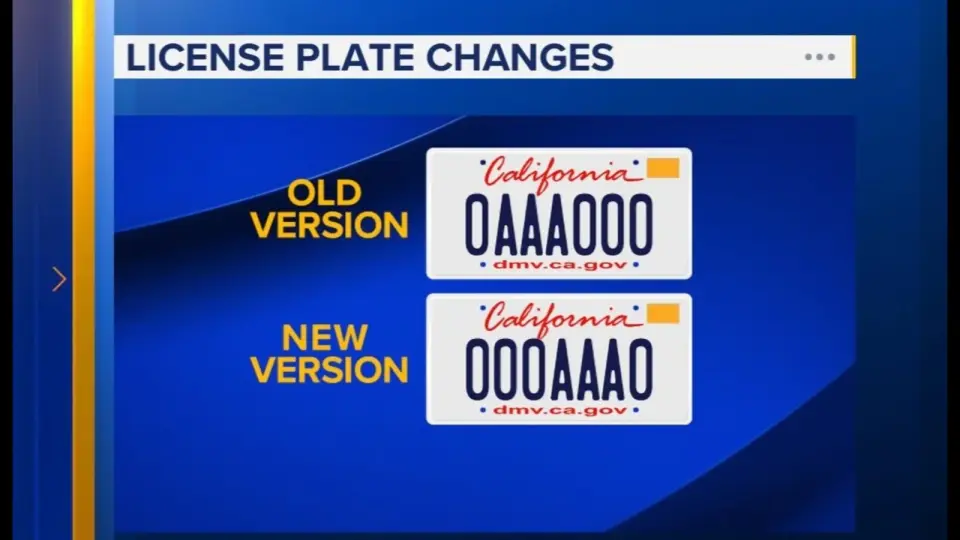
California has officially exhausted its standard license plate combinations, ending a sequence used since 1980. The state is transitioning to a new 'mirrored' format to accommodate future registrations. While production of the new plates has begun, the old plates remain in circulation due to existing inventory.
Key points
- The previous sequence, consisting of one number, three letters, and three numbers, began in 1980 and ended with the production of plate 9ZZZ999.
- The new configuration reverses the order to three numbers, three letters, and one number, starting with 000AAA1.
- The California DMV states that over 110,000 plates from the old sequence remain in storage at DMV and auto club offices.
- The new format is projected to last approximately 40 years, offering over 100 million unique combinations.
- All standard plates continue to be manufactured by inmates at Folsom State Prison, with daily production estimated at 45,000 units.
Background
This change follows a 2026-08-01 report noting that California's automatic license plate reader (ALPR) network had surpassed 9 billion scans, highlighting the critical role of plate identification in state infrastructure. Additionally, a 2026-09-09 article discussed wrongful arrests linked to ALPR data in Florida, underscoring the broader national debate regarding the accuracy and privacy implications of license plate tracking systems. The current plate change is a logistical necessity driven by registration volume, distinct from these privacy-focused developments.
How outlets are covering it
ABC7 Los Angeles and the Los Angeles Times emphasize the historical significance of the 46-year run and the logistical reality that old plates are still being issued from existing stock. FOX 11 Los Angeles highlights the 'mirrored' nature of the new design and the specific manufacturing details at Folsom. The Mercury News provides a timeline perspective, noting that the DMV predicted this shortage for late 2026 or early 2027, and confirms that new plates have already been sighted on the road, contradicting the notion that the transition is purely theoretical. While all outlets agree on the sequence change, they differ on the immediacy of the public rollout, with some noting that the final old plate has not yet been assigned to a vehicle, while others report sightings of the new format.
Why it matters
The transition ensures the state can continue registering vehicles without interruption. It also highlights the efficiency of the prison labor program at Folsom, which produces the majority of the state's plates. The change may impact automated systems, such as tolling and law enforcement databases, that rely on specific plate formats for identification and tracking.
What to watch
The new plates will gradually replace the old ones as local DMV offices and auto clubs deplete their current inventory. Drivers will likely see a mix of both formats on the road for some time. The DMV expects the new sequence to remain in use for the next four decades, based on historical registration data.
- California to change license plate sequence for 1st time in 40 years due to shortage of combinations ABC7 Los Angeles
- California is changing its license plate sequence for the first time since the 1980s Los Angeles Times
- California to change license plate sequence for first time since 1980 SFGATE
- PREVIOUS COVERAGE: Steve Hilton announces plan to abolish California DMV FOX 11 Los Angeles
- California has run out of license plate numbers. Here’s what happens now. The Mercury News
Want the full story? Read the original reporting
Read on ABC7 Los Angeles