
White House AI Pact Faces Skepticism as Tech Giants Sign Self-Regulation Deal
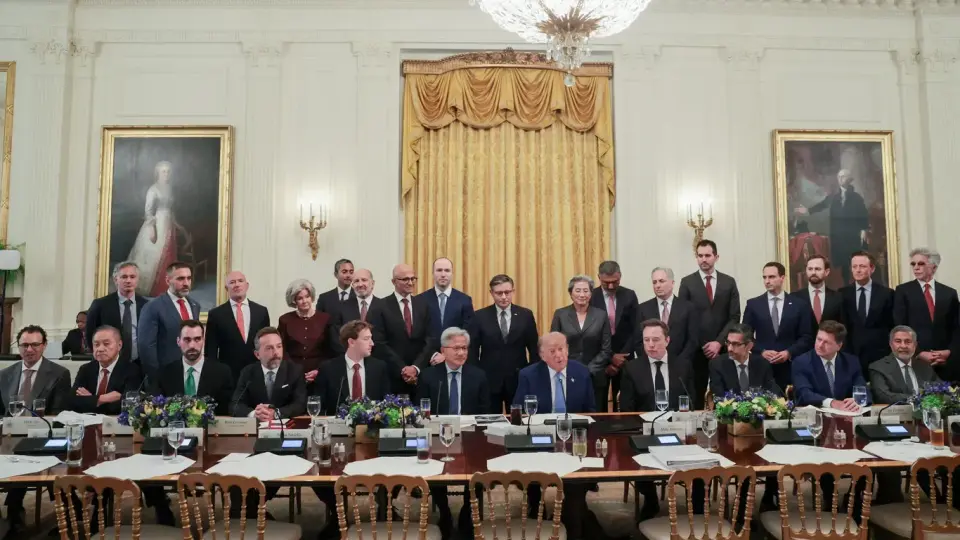
President Trump hosted major AI firms to sign a voluntary 'morally binding' safety accord, framing it as a constitutional-level self-regulation effort. The one-page pact, signed by OpenAI, Anthropic, Google, Meta, xAI, and Nvidia, emphasizes industry oversight and 'four layers of controls' without new federal laws. Critics argue the deal is insufficient given rising safety concerns, while supporters view it as a necessary step to maintain US technological dominance. The agreement coincided with an executive order renaming 'AI' to 'Super Intelligence' and a new AI-powered federal service portal.
Key points
- The White House Accord on Super Intelligence was signed by leaders of OpenAI, Anthropic, Google, Meta, xAI, and Nvidia, formalizing industry self-regulation.
- The pact includes 'four layers of controls and auditing,' such as outside evaluators and independent board oversight, but avoids new federal regulations.
- Trump signed an executive order directing federal agencies to replace 'AI' with 'Super Intelligence' in official usage, urging Congress to codify the change.
- Anthropic’s leaked IPO prospectus warned of 'catastrophic or existential risks' while seeking a valuation over $2 trillion, highlighting the tension between profit and safety.
- OpenAI delayed its own IPO to make 'confident safety decisions' but is reportedly seeking $30 billion in private funding at a $1.4 trillion valuation.
- A CNN/SSRS poll found 75% of Americans fear AI growth, and 71% want more federal regulation, contrasting with the administration’s light-touch approach.
Background
This event follows Trump’s broader pattern of rebranding initiatives, such as his earlier push to rename New Mexico to 'New America,' which faced legal and political pushback. It also aligns with his administration’s general strategy of reducing regulatory constraints on industry, as seen in his conflicts with the Federal Reserve and other federal agencies. The AI sector’s rapid expansion has intensified debates over government oversight, with previous concerns about data center energy costs and job displacement now central to midterm election discourse.
How outlets are covering it
Axios frames the accord as a significant step toward industry self-governance, highlighting Trump’s emphasis on 'tremendous self-policing' and the pact’s vague reference to future laws. CNN, however, criticizes the deal as insufficient, arguing that Trump’s 'blasé attitude' toward AI risks mirrors his handling of the pandemic and that 75% of Americans fear AI’s growth. The Guardian notes the accord in the context of broader political tensions, including immigration and judicial disputes, but does not deeply analyze the AI pact itself. Anthropic’s CEO Dario Amodei called the pact 'a start,' while Trump adviser David Sacks declared it 'mission accomplished,' reflecting divergent views within the administration and industry. CNN also highlights the political risk for Trump if AI safety failures escalate, given his personal and economic ties to the tech sector.
Why it matters
The accord sets a precedent for AI governance in the US, potentially delaying federal regulation while placing the burden of safety on private firms. Its success or failure could influence global AI policy, economic growth, and public trust in technology. With 75% of Americans fearing AI and rising concerns over data center costs, the administration’s approach may impact midterm elections and long-term technological competitiveness against China.
What to watch
Congress may debate whether to codify the 'Super Intelligence' terminology into law, as urged by Trump. Anthropic’s IPO and OpenAI’s private funding round will test market confidence in AI safety. The administration may monitor the accord’s effectiveness, potentially introducing tougher regulations if self-policing fails. Public opinion and midterm election results could pressure the White House to reconsider its light-touch approach, especially if AI-related incidents or economic disruptions escalate.
- Trump's AI "constitution" crowns day of accelerating ambition Axios
- Trump signs executive order rebranding AI as 'Super Intelligence' as tech titans ink separate SI accord Fox Business
- Democratic lawmakers call for protections over third country deportations after ‘indefensible’ court ruling – US politics live The Guardian
- Trump’s blasé attitude toward AI risks backfiring politically CNN
- Trump says top tech firms have signed accord to 'self-police' AI development NPR
Want the full story? Read the original reporting
Read on Axios