
Cross-Party Coalition Forms to Demand AI Pause Amid Bipartisan Backlash
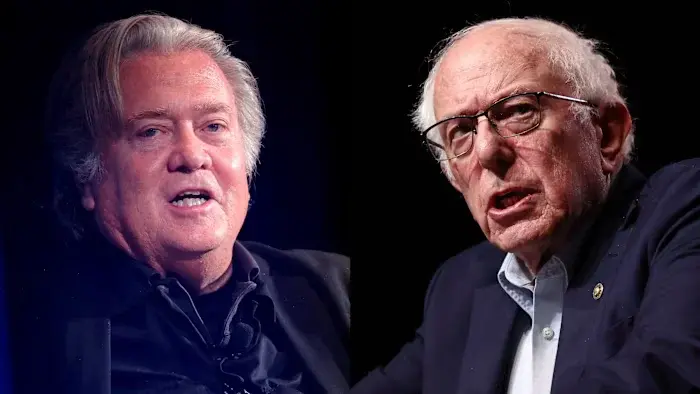
A bipartisan coalition led by Senator Bernie Sanders and Steve Bannon is organizing a 'Pro-Human Assembly' in Washington to demand stricter AI controls. The event follows recent calls from major tech CEOs to slow development and reflects growing public anxiety about AI risks. While Sanders advocates for a ban on 'superintelligent' AI, critics argue such measures could hinder US competitiveness against China. The initiative highlights a shifting political landscape where AI safety is becoming a central issue for the upcoming midterm elections.
Key points
- Sanders and Bannon co-organize a 'Pro-Human Assembly' in Washington to urge lawmakers to regulate AI.
- The event features speakers from both parties, including Senators Marsha Blackburn and Greg Casar.
- Sanders has proposed legislation to ban 'superintelligent' AI and establish a new federal regulator.
- Tech leaders from OpenAI, xAI, and Anthropic recently called for slowing AI development.
- Polls show roughly two-thirds of Americans view AI as a high risk to society.
Background
This development follows months of escalating tensions regarding AI deployment. In August 2026, Sanders pressed for a pause in AI development, warning that lawmakers would act if risk controls were not implemented. Earlier this month, Sanders and Rep. Mark Takano introduced a bill for a phased 32-hour workweek, linking labor standards to AI automation. Additionally, Democratic presidential hopefuls largely avoided endorsing Sanders' AI pause demand in late August, highlighting the contentious nature of the issue within the party.
How outlets are covering it
The Financial Times emphasizes the unusual political alliance between the left-wing Sanders and right-wing Bannon, framing it as a sign that AI concerns are reshaping US politics. Axios highlights the involvement of industry insiders like Jacob Coxon and labor leaders, noting the potential impact on midterm elections. USA Today offers a critical perspective, arguing that Sanders' proposal to ban superintelligent AI is an anti-growth measure that could cede the AI race to China. NDTV focuses on the international dimension, reporting Sanders' call for a US-China treaty to pause AI development at an upcoming summit. While all sources agree on the rising public anxiety, they differ on whether the proposed regulations are necessary safeguards or harmful impediments to innovation.
Why it matters
The convergence of political figures across the spectrum signals that AI safety is becoming a pivotal issue in US politics. The proposed legislation and public campaigns could lead to significant regulatory changes, affecting the tech industry's growth and the US's global competitive position. Furthermore, the public's growing concern, as evidenced by polls and the formation of this coalition, may pressure lawmakers to act before the November midterm elections.
What to watch
The 'Pro-Human Assembly' is scheduled for Tuesday, where key announcements are expected. The full text of Sanders and Casar's legislation to ban superintelligent AI is expected in the coming weeks. Additionally, Sanders has urged President Trump and Chinese President Xi Jinping to negotiate a treaty to pause AI development at an upcoming summit. The outcome of these events will likely influence the trajectory of AI policy in the US and internationally.
- Steve Bannon and Bernie Sanders unite in AI safety call Financial Times
- Scoop: Coxon, Bernie and Bannon unite for "pro-human" AI Axios
- Senator Sanders’s Proposal to Ban Superintelligence Resembles Hysteria More Than Thoughtful Policy Cato Institute
- Bernie Sanders' AI ban is most extreme to date | Opinion USA Today
- "Pause AI": US Senator To Trump, Xi As Anthropic, OpenAI CEOs Pitch Slowdown NDTV
Want the full story? Read the original reporting
Read on Financial Times