
120-Million-Year-Old Fossil Reveals Mammal with Reptile-Like Teeth and Platypus Feet
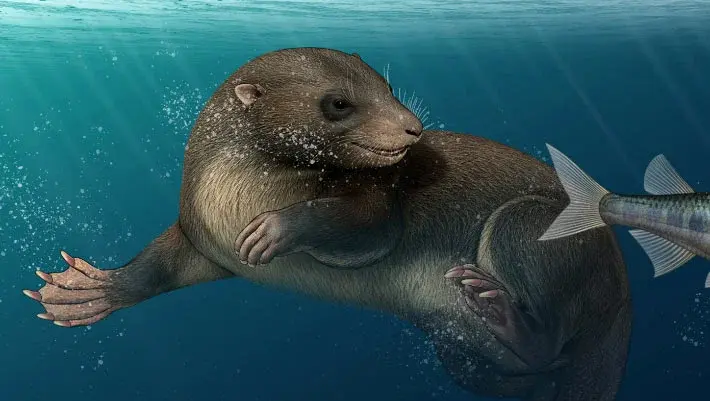
A newly described Early Cretaceous mammal, Dongoconodon platycauda, challenges long-held views of mammalian evolution by exhibiting polyphyodonty (multiple tooth replacements) and semi-aquatic adaptations similar to modern platypuses and nutrias. Found in China, this 120-million-year-old specimen suggests that key mammalian traits like dental replacement and ear structure evolved independently rather than as a single package.
Key points
- Dongoconodon platycauda, a small eutriconodontan mammal, lived approximately 120 million years ago in what is now Liaoning, China.
- The fossil, collected in 2016, is the only known mammal to show polyphyodonty across all four tooth types, a trait previously associated with reptiles.
- Anatomical features, including webbed hands and feet and a flattened tail, indicate a semi-aquatic lifestyle similar to modern platypuses and nutrias.
- The specimen preserves an intermediate stage of Meckel’s cartilage, suggesting that the separation of the middle ear from the jaw evolved independently from dental changes.
- Researchers propose that the return to repeated tooth replacement was linked to a carnivorous diet and specific ecological niches.
Background
This discovery follows recent paleontological findings that have pushed back the origins of various animal lineages, such as the 120-million-year-old marsupial fossil mentioned in our archive. It also complements ongoing debates about the timing of mammalian trait evolution, which has been complicated by earlier discoveries like the Norian eucynodont Brasilodon, which showed ante-molar diphyodonty 20 million years earlier than previously thought.
How outlets are covering it
While Sci.News and New Scientist emphasize the surprising nature of the polyphyodont dentition and the platypus-like swimming adaptations, Global Times highlights the significance of this being the earliest confirmed swimming mammal in the crown group. Nature provides the technical anatomical details, noting that the dental formula and ear structure differ from related gobiconodontids. Mike Benton of the University of Bristol, cited by New Scientist, notes that this late-occurring mammal retained reptilian ancestry more than many other Mesozoic mammals, which had already transitioned to diphyodonty by the end of the Triassic period.
Why it matters
This fossil reshapes our understanding of mammalian evolution by demonstrating that key diagnostic features like diphyodonty and a fully detached middle ear did not evolve as a tightly linked suite. Instead, they evolved independently, allowing for a greater diversity of evolutionary experiments during the age of dinosaurs. This challenges the traditional textbook view that mammals acquired these traits in a single, rapid transition.
What to watch
Further analysis of the fossil may provide more insights into the evolutionary pathways of mammalian traits. Researchers will likely continue to study other Mesozoic mammals to determine if similar patterns of polyphyodonty and semi-aquatic adaptations are present in other lineages, potentially revealing more about the ecological diversification of early mammals.
- Dinosaur-Era Mammal Swam Like Platypus and Replaced Its Teeth Multiple Times Sci.News
- Fossil mammal with reptile-like teeth changes picture of our evolution newscientist.com
- A polyphyodont, semiaquatic eutriconodontan mammal from the Early Cretaceous of China Nature
- Earliest confirmed swimming mammal discovered in China Global Times
- 125-million-year-old fossil: Earliest true mammal ever built for swimming Yahoo
Want the full story? Read the original reporting
Read on Sci.News