
Bacteria Detect Viral Protease Activity to Trigger Self-Destructive Immunity
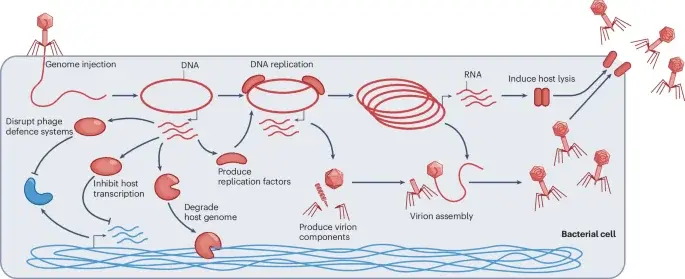
A new study in Science reveals that bacteria can detect viral invasion by sensing the enzymatic activity of phage proteases, rather than just viral genetic material. This discovery identifies a specific trigger for the CBASS immune system, which causes infected bacteria to self-destruct to prevent viral spread. Understanding this mechanism offers a pathway for engineering phages that evade bacterial defenses, potentially improving treatments for antibiotic-resistant infections.
Key points
- Researchers at the University of Utah Health identified that phage proteases directly cleave host sensor proteins to activate the CBASS anti-phage signaling system.
- The CBASS pathway functions as a last-resort defense, triggering a self-destructive response in the infected bacterium to prevent viral replication and spread.
- This finding challenges the previous assumption that bacterial immunity is primarily triggered by the presence of viral DNA or RNA.
- The discovery has implications for phage therapy, as engineers can design phages lacking these specific proteases to bypass bacterial immune detection.
- The CBASS pathway is evolutionarily conserved, sharing similarities with immune signaling pathways found in humans, highlighting its fundamental importance across domains of life.
Background
Recent advancements in phage therapy, including engineered gut bacteria that deploy phages against Salmonella, have highlighted the need for phages that can evade bacterial immune systems. Previous research also showed that phages use kinases to disable bacterial defenses, illustrating the complex arms race between bacteria and viruses. This new finding adds another layer to that dynamic by revealing how bacteria detect the functional activity of viral enzymes.
How outlets are covering it
The primary source, a review in Nature Reviews Microbiology, provides a broad framework for bacterial immune sensing, categorizing triggers into phage nucleic acids, proteins, and host process perturbations. It emphasizes the diversity of mechanisms and the evolutionary trade-offs phages face. In contrast, the secondary source from Bioengineer.org focuses on a specific recent discovery in Science regarding the CBASS pathway. While the review highlights the complexity of sensing across multiple classes, the secondary source zeroes in on the novelty of detecting protease activity as a trigger, linking it directly to the development of phage therapies for antibiotic-resistant infections. Both sources agree on the importance of understanding these mechanisms for therapeutic applications but differ in scope, with the review offering a comprehensive overview and the secondary source detailing a specific mechanistic breakthrough.
Why it matters
Understanding how bacteria detect viral proteases allows for the engineering of phages that can evade these immune responses, potentially making phage therapy more effective against antibiotic-resistant bacteria. This knowledge also provides insights into the evolutionary conservation of immune systems, bridging the gap between bacterial and human immunity.
What to watch
Researchers will likely focus on engineering phages that lack or modify the specific proteases that trigger the CBASS pathway. This could lead to the development of more robust phage therapies for treating bacterial infections, particularly those caused by antibiotic-resistant strains. Further studies may also explore the evolutionary implications of this conserved immune signaling pathway.
- How bacterial immune systems sense phage infection Nature
- Viral enzyme cuts bacterial sensor protein, triggering defense against invading phages Phys.org
- Bacteria Detect Viral Proteases to Trigger Immune Response Bioengineer.org
- Research uncovers how bacteria fight viruses, opening the door to better virus-based antibiotics EurekAlert! Science News Releases
Want the full story? Read the original reporting
Read on Nature