
Chemical Analysis Confirms Heme in 115-Million-Year-Old Dinosaur Bone
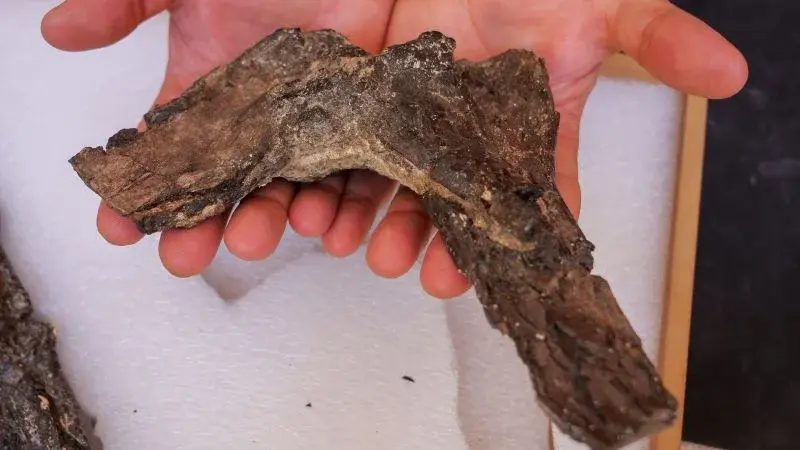
Researchers have identified the strongest evidence yet of preserved red blood cells in a 115-million-year-old dinosaur fossil. By combining microscopic imaging with chemical analysis, the team detected heme, a key component of hemoglobin, within the bone of Aratasaurus museunacionali. While this discovery challenges previous assumptions about molecular preservation, experts remain divided on whether the structures are genuine blood cells or artifacts of fossilization.
Key points
- A study published in the Proceedings of the National Academy of Sciences reports the first in-situ detection of heme in a dinosaur fossil.
- The specimen is a partial hind limb of Aratasaurus museunacionali, a theropod dinosaur from the Early Cretaceous period found in Brazil in 2008.
- Lead author Kliti Grice of Curtin University states that low-oxygen burial conditions and manganese oxides likely helped preserve the cellular structures.
- The fossilized cells differ in size and shape from those of modern birds and crocodilians, though the authors suggest this may be due to post-mortem changes.
- Future research aims to apply these techniques to other museum specimens to determine if such preservation is widespread or rare.
Background
Previous studies from the late 1990s reported similar structures in reptile fossils, but their validity was fiercely debated. Recent archive coverage from November 3, 2026, noted the initial announcement of these chemical and microscopic findings. This discovery follows other paleontological developments, such as the excavation of the Ironstone Bonebed in Utah, which highlights ongoing efforts to understand dinosaur biology and extinction recovery.
How outlets are covering it
Kliti Grice and her team emphasize the significance of detecting heme within the structures, arguing that this provides concrete molecular evidence of blood cells. They view the discovery as a breakthrough that challenges the conventional wisdom that such biomolecules cannot survive deep time. Conversely, Mary Schweitzer of North Carolina State University remains skeptical, stating that the findings do not meet established standards for identifying fossilized blood cells. She questions the relevance of hausmannite, a manganese oxide found in the sample, since it is not present in living red blood cells. Timothy Cleland of the Smithsonian Institution notes that while the study opens new avenues, it does not imply the survival of DNA, as heme and DNA fossilize differently. Popular Science highlights the broader implications for astrobiology, suggesting that if such molecules survive on Earth, similar traces might exist elsewhere in the universe.
Why it matters
This discovery could revolutionize paleontology by allowing scientists to access molecular and cellular information from extinct animals. If confirmed, it may help researchers understand dinosaur physiology, metabolism, and oxygen transport. Furthermore, it suggests that many fossils in museum collections may contain hidden biological data that has never been investigated, potentially unlocking new insights into the evolution of life.
What to watch
Grice and her team plan to expand their research to other fossils from different species, geological periods, and environments to assess how common this type of preservation is. They aim to determine if the findings are a rare occurrence or if similar molecular evidence exists in other specimens. Additionally, researchers will investigate how red blood cells change after death to better understand the discrepancies in cell size and shape observed in the fossil.
- Scientists say they’ve found rare evidence of blood cells in a fossil. Not everyone is convinced CNN
- Dinosaur blood found in fossils for the first time Popular Science
- Scientists say they've found the strongest evidence yet of red blood cells in a dinosaur bone KCRA
- Dinosaur red blood cells recovered from 115-million-year-old fossil New Scientist
- Fossilised red blood cells found in 115m-year-old dinosaur’s bone, say scientists The Guardian
Want the full story? Read the original reporting
Read on CNN