
Colorado Teacher Unveils World's First Adult T. Rex Trackway at Denver Museum
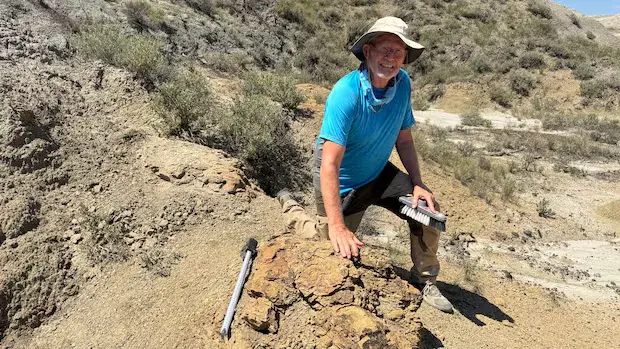
Kent Hups, a high school science teacher in Colorado, has unveiled the first confirmed trackway of an adult Tyrannosaurus rex at the Denver Museum of Nature & Science. Discovered in the North Dakota Badlands in 2025, the 66.5-million-year-old footprints offer rare insights into the dinosaur's movement. While T. rex bones are common, trackways are exceptionally rare; this find includes four to five prints that confirm the predator walked at a brisk human pace. The discovery, published in the Journal of Vertebrate Paleontology, highlights the value of trace fossils in understanding dinosaur behavior, with some prints left in situ for future study.
Key points
- Kent Hups, a science teacher at Northglenn High School in Colorado, discovered the trackway while exploring the Hell Creek Formation in North Dakota in 2025.
- The trackway consists of four to five three-toed footprints, each nearly one meter long, dating back approximately 66.5 million years.
- Researchers estimate the T. rex had a stride of about four meters and walked at a speed of 5.5 to 7.2 km/h (3.5 to 4.5 mph), comparable to a brisk human walk.
- The discovery was confirmed by analyzing size, stride, and proximity to known T. rex fossils, as no skeleton was found at the end of the track.
- Three prints were excavated and airlifted to the Denver Museum of Nature & Science, while two remain in the ground for future technological analysis.
- The find was co-authored by Hups and published in the Journal of Vertebrate Paleontology in September 2026, resolving debates about T. rex locomotion.
Background
Prior to this discovery, T. rex bones were frequently found, but isolated footprints or trackways were extremely rare. Our earlier coverage in September 2026 noted the publication of the study in the Journal of Vertebrate Paleontology, which highlighted the significance of the find in resolving long-standing debates about T. rex walking speed. The current unveiling at the Denver Museum of Nature & Science marks the public debut of the excavated prints, which were previously documented through 3D scanning and high-resolution photography.
How outlets are covering it
CBC emphasizes the personal journey of Kent Hups, a lifelong fossil enthusiast, and the rarity of the find, noting that while T. rex bones are common, tracks are scarce due to preservation conditions. Colorado Public Radio highlights the technical definition of a trackway (at least three prints) and the collaboration with paleontologist Martin Lockley, who died in 2023, underscoring the decades-long search for such a find. WKRC and 98.5 KYGO focus on the public unveiling and the educational aspect, with Hups encouraging students to explore outdoors rather than stay indoors. All sources agree on the significance of the trackway in understanding T. rex movement, but differ in emphasis: CBC and CPR focus on the discovery process and scientific validation, while WKRC and KYGO highlight the public exhibition and educational impact. There is no disagreement on the core facts, but the framing varies between scientific validation and public engagement.
Why it matters
This discovery provides the first direct evidence of T. rex locomotion, resolving debates about whether the dinosaur could run or only walked. It underscores the importance of trace fossils in paleontology, as they capture behavior rather than just skeletal remains. The find also highlights the value of citizen science and the role of educators in scientific discovery, with Hups's background as a teacher and museum volunteer contributing to the breakthrough. Additionally, the decision to leave two prints in the ground for future analysis reflects a long-term approach to fossil preservation and technological advancement in paleontology.
What to watch
Researchers will continue to study the two prints left in the North Dakota Badlands, anticipating future technological advancements that may reveal more details. The excavated prints at the Denver Museum of Nature & Science will remain on public display through the end of 2026, with hopes of extracting skin samples for further analysis. The museum's 'Discovering Teen Rex' exhibit, which includes the trackway, will run through the end of the year, providing public access to this rare find.
- How a high school science teacher stumbled upon the 1st known T. Rex trackway CBC
- How much can you tell about a T. rex from its footprints? Quite a bite … er, bit. Colorado Public Radio
- Only known T. rex trackway in the world unveiled at museum WKRC
- Colorado teacher’s rare T. Rex find on display at Denver Museum of Nature & Science 98.5 KYGO
Want the full story? Read the original reporting
Read on CBC