
Florence Team Achieves Room-Temperature Entanglement Between Levitated Glass and Light
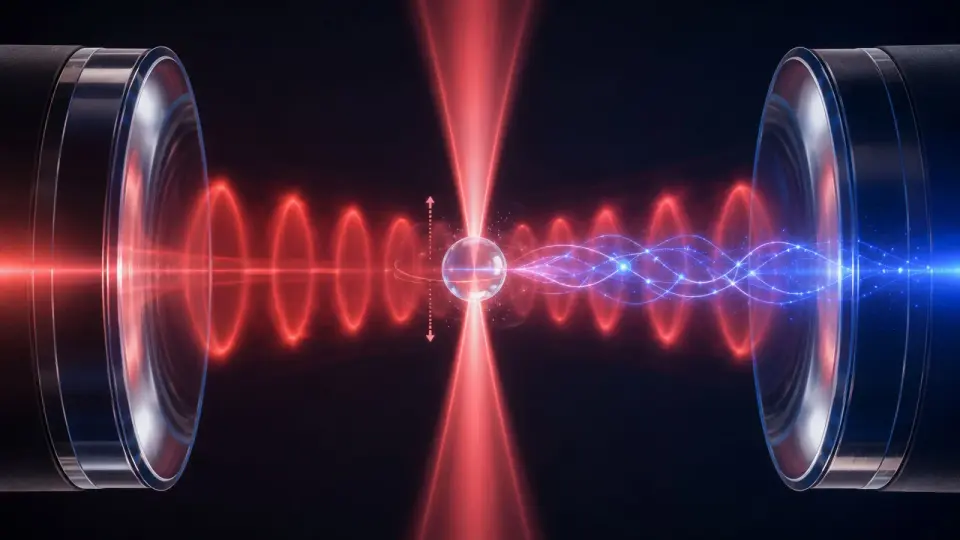
Researchers at the University of Florence have demonstrated persistent quantum entanglement between a levitated 100-nanometer glass nanosphere and light at room temperature. By using a dual-laser optical tweezer system, they cooled the sphere's motion to its quantum ground state while entangling it with outgoing light, bypassing the need for cryogenic cooling. This milestone, published in Science, provides a potential interface for quantum networks by allowing entangled states to travel via light.
Key points
- Francesco Marin and colleagues at the University of Florence achieved entanglement between a levitated glass nanosphere and light without cryogenic cooling.
- The experiment utilized a 100-nanometer glass sphere, containing tens of millions of atoms, levitated in a near-vacuum optical cavity.
- A two-color laser system was employed: red-detuned light cooled the sphere's motion, while blue-detuned light generated the entanglement.
- The entanglement persisted in the light traveling away from the cavity, creating a potential channel for transmitting quantum information.
- The results were published in the journal Science, marking the first demonstration of persistent entanglement between a levitated object and propagating light at room temperature.
Background
This development follows recent advancements in room-temperature quantum technologies, such as Japan's Shunkai quantum computer using optical tweezers and demonstrations of phonon focusing in boron arsenide. It also aligns with broader efforts to scale quantum networking, including recent 100-channel teleportation experiments and evidence of entanglement in Higgs boson decays at the LHC.
Why it matters
This experiment establishes a practical interface for connecting mechanical systems to quantum networks. By proving that entanglement can survive in light traveling away from a levitated object at room temperature, it offers a pathway for future quantum communication devices that do not require expensive cryogenic infrastructure. It bridges the gap between isolated quantum states and usable quantum resources.
What to watch
Researchers must now strengthen the entanglement and learn to control it dynamically rather than just observing stationary states. The goal is to enable quantum information to be written to, stored in, and retrieved from the mechanical oscillator. Ultimately, the team aims to connect multiple nanospheres in different optical tweezers to form larger quantum systems.
Want the full story? Read the original reporting
Read on ScienceAlert