
Mantle Convection Erased 1.2 Billion Years of Earth’s History
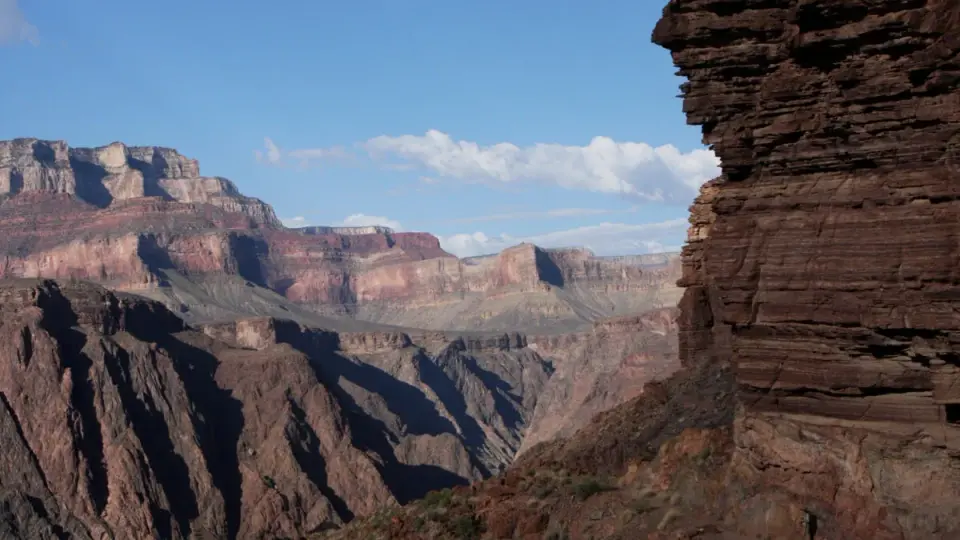
A new study in Nature attributes the Grand Canyon’s Great Unconformity, a 1.2-billion-year gap in the rock record, to deep Earth processes. Researchers argue that mantle convection caused continents to rise and then sink, erasing ancient layers and burying them under new sediment.
Key points
- The Great Unconformity represents a missing 1.2 billion years of geological history at the Grand Canyon, where Cambrian rocks sit directly atop much older igneous and metamorphic layers.
- Researchers from the University of Wollongong propose that mantle convection drove this gap, causing continents to uplift and then subside over hundreds of millions of years.
- The study models show that continents like Laurentia, Baltica, and North China experienced prolonged uplift followed by subsidence, which eroded ancient rock and preserved the resulting surface.
- This vertical motion aligns with the start of the Cambrian era, potentially linking deep Earth dynamics to the explosion of complex life.
- Previous theories, such as glacial erosion or sea-level fall, had not been tested against global models, making this the first dynamic test of the phenomenon.
Background
The Great Unconformity was first identified by geologist John Wesley Powell at the Grand Canyon. While earlier reports have focused on other geological mysteries, such as Martian meteorites or crypto thefts, this study addresses a long-standing question in Earth science: why entire sections of the geological record are missing. The gap is not unique to North America; similar unconformities exist in Europe, Africa, and Asia, but the Grand Canyon’s is the most prominent.
How outlets are covering it
Gizmodo highlights the dramatic nature of the missing 'pages' in Earth’s history, quoting lead author Santosh Dhungana on how the gap jumps from early chapters to later ones. The Nature article provides the technical framework, emphasizing that mantle-driven dynamic topography is the first mechanism tested against global datasets. While Gizmodo focuses on the narrative of lost time, Nature stresses the consistency of model predictions with preserved sediment volumes across continents, noting that Laurentia’s large area and limited deformation explain why the gap is best documented there.
Why it matters
Understanding the Great Unformity offers new insights into the Cambrian explosion, as landscape dynamics affect seawater chemistry and environmental conditions. The findings suggest that deep Earth processes, not just surface events, shaped the conditions for life’s diversification. This research bridges geodynamics and paleontology, providing a clearer picture of how Earth’s interior influenced its surface history.
What to watch
Researchers may further explore how dynamic topography influenced other geological periods and environmental transitions. The study opens avenues for understanding the link between deep Earth processes and surface conditions, potentially refining models of past climate and biological evolution.
- The Grand Canyon Is Missing 1.2 Billion Years of Earth History. Scientists May Have Figured Out Why Gizmodo
- The deep Earth origin of the Great Unconformity Nature
- New modeling links gaps in Earth's geological record to rising and sinking continents Phys.org
- Earth’s geological record is missing hundreds of millions of years. UOW scientists think they know why EurekAlert!
Want the full story? Read the original reporting
Read on Gizmodo