
Mars North Pole Ice Found to Be 3% Dust, Not 25%
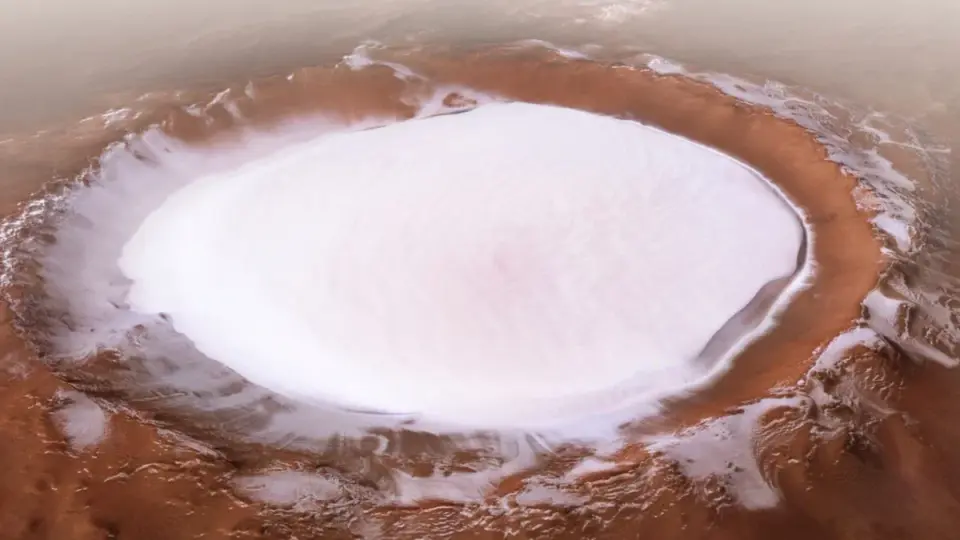
A new study published in npj Space Exploration corrects a major error in Mars science, revealing that the north polar ice cap contains only about 3% dust by mass, rather than the previously estimated 25%. Researchers Aditya Khuller and Pari Mohan used Earth-based snow models to analyze data from the Phoenix lander and orbiters, finding that the ice is layered like an 'ice-cream sandwich' with seasonal dust frost covering cleaner, older ice. This finding impacts models of Martian climate history and potential habitability.
Key points
- The new study estimates the top layer of Mars's north polar ice contains roughly 3% dust by mass, a significant drop from the previous 25% estimate.
- The discrepancy arose because earlier calculations used radiative transfer models originally designed for lunar regolith, which did not accurately apply to Martian ice.
- Researchers adapted methods developed for Earth's snow and ice, using data from the Phoenix lander, Mars Express, and Mars Reconnaissance Orbiter to analyze six north polar locations.
- The north pole features a layered structure where a dusty winter frost sublimates in summer, exposing cleaner, older ice beneath.
- Cleaner ice layers may preserve a record of past atmospheric conditions and could potentially trap heat to form meltwater pockets, raising questions about habitability.
Background
This finding follows recent debates about Martian geology, including studies suggesting red dust may indicate ancient wet times and that gullies were carved by CO2 ice rather than water. Previous archive coverage also highlighted the seasonal freezing of CO2 into polar caps, which affects global pressure. The current study refines our understanding of the water ice component of these polar regions, which is distinct from the seasonal CO2 frost.
How outlets are covering it
All four sources agree on the core finding: the dust content is significantly lower than previously thought. Gizmodo and SciTechDaily emphasize the methodological error, noting that the old models were designed for the Moon and failed when tested against Earth ice. Universe Today highlights the broader implications for Mars's axial tilt and climate history, explaining how massive ice ages redistribute dust. Sci.News provides the most granular data, noting that for the Korolev crater, the new study finds 0.2-0.4% dust compared to previous estimates of 15-22%. While all outlets cite Aditya Khuller, Gizmodo and SciTechDaily focus on the astrobiological implications of meltwater pockets, whereas Universe Today focuses on the geological stability of the planet's tilt.
Why it matters
Accurate dust measurements are critical for modeling how quickly Martian ice sublimates, which affects the planet's water cycle and potential for liquid water. If the ice is cleaner, it reflects more sunlight and may not warm as quickly as previously assumed, altering predictions about where and when meltwater could form. This also impacts the interpretation of ice cores as climate archives, as the 'dustiness' of layers is a key proxy for past atmospheric conditions.
What to watch
Researchers plan to apply this improved analysis to other parts of Mars to build a clearer record of climate change over time. The findings may also inform future missions designed to sample subsurface ice, as the lower dust content suggests the ice may be more accessible and less contaminated than previously believed.
- Scientists Thought Mars’s North Polar Ice Was 25% Dust. They Were Way Off Gizmodo
- Mars' North Pole Ice Is Far Cleaner Than Expected Universe Today
- Water Ice at Mars’ North Pole is Considerably Cleaner than Previously Believed Sci.News
- Mars’ North Polar Ice Is Much Cleaner Than Scientists Thought scitechdaily.com
- The North Pole Of Mars Is Less Dusty Than Scientists Thought Astrobiology Web
Want the full story? Read the original reporting
Read on Gizmodo