
New Chinese Fossil Suggests Flight Evolved Independently in Birds and Microraptorines
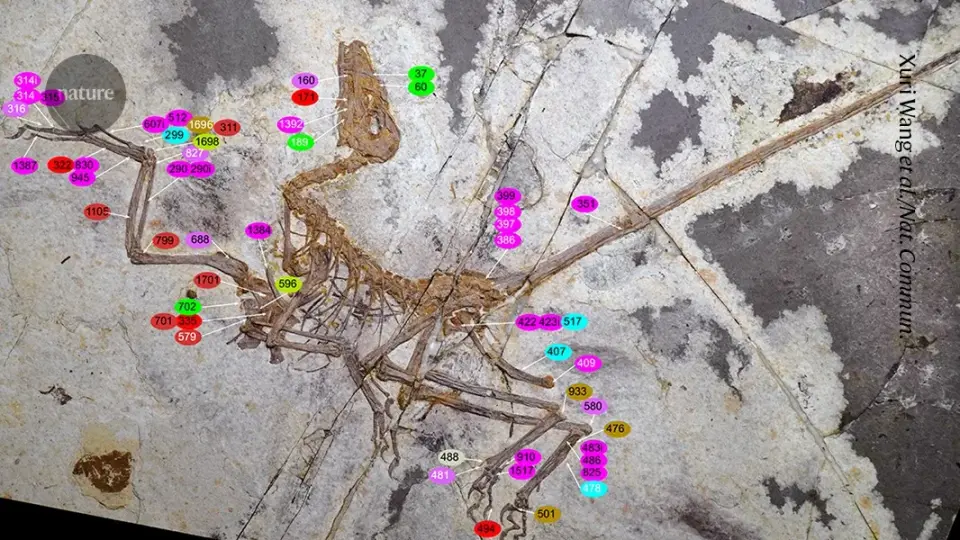
A newly described 57-centimeter microraptorine dinosaur, Norellraptor barsboldi, from Liaoning province, China, provides evidence that flight evolved independently in birds and non-avian dinosaurs. The fossil, dated to 145–100 million years ago, shares 30% of flight-related adaptations with birds but in a different sequence, supporting convergent evolution over a shared ancestral flight apparatus.
Key points
- Norellraptor barsboldi is a 57-centimeter microraptorine dinosaur discovered in Liaoning province, China, and described in Nature Communications on September 29, 2026.
- The fossil shows feather traces on fore and hind limbs and the tail, with flight-related adaptations similar to birds but developed in a different order.
- Researchers found that 30% of 194 flight-related adaptations in microraptorines also evolved in birds, but the sequence of development differs, indicating independent evolutionary pathways.
- The specimen was estimated to be about three years old at death, with its forearm development stopping early, unlike modern birds.
- The discovery supports the hypothesis that flight evolved multiple times among feathered dinosaurs, including independently in microraptorines and birds.
Background
Previous coverage in our archive (September 2026) highlighted the Norellraptor barsboldi fossil as evidence for independent flight evolution in birds and microraptorines, noting the 30% overlap in anatomical changes but different developmental sequences. Earlier studies (August 2026) also emphasized fossil record biases, which may affect interpretations of evolutionary history.
How outlets are covering it
Nature emphasizes the fossil's contribution to evidence that flight evolved multiple times, highlighting the 30% overlap in adaptations but different sequences. ScienceAlert focuses on the convergent evolution aspect, comparing it to whales and fishes, and notes that more evidence is needed to confirm independent flight evolution. Both sources agree on the fossil's significance but differ in emphasis: Nature stresses the multiple origins of flight, while ScienceAlert highlights the convergent evolution and the need for further evidence.
Why it matters
The discovery challenges the traditional view that flight evolved once in a shared ancestor of birds and microraptorines, suggesting instead that flight evolved independently in multiple lineages. This has implications for understanding the evolution of flight and the diversity of adaptive strategies in feathered dinosaurs.
What to watch
Further research is needed to confirm the independent evolution of flight in birds and microraptorines. Additional fossils and studies will help clarify the developmental and evolutionary pathways of flight-related adaptations in these groups.
- Stunning fossil shows dinosaurs’ distinctive path to flight Nature
- Independent assembly of the flight apparatus in a non-avian dinosaur clade Nature
- New feathered, winged dinosaur from China challenges our theories on bird and dinosaur evolution Phys.org
- Scientists Discover New Dinosaur Species from Remarkably Complete Fossil — and Its Feathers Are Still Preserved people.com
- Revolutionary Feathered Dinosaur Discovery in China Suggests Flight Evolved Multiple Times ScienceAlert
Want the full story? Read the original reporting
Read on Nature