
Saturn Reaches Peak Brightness This Weekend as Rings Return to View
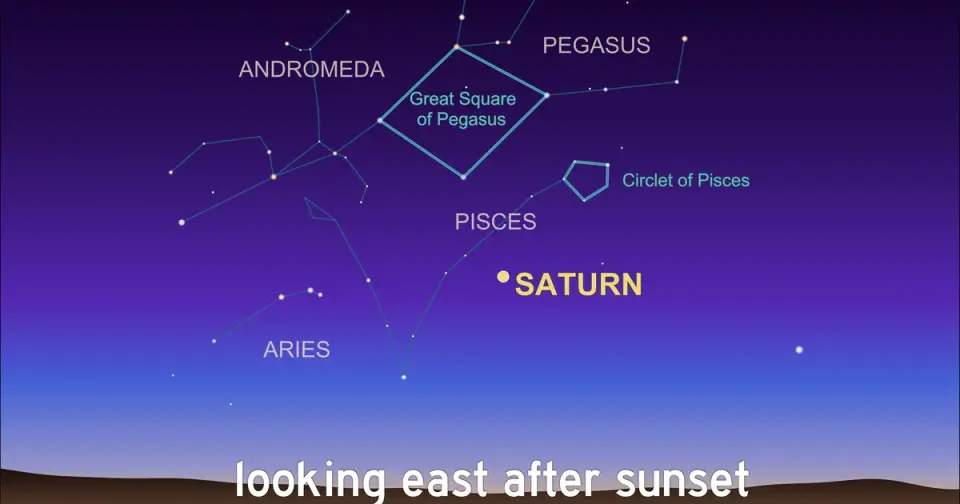
Saturn reaches opposition on October 4, 2026, becoming the brightest and closest to Earth this year. The event offers optimal viewing conditions for the planet's rings, which are now tilted 7.5 degrees from Earth's perspective. While clouds may obscure views in some regions, the planet remains visible throughout October, with the Seeliger effect enhancing ring brightness.
Key points
- Saturn reaches opposition on October 4, 2026, at 8:21 a.m. EDT, marking its closest approach to Earth at 784 million miles.
- The planet appears as a yellowish point of light in the eastern sky, visible from sunset to dawn without a telescope.
- Telescopes can reveal Saturn's rings and its 293 moons, with the Seeliger effect causing the rings to appear brighter than the planet's globe.
- The ring system, spanning 175,000 miles but only 30 feet thick, is now tilted 7.5 degrees, making it visible after being edge-on in 2025.
- The Orionid meteor shower peaks on October 21-22, offering another major skywatching opportunity this month.
Background
Saturn's previous opposition occurred on September 21, 2025, when Earth crossed the plane of Saturn's rings, making them effectively invisible. The current opposition marks the return of the rings to view. In September 2026, the Harvest Moon aligned with Saturn, offering a dual viewing opportunity. Additionally, in September 2026, astronomers using the Hubble Space Telescope detected a new 10-sided polygon (decagon) at Saturn's south pole, adding to the planet's famous north-pole hexagon.
How outlets are covering it
WRAL.com emphasizes the practical viewing details, noting that clouds may obscure views this weekend but that Saturn will remain visible throughout October. Sky & Telescope highlights the Seeliger effect, which brightens Saturn's rings during opposition, and provides detailed timing for the event. NASA Science focuses on the broader skywatching context, including the Orionid meteor shower and the Moon's proximity to the Pleiades. Nautilus | Science Connected stresses the importance of using a telescope to view Saturn's rings and the Cassini Division, while also mentioning the decagonal atmospheric pattern on Saturn's south pole.
Why it matters
Saturn's opposition provides a rare opportunity to observe the planet at its brightest and closest to Earth, offering the best chance to see its rings and moons. The event also highlights the dynamic nature of Saturn's atmosphere, with the newly discovered decagonal pattern on its south pole. For amateur astronomers, this is a prime opportunity to use telescopes and binoculars to explore the night sky, while for scientists, it offers a chance to study atmospheric features and ring dynamics.
What to watch
Saturn will remain an excellent evening target for much of October 2026. The Orionid meteor shower will peak on October 21-22, offering another major skywatching event. The Moon will pass near the Pleiades star cluster on October 27-28. Jupiter will reach opposition on February 11, 2027, followed by Mars on February 19, 2027.
- Look up: Saturn is at its brightest this weekend WRAL
- This Week's Sky at a Glance, October 2 – 11 Sky & Telescope
- What’s Up: October 2026 Skywatching Tips from NASA NASA Science (.gov)
- Don’t Miss Saturn in All its Glory This Weekend Nautilus | Science Connected
- Get ready to start seeing Saturn more clearly ABC15 Arizona
Want the full story? Read the original reporting
Read on WRAL