
Submerged Neutrino Telescope Confirms Einstein's Relativity Limits
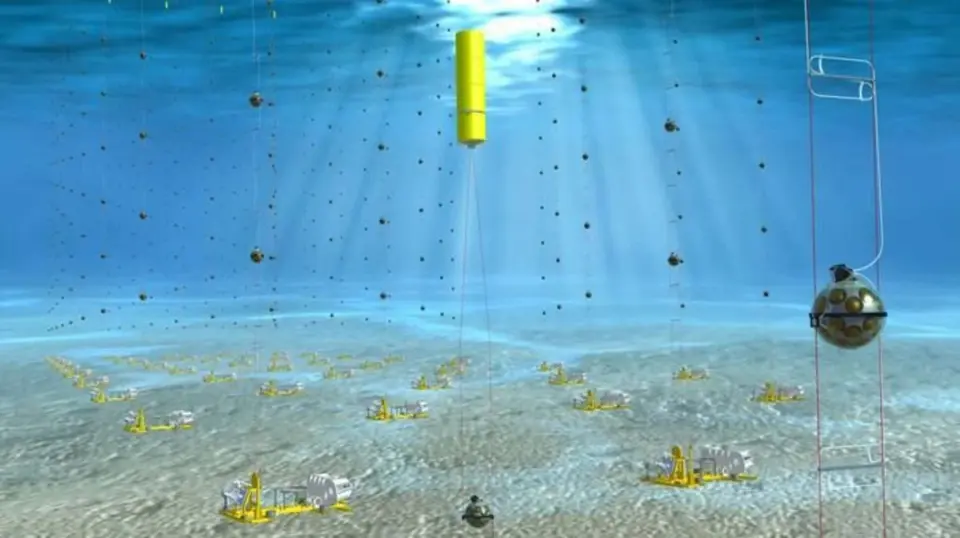
A partial neutrino telescope located 1.5 miles beneath the Mediterranean Sea has confirmed that Einstein's principle of Lorentz invariance holds true. By analyzing 5,828 neutrinos over 17 months, researchers found no evidence that the laws of physics change based on direction or speed. These results set competitive limits for quantum gravity theories, matching data from much larger detectors.
Key points
- The Oscillation Research with Cosmics in the Abyss (ORCA) detector, situated 2.4 kilometers below the surface off Toulon, France, tested the principle of Lorentz invariance.
- Lorentz invariance states that the laws of nature remain consistent regardless of an observer's velocity or orientation, a core assumption of both general relativity and the Standard Model.
- Researchers analyzed 5,828 neutrinos collected between 2020 and 2021, including particles that traveled through the entire 12,700-kilometer width of the Earth.
- The study found no deviations in neutrino oscillation patterns, indicating that any violation of Lorentz invariance is weaker than the new limits established by the experiment.
- The results, published in the Journal of Cosmology and Astroparticle Physics, rule out certain quantum gravity models that predict stronger violations of this principle.
Background
This experiment contributes to a broader scientific effort to test the foundations of Einstein's theories. Recent debates have questioned whether dark energy is a mathematical illusion or if gravity alters the speed of light, challenging standard assumptions. Additionally, new mathematical models of gravitational reconnection and proposals for laser-powered probes to test gravity near black holes highlight the ongoing drive to verify general relativity in extreme conditions. The ORCA findings provide empirical constraints that help narrow the field for theories attempting to unify quantum mechanics and gravity.
Why it matters
Confirming Lorentz invariance is crucial for unifying general relativity and the Standard Model of particle physics. While both theories work well in their respective domains, they conflict in extreme settings like the early universe. By setting strict limits on potential violations, this experiment helps physicists eliminate incorrect models of quantum gravity, such as certain string theory or loop quantum gravity variants that predict a grainy structure of space-time.
What to watch
The ORCA detector currently has 44 units in the water, with plans to activate 108 by 2030. Researchers intend to repeat these tests using the sister ARCA detector off Sicily, which is designed to capture high-energy cosmic neutrinos. These distant particles are expected to provide even stronger tests for Lorentz invariance violations, as the effects grow more pronounced over longer distances and higher energies.
Want the full story? Read the original reporting
Read on Yahoo