
Tasmania’s 43,600-Year-Old King’s Holly Remains a Genetic Enigma
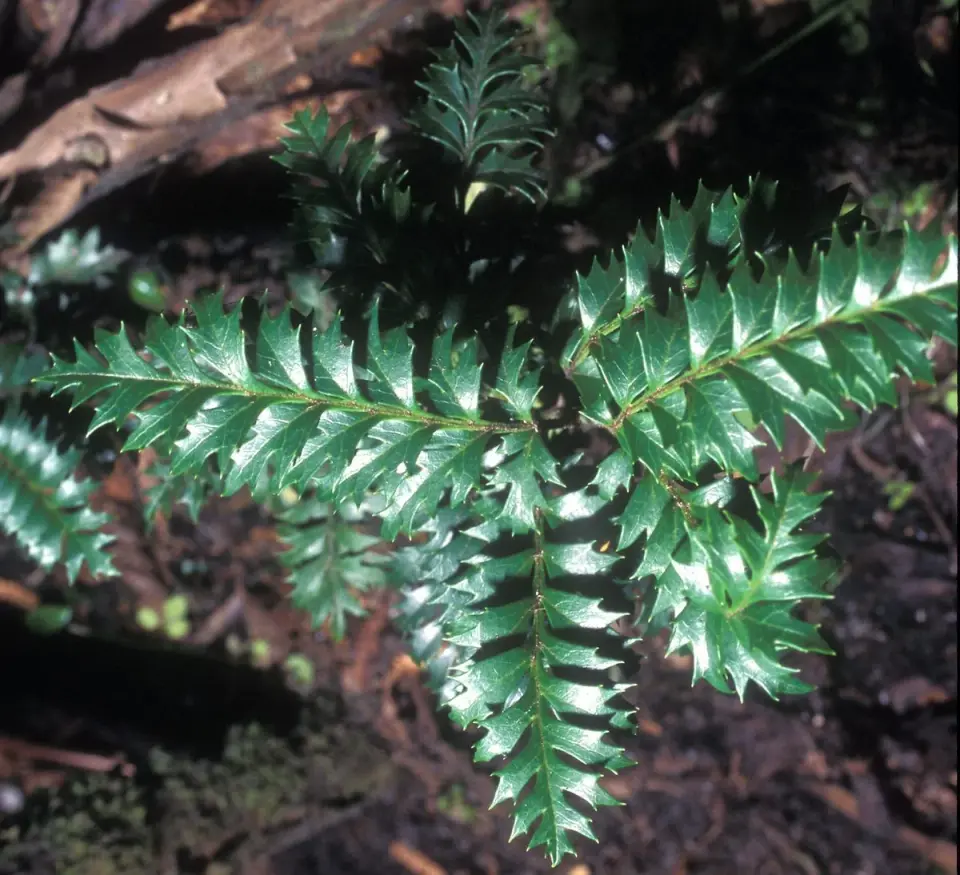
King’s holly, a shrub in southwest Tasmania, is among Earth’s oldest clonal organisms, with fossil evidence dating back 43,600 years. Despite producing flowers, it is sterile due to triploid chromosomes and reproduces only through cloning. Its survival is precarious, with populations confined to small areas and threatened by fire and pathogens, though a new colony was recently discovered.
Key points
- King’s holly (Lomatia tasmanica) is a shrub found in southwest Tasmanian rainforests, reaching heights of 2 to 8 meters.
- Fossilized leaf fragments found in 1989 by Greg Jordan date to 43,600 years ago, with some estimates suggesting an age of up to 135,000 years.
- The plant is genetically identical to its ancient ancestors, reproducing via cloning through root systems or fallen branches rather than seeds.
- It possesses triploid chromosomes, making it sterile despite producing purple-red flowers, as the chromosomes cannot pair for sexual reproduction.
- Individual plants grow slowly at 2.6mm per year and can live up to 300 years, but the species faces threats from fire and the pathogen Phytophthora cinnamomi.
- A new colony was discovered in 2026, though its location is kept secret to protect it from human damage and disease.
Background
This story highlights the unique biological mechanisms of long-lived clonal plants. While previous coverage in our archive focused on human longevity, such as the 117-year-old Ethel Caterham, King’s holly represents a different form of longevity through genetic continuity rather than individual lifespan. The discovery of a new colony in 2026 adds a recent development to the species' precarious conservation status, which has been monitored since its identification in the 20th century.
Why it matters
King’s holly offers critical insights into plant genetics and evolutionary survival strategies, particularly how triploid chromosomes can lead to sterility and reliance on clonal reproduction. Its extreme age challenges conventional understanding of plant lifecycles and highlights the vulnerability of ancient species to modern environmental threats. Successful propagation efforts could aid in preserving this unique genetic resource for future scientific study and ecological stability.
What to watch
Conservationists will continue to monitor the newly discovered colony and improve propagation techniques in captivity. The approved Australian nursery will work on non-commercial propagation to bolster wild populations. Researchers may further investigate the genetic mechanisms behind King’s holly’s longevity and sterility, potentially uncovering new insights into plant biology and conservation strategies for other clonal species.
Want the full story? Read the original reporting
Read on BBC Wildlife Magazine