
Epic Games Launches AI-Generated Client, Promises Linux Support and 30x Speed Gains
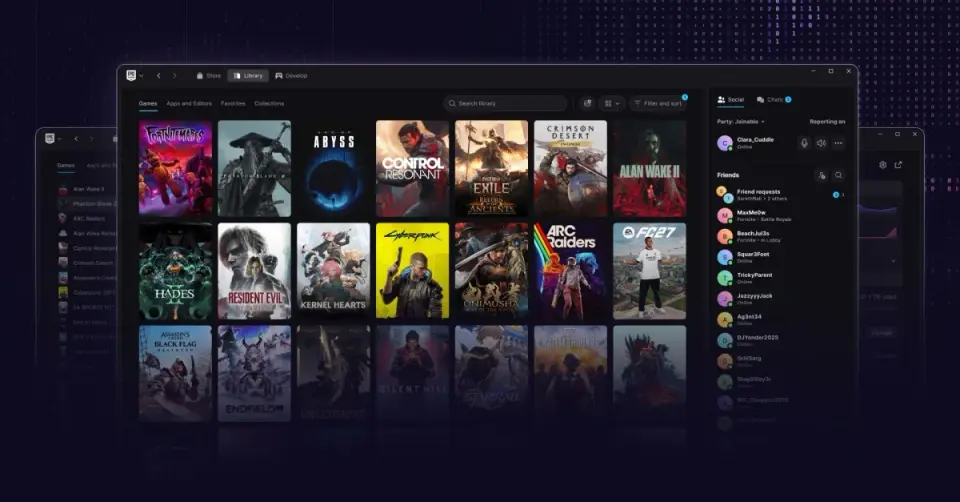
Epic Games has released a preview of its new PC games launcher, which the company describes as 'vibe coded' using AI tools. The update offers significantly faster performance, including library load times up to 30 times quicker than the previous version, and introduces support for Linux. This move aligns with CEO Tim Sweeney’s recent strategic pivot toward AI-accelerated development, though the launcher team maintains human oversight of the AI-generated code. The new client also includes cross-platform game detection and persistent voice chat features, with a full rollout planned once stability is confirmed.
Key points
- The new Epic Games Launcher is available in preview on Windows, Mac, and Linux, featuring a redesigned interface and improved speed metrics.
- Epic states the launcher was 'vibe coded,' utilizing AI agents to write and review code, though human developers supervised the entire process.
- Performance improvements include cold boot times up to twice as fast and system-tray restoration up to 15 times faster than the legacy version.
- The update introduces 'Epic Parties' for persistent voice chat and allows users to detect games installed via Steam and Xbox PC apps.
- Fortnite is planned for Linux release, contingent on meeting security requirements across major Linux distributions, with no specific timeline provided.
Background
This launch follows a series of significant shifts at Epic Games in 2026. In March, the company laid off over 1,000 employees, an event CEO Tim Sweeney later clarified was not directly related to AI adoption. More recently, in October, Sweeney announced a 'huge pivot' toward AI-accelerated development, mandating that staff retool to maximize AI efficiency. This strategy coincided with the indefinite delay of a $1.5 billion Marvel and Star Wars shooter collaboration with Disney, which was reportedly being redeveloped using AI tools like Anthropic's Claude. The new launcher serves as a practical demonstration of this new development philosophy, aiming to prove that AI can enhance productivity without necessarily reducing headcount.
How outlets are covering it
The Verge highlights the 'vibe coded' nature of the launcher, emphasizing Epic's public embrace of AI-assisted development and the company's broader strategic pivot. GamesBeat focuses on the technical improvements, citing specific metrics such as 30x faster library loading and the new cross-platform detection features, while noting the lack of a fixed timeline for the full rollout. PC Gamer frames the update as a competitive response to Steam, highlighting the speed gains and the potential for Linux compatibility. While all outlets acknowledge the AI involvement, The Verge and PC Gamer place greater emphasis on the cultural and strategic implications of the 'AI-first' mandate, whereas GamesBeat concentrates on the user experience and technical specifications. There is no direct disagreement on the facts, but the emphasis varies between the technological achievement and the broader industry trend toward AI automation.
Why it matters
The release of the new launcher signals a concrete application of Epic's controversial shift toward AI-driven development. By publicly admitting to 'vibe coding' a core piece of infrastructure, Epic is testing the viability of AI-generated software in a high-stakes consumer environment. The success or failure of this update could influence how other major tech companies approach AI integration in their development pipelines. Furthermore, the expansion to Linux and the integration of cross-platform game detection could shift the competitive landscape for PC gaming clients, potentially challenging Steam's dominance. The move also serves as a response to recent layoffs and industry backlash, attempting to demonstrate that AI can enhance output without necessarily replacing human roles entirely, at least in the short term.
What to watch
Epic Games will monitor the preview version of the launcher for stability and feature parity before initiating a full rollout. The company has not provided a specific timeline for when the legacy launcher will be deprecated, but Keely indicated that the transition will happen 'soon' to avoid a prolonged coexistence of old and new interfaces. Additionally, Epic will continue to work with Linux distribution maintainers to ensure Fortnite meets security requirements for a native Linux release. The broader impact of the 'AI-first' development model will be observed in upcoming projects, including the delayed Disney collaboration, as the company seeks to validate its new efficiency strategies.
- Epic’s new games launcher is ‘vibe coded’ The Verge
- 'The Library Loads 30x Faster’ – The New, Much Speedier Epic Games Launcher Has Arrived IGN India
- Epic confirms Fortnite is coming to Linux with new Easy Anti-Cheat v2 VideoCardz.com
- Epic Games releases new launcher with a streamlined user experience and future Fortnite Linux compatibility GamesBeat
- Epic says its new 'vibe coded' Epic Games Store launcher is faster than Steam PC Gamer
Want the full story? Read the original reporting
Read on The Verge