
ASUS ROG XG Station 3 Launches as First Thunderbolt 5 eGPU Dock with Open-Frame Design
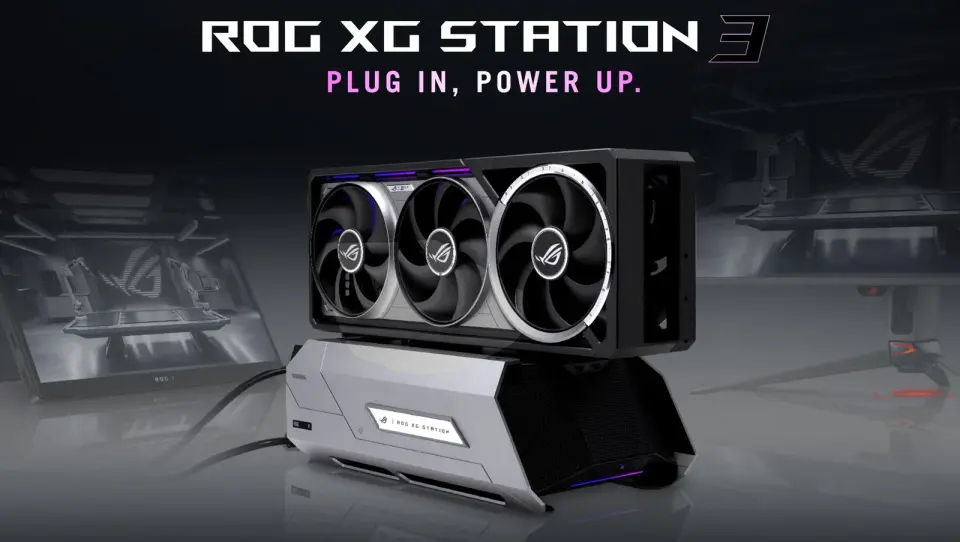
ASUS has officially launched the ROG XG Station 3, an external graphics processing unit (GPU) dock featuring Thunderbolt 5 connectivity. The device supports up to 80 Gbps of bidirectional bandwidth and 120 Gbps for video traffic, enabling high-performance gaming and content creation on laptops. It includes an open-frame design for improved cooling, supports NVIDIA, AMD, and Intel GPUs, and offers backward compatibility with Thunderbolt 4. Notably, the dock does not include a power supply, requiring users to provide their own SFX or SFX-L unit. Pricing and availability have not yet been disclosed.
Key points
- The ROG XG Station 3 is the first ASUS external GPU dock to feature a Thunderbolt 5 interface, offering up to 80 Gbps of bidirectional bandwidth and 120 Gbps for high-volume video traffic.
- The dock supports a wide range of modern GPUs, including NVIDIA GeForce RTX 50 series, RTX PRO 6000, AMD Radeon RX 9000 series, and Intel Arc series.
- It features an open-frame design to ensure unobstructed cooling for the installed GPU and includes a GC-HPWR connector for ASUS BTF (Back-to-Front) graphics cards, eliminating the need for external power cables.
- The device includes dual Thunderbolt 5 ports (one upstream for laptop connection with 140W power delivery, one downstream for up to three 4K displays via daisy-chaining) and two 10 Gbps USB Type-C ports for peripherals.
- Unlike its predecessor, the ROG XG Station 2, the new dock does not include a power supply; users must supply their own SFX or SFX-L unit. Pricing and availability remain unannounced.
Background
The XG Station lineup was introduced by ASUS in 2007, with the previous generation, the ROG XG Station 2, utilizing Thunderbolt 3. The new XG Station 3 was first showcased at Computex 2025. In the broader market, competitors like Ugreen have launched Thunderbolt 5 eGPU docks with included power supplies, such as the LinkStation Pro with an 850W unit. ASUS has also recently expanded its gaming peripheral lineup with high-refresh-rate OLED monitors and gaming handhelds, indicating a continued focus on high-performance gaming ecosystems.
How outlets are covering it
Wccftech and TechPowerUp emphasize the technical specifications, highlighting the Thunderbolt 5 interface, support for latest-generation GPUs, and the open-frame design for cooling. TechPowerUp notes the aesthetic appeal of the open design and the practicality of the BTF power delivery. Notebookcheck provides a comparative perspective, noting that while Thunderbolt 5 offers 80 Gbps, PCIe tunneling is limited to 64 Gbps, which may result in slightly lower real-world performance compared to OCuLink docks. Notebookcheck also highlights the absence of a bundled power supply as a downside compared to competitors like Ugreen, which includes an 850W unit, and the previous ASUS model, which included a 600W unit. All sources agree on the core specifications but differ in their emphasis on the trade-offs between bandwidth, power delivery, and included accessories.
Why it matters
The launch of the ROG XG Station 3 marks a significant step for ASUS in the external GPU market, aligning with the latest Thunderbolt 5 standard. This allows laptop users to access desktop-class GPU performance without purchasing a new PC, offering a flexible upgrade path. The support for BTF graphics cards and the open-frame design cater to enthusiasts seeking both performance and aesthetics. However, the lack of a bundled power supply may deter some users, as it adds to the overall cost and complexity of setup. The device positions ASUS competitively against other Thunderbolt 5 eGPU docks, though the pricing and availability will be crucial factors in its market reception.
What to watch
ASUS has not yet announced pricing or availability for the ROG XG Station 3. Users will need to wait for official announcements to determine the cost and when the device will be available for purchase. The market response to the dock, particularly regarding the lack of a bundled power supply and the performance implications of Thunderbolt 5's PCIe tunneling limits, will likely influence future product decisions from ASUS and competitors.
- ASUS Debuts ROG XG Station 3 Dock With Thunderbolt 5 Interface, Supporting Up To 80 Gbps Of Bandwidth For Modern GPUs Wccftech
- ASUS Republic of Gamers Announces ROG XG Station 3 With Thunderbolt 5 TechPowerUp
- ASUS XG Core Radeon RX 9060 XT LP runs at just 1.6 GHz, nearly half the clock speed of desktop cards VideoCardz.com
- ROG XG Station 3: Can an eGPU Dock Run an RTX 5090? EJS Computers
- Asus launches new Thunderbolt 5 eGPU dock with open design and plenty of ports Notebookcheck
Want the full story? Read the original reporting
Read on Wccftech