
Portadown Standoff: Protesters Block First Orange Order March on Garvaghy Road Since 1998
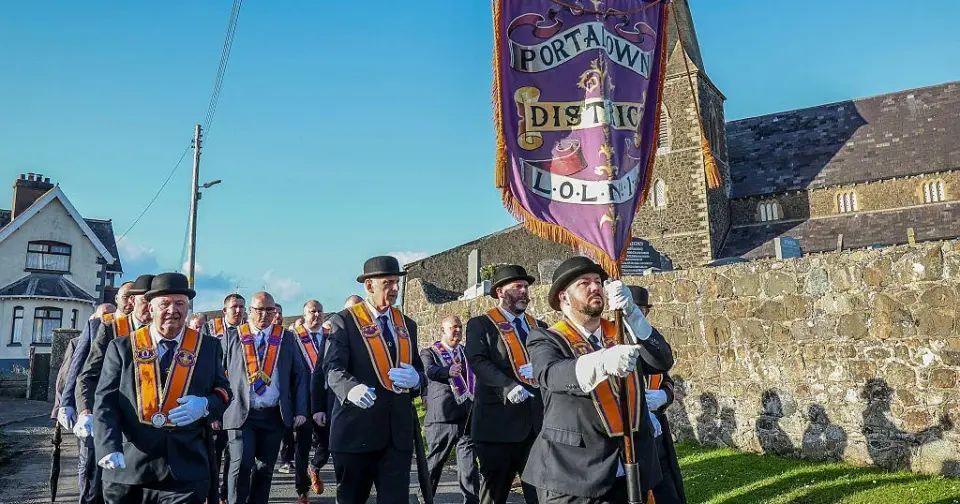
Thousands of protesters blocked the Orange Order from marching down Garvaghy Road in Portadown, Northern Ireland, on Sunday, September 27, 2026. This was the first time the parade was permitted on this route in nearly 30 years, following a High Court decision. Nationalist politicians, including First Minister Michelle O'Neill, joined the blockade, while loyalist groups and the DUP insisted the march was lawful. Police maintained a presence but did not clear the road, and the standoff ended without violence as protesters dispersed late in the evening.
Key points
- The Orange Order was scheduled to march from Drumcree Church down Garvaghy Road at 8:00 AM BST, a route banned since the 1998 Good Friday Agreement.
- A High Court in Belfast granted the parade approval in an early-morning ruling on Sunday, prompting immediate protests.
- Thousands of demonstrators, many wearing balaclavas, blocked the road, joined by Sinn Féin President Mary Lou McDonald and First Minister Michelle O'Neill.
- Loyalist supporters and Orange Order members formed a barricade at Drumcree Church, refusing to leave despite police presence.
- Police Chief Constable Jon Boutcher stated he hoped for a 'sensible and peaceful conclusion' and noted that 'sensible voices' calling for calm were being listened to.
- By late evening, protesters had largely dispersed, though 20 to 30 residents remained, and traffic resumed on Garvaghy Road.
Background
The Good Friday Agreement of 1998 largely ended the 'Troubles,' a conflict that killed approximately 3,600 people and wounded 50,000. The agreement established a power-sharing government in Northern Ireland, which remained part of the United Kingdom while the rest of Ireland became independent. The Garvaghy Road had been a notorious flashpoint between nationalist and unionist communities. Recent tensions were heightened by U.S. President Donald Trump's comments in September 2026 suggesting a united Ireland was 'fantastic' and inevitable, which drew criticism from unionist leaders and UK officials.
How outlets are covering it
Sinn Féin and nationalist protesters viewed the march as a regression to the violent past and a violation of community safety, with Mary Lou McDonald calling on the Northern Ireland Secretary to ban the parade. They argued that the progress of the last 28 years was being undermined. In contrast, the Democratic Unionist Party (DUP) and the Orange Order insisted the march was lawful, with DUP leader Gavin Robinson accusing O'Neill of 'wilfully disregarding' court rulings and 'giving two fingers to the police, the courts and the rule of law.' DUP MP Carla Lockhart described O'Neill's actions as 'untenable.' British Prime Minister Andy Burnham and Irish Taoiseach Micheál Martin both called for calm, with Martin describing the Parades Commission's decision as 'incomprehensible and wrong,' while Burnham emphasized the need to protect gains made in Northern Ireland. Police Chief Constable Jon Boutcher maintained a neutral stance, focusing on evidence-gathering and a peaceful resolution.
Why it matters
The standoff tested the stability of the peace process established by the Good Friday Agreement nearly three decades ago. The involvement of senior politicians in an unlicensed protest raised questions about the rule of law and the effectiveness of power-sharing institutions. The event highlighted ongoing tensions between nationalist and unionist communities in Northern Ireland and the potential for historical grievances to reignite conflict. It also underscored the challenges faced by authorities in balancing legal rulings with community safety and political pressure.
What to watch
The Garvaghy Road Residents' Coalition plans to meet with the Police Service of Northern Ireland and the Northern Ireland Secretary on Monday to discuss the incident. Residents have stated they intend to prevent future marches on the route 'permanently.' Political leaders are expected to engage in 'longer-term conversations' to resolve the underlying issues. The outcome of these discussions will likely influence future parade decisions and the stability of the power-sharing government in Northern Ireland.
- Protesters block Northern Ireland march being held for first time since Good Friday Agreement CBS News
- Drumcree: NI secretary of state calls for 'compromise' as Orange Order march blocked by protesters BBC
- Standoff in a Northern Irish Town Over Contentious Sectarian March The New York Times
- Protesters block Orange Order from marching through Catholic area in Northern Ireland Reuters
- Large police operation as protesters block parade route rte.ie
Want the full story? Read the original reporting
Read on CBS News