
Google’s AI Push Meets Market Turbulence and Bank Penalties
By tl;dr Editorial Team · Published
Listen to this briefing · 4 min
Podcast feedThe tech sector is navigating a complex landscape as Google aggressively expands its AI offerings while global markets react to valuation fears and regulatory crackdowns. From new hardware to financial penalties, the day’s news highlights a shift toward stricter compliance and rapid technological integration.
Tech and AI
Google has officially released Gemini 4 Argon to its Pro and Ultra subscribers, marking a significant return to the competitive frontier against rivals like OpenAI and Anthropic. The model, which claims superior performance in coding and cybersecurity, is available through the Gemini app and Search, with advanced agentic coding tools restricted to the higher-tier Ultra plan. While the introductory API pricing is aggressive, rates are set to double in November, potentially limiting access for smaller developers. This move coincides with Samsung’s launch of its first smart glasses, the Galaxy Glasses, which weigh just 41 grams and feature Google’s Gemini AI. Priced at $399, the device challenges Meta’s dominance with a lighter, more affordable design. Meanwhile, Apple is preparing for a major event on October 27, expected to unveil the first touchscreen MacBook Pro and M6-based updates, signaling a convergence between Mac and iPad ecosystems. In a lighter note, veteran game creator Yuji Horii released a new AI-generated mystery game in 30 minutes, illustrating how AI tools are lowering barriers to entry in game development.

Google Launches Gemini 4 Argon to Paying Users, Challenging Rivals with Aggressive Pricing
Google has officially released Gemini 4 Argon, its latest frontier AI model, to Pro and Ultra subscribers after months of delayed testing. The model claims to outperform competitors like OpenAI’s GPT-6 Astra and Anthropic’s Claude Fable 5.1 in coding, cybersecurity, and legal tasks. While Google emphasizes its safety measures and internal efficiency gains, the rollout is restricted to higher-tier plans, and API prices are set to double in November.
Source: The Verge

Google Unlocks Gemini 4 Argon for Paying Users, Restricts Coding Features to Top Tier
Google has begun rolling out its latest frontier model, Gemini 4 Argon, to paying subscribers. Access is tiered: AI Pro users ($20/month) get general access, while AI Ultra users ($99/month) are required for advanced coding tools like Antigravity. Developers can access the model via API at introductory rates of $2 per million input tokens and $10 per million output tokens, with a 95% discount for cached tokens. These introductory prices expire on November 30, after which rates will double. The model is not available to free users, who are limited to Flash-Lite.
Source: Ars Technica

Yuji Horii Releases AI-Generated Mystery Game in 30 Minutes
Yuji Horii, creator of the Dragon Quest series, has released a new browser-based game titled 'Komiya in the Interrogation Room,' which he claims was developed using AI in approximately 30 minutes. The game is a text-based interrogation puzzle where players question a 72-year-old suspect named Komiya about a pawnshop break-in. Horii stated that AI tools now allow individuals to create decent games without traditional coding or drawing skills, contrasting this with his 1983 solo creation of The Portopia Serial Murder Case. The release highlights his growing enthusiasm for AI in game development, following earlier AI integrations in the Dragon Quest franchise.
Source: GamesIndustry.biz

Samsung Galaxy Glasses Weigh 41g, Launch in November with $399 Price Tag
Samsung’s first smart glasses, the Galaxy Glasses, are set to launch in November 2026. Weighing approximately 41 grams with standard lenses, the device is lighter than previous estimates and Meta’s Ray-Ban competitors. Powered by the Snapdragon AR1 Gen 1 chip and Google’s Gemini AI, the glasses feature a 12MP camera, open-ear speakers, and no display. They will be available in multiple frame styles from Gentle Monster and Warby Parker, with pricing expected to be $399.
Source: SammyGuru

Apple's October 27 Event to Unveil Touchscreen MacBook Pro and M6 Updates
Apple is expected to hold a second major event on October 27, 2026, following its October 13 'Welcome Home' launch. This upcoming event will feature the debut of the first touchscreen MacBook Pro, an OLED iPad Mini, and M6-based updates for the standard MacBook Pro and iMac. While the new Macs will be announced in late October, they are not expected to ship to customers until early November. The iPhone Duo, Apple's first foldable, is also scheduled to launch in the US on October 23, with wider global availability following by month's end.
Source: MacRumors
Markets and Finance
Global semiconductor stocks have suffered a sharp sell-off, driving South Korea’s Kospi index to its lowest level since late July. The decline, triggered by fears of overheated AI valuations and rising competition from Chinese memory chipmakers, saw major players like SK Hynix and Samsung Electronics drop significantly. This market turmoil contrasts with the mixed results from U.S. banks, where JPMorgan Chase missed profit expectations due to higher expenses and weaker fixed-income trading. While Goldman Sachs and Citigroup exceeded estimates, JPMorgan’s performance highlights mounting pressure from rising interest rates and potential AI-driven changes in deposit behavior. In a separate development, the U.S. Treasury Department imposed a $1.2 billion penalty on Bank of America for willful violations of anti-money laundering and sanctions laws. The fine, the third-largest in Treasury history, underscores the government’s intensified efforts to enforce compliance among major financial institutions, potentially leading to increased investment in compliance technologies across the industry.

Global Chip Selloff Drives Kospi to July Lows as AI Valuation Fears Intensify
A sharp global sell-off in semiconductor stocks has driven South Korea’s Kospi index to its lowest level since late July, falling 7.4% to 5,914.35. The decline was triggered by fears that the artificial intelligence boom is overheated, rising financing costs, and intensifying competition from Chinese memory chipmakers. Memory chip leaders SK Hynix and Samsung Electronics led the losses, with SK Hynix dropping 10% and Samsung falling 7.7%. The weakness spread across the sector, affecting U.S. and Japanese chipmakers, with 10 major chip stocks now showing oversold technical conditions.
Source: Seeking Alpha
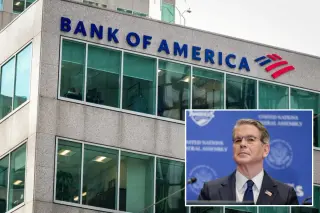
Treasury Imposes $1.2B Penalty on Bank of America for AML and Sanctions Failures
The U.S. Treasury Department has levied a $1.2 billion fine on Bank of America for willful violations of anti-money laundering and sanctions laws. The penalty, the third-largest in Treasury history, stems from the bank's failure to report over $5 billion in suspicious transactions linked to Chinese networks and the southwest border. Bank of America admitted to these violations and agreed to an additional $11.6 million settlement with the Office of Foreign Assets Control.
Source: New York Post

JPMorgan Misses Expectations as High Rates and AI Risks Test US Bank Profits
JPMorgan Chase reported third-quarter net income of $15.3 billion, missing analyst estimates of $5.93 per share due to higher expenses and weaker fixed-income trading. While JPMorgan lagged, Goldman Sachs and Citigroup exceeded expectations, with Goldman’s equities revenue surging 72%. Executives warned that rising interest rates and potential AI-driven deposit outflows pose long-term risks to banking margins, even as consumer spending remains resilient.
Source: Yahoo Finance
World and Trade
The European Union and China have reached a preliminary agreement to cap Chinese hybrid vehicle exports to Europe at 350,000 units annually, a move designed to counter industrial overcapacity without adopting the heavy tariff strategies used by the United States. This quota, which would cut projected 2026 shipments by more than half, marks a distinct approach to trade policy, though analysts warn it does not address broader structural imbalances. In a related development, Paramount Pictures has taken over the lease for the Bay Theater in Pacific Palisades, planning to reopen the five-screen venue later this year. The theater, closed since the January 2025 wildfires, will be operated by The Lot and feature first-run releases, signaling a strategic commitment to theatrical exhibition and a symbolic recovery for the devastated community.

EU Caps Chinese Hybrid Car Imports in Bid to Counter Industrial Overcapacity
The European Union and China have reached a preliminary agreement to cap Chinese hybrid vehicle exports to Europe at 350,000 units annually, potentially starting in December. This move aims to protect European manufacturers from Chinese industrial overcapacity without adopting the heavy tariff strategies used by the United States. While the deal limits immediate damage to the auto sector, analysts warn it does not address broader structural imbalances in global trade.
Source: Axios

Paramount to Reopen Bay Theater in Pacific Palisades by Year's End
Paramount Pictures has taken over the lease for the Bay Theater in Pacific Palisades, planning to reopen the five-screen venue later this year. The theater, which has been closed since the January 2025 wildfires, will be operated by The Lot and feature first-run releases, classics, and immersive events. The move follows the recent merger of Paramount and Warner Bros. Discovery under Skydance.
Source: Variety
As AI integration accelerates in both consumer devices and enterprise workflows, the market is grappling with the sustainability of current valuations. Simultaneously, stricter regulatory frameworks in finance and trade suggest a new era of compliance and protectionism that will shape the coming year.