
Lufthansa 747 narrowly avoids tail strike during aborted LAX landing
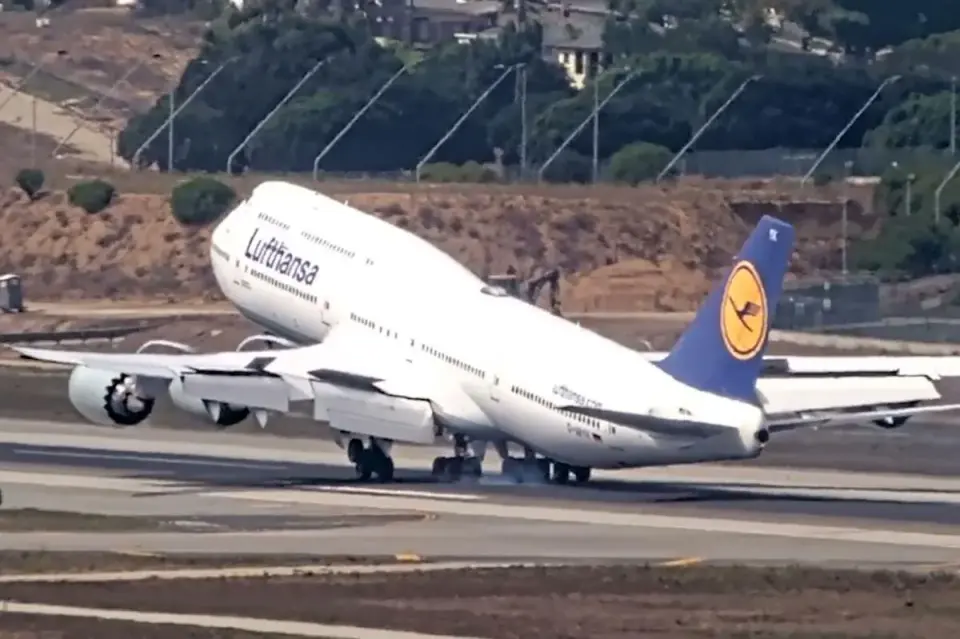
A Lufthansa Boeing 747-8 aborted its landing at Los Angeles International Airport (LAX) on October 10, 2026, after the aircraft touched down late on Runway 24R. As the pilots executed a go-around, the jet’s nose pitched sharply upward, bringing its tail within inches of the runway surface. No tail strike occurred, and the plane landed safely on a second attempt approximately 15 minutes later. The incident, captured by aviation enthusiasts, highlights the risks of managing large aircraft during unstable approaches, though no injuries or damage were reported.
Key points
- Lufthansa Flight LH 456, a Boeing 747-8 arriving from Frankfurt, aborted its landing on Runway 24R at LAX on October 10, 2026.
- The aircraft touched down approximately one-third of the way down the runway, leaving less than 6,000 feet of pavement remaining, prompting the crew to initiate a go-around.
- During the climb, the nose pitched up sharply, causing the tail to come dangerously close to the runway, but no contact was made.
- The plane circled and landed safely on the same runway about 15 minutes later without incident.
- Lufthansa operates more than half of the world’s remaining approximately 50 passenger Boeing 747s, making such large aircraft increasingly rare in commercial service.
Background
Recent aviation incidents, such as the Amazon cargo jet overrun at Miami in September 2026, have underscored the complexities of landing procedures and the critical importance of go-around maneuvers. While that incident involved a different aircraft type and resulted in fatalities, the LAX event illustrates how standard safety protocols can prevent potential damage. The Boeing 747-8, measuring roughly 250 feet long, requires precise pitch management during takeoff and landing to avoid tail strikes, a risk that increases with the aircraft’s size and weight.
How outlets are covering it
California Post and One Mile at a Time emphasize the dramatic nature of the go-around, noting the close proximity of the tail to the runway and the visual intensity of the maneuver. California Post highlights the rarity of the Boeing 747 in modern fleets, while One Mile at a Time clarifies that go-arounds are standard safety procedures and that a near tail strike does not necessarily pose a danger to passengers. وردنا (Wardna) focuses on the technical details, confirming that the landing was aborted due to an unstable approach and that the aircraft landed safely on the second attempt. All sources agree that no damage or injuries resulted, but they differ in emphasis: California Post frames the event as a 'perilously close' disaster, while One Mile at a Time and وردna present it as a routine, albeit visually striking, safety maneuver.
Why it matters
The incident underscores the ongoing importance of pilot training and decision-making in aviation safety, particularly for large, heavy aircraft like the Boeing 747. While go-arounds are standard, the close call at LAX highlights the risks associated with late touchdowns and sharp pitch changes. As airlines phase out four-engine jumbos in favor of more fuel-efficient twin-engine aircraft, the remaining 747s require even greater precision during landing, making such incidents notable for their potential to cause significant damage if not managed correctly.
What to watch
No further action is expected from the Lufthansa flight, as the aircraft landed safely and no damage was reported. Aviation authorities are not indicated to have launched an investigation, as go-arounds are routine. However, the incident may prompt internal reviews by Lufthansa to ensure that landing procedures for large aircraft remain robust, particularly as the fleet of 747s continues to shrink globally.
- Terrifying moment massive Boeing 747 bounces off runway at LAX as tail scrapes ground New York Post
- Lufthansa Boeing 747-8 Escapes Tail Strike By Inches At LAX As Pilots Abort Landing Simple Flying
- Lufthansa jet aborts LAX landing, narrowly avoids hitting tail on runway Yahoo
- Boeing 747-8 Narrowly Avoids Crash at LAX in Close Call Incident وردنا
- Lufthansa Boeing 747 Performs Eye-Catching Go-Around At LAX One Mile at a Time
Want the full story? Read the original reporting
Read on New York Post