
Canada Fast-Tracks Pacific Link Pipeline to Diversify Oil Exports Away from US
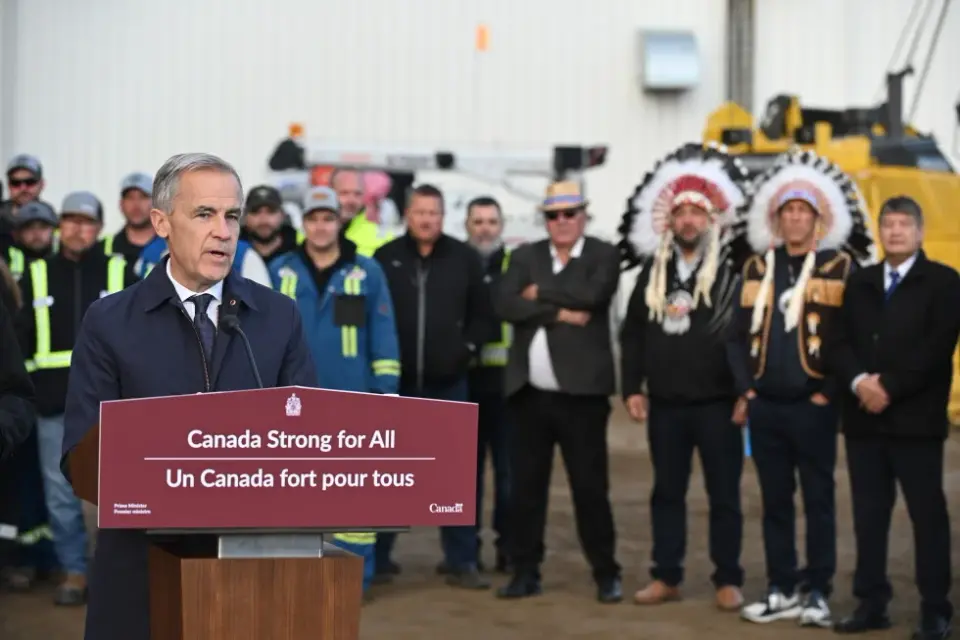
Prime Minister Mark Carney has designated the Pacific Link oil pipeline as a project of national interest, fast-tracking its regulatory approval to reduce Canada's dependence on the US market. The 1,250km pipeline, costing up to C$43.7 billion, aims to export one million barrels per day to Asia, creating 140,000 jobs and boosting GDP by C$30 billion annually, though it faces opposition from Indigenous groups and environmentalists.
Key points
- Carney designated Pacific Link a project of national interest, fast-tracking federal approvals under a new law, with final regulatory conditions expected by September 2027 and operation by 2032-2033.
- The 1,250km pipeline will transport one million barrels per day from Bruderheim, Alberta, to a deep-water port near Delta, British Columbia, for export to Asia-Pacific markets like Japan, South Korea, and China.
- The project is estimated to cost between C$35.2 billion and C$43.7 billion, with the federal and Alberta governments contributing roughly C$2.8 billion initially, while Pembina Pipeline Corp. holds a 10% economic interest and must decide on further investment before a final investment decision.
- Carney stated the pipeline would boost Canada's GDP by up to C$30 billion per year, create 140,000 jobs, and generate C$100 billion in government revenue by 2060, reducing US oil export dependence from 90% to 65-70%.
- Indigenous communities and environmental groups oppose the project, citing concerns over its route, environmental effects, marine shipping, and treaty rights, with the government committing to offer Indigenous communities at least a 10% ownership stake and conducting intensive consultations.
Background
Canada has historically relied heavily on the US for oil exports, sending over 90% of its crude south of the border, with the Trans Mountain pipeline expansion completed in 2024 but already at capacity. Recent US-Canada trade tensions, including US tariffs on Canadian goods, have prompted Ottawa to seek economic diversification. The Pacific Link project is part of a broader strategy to reduce dependence on US infrastructure, alongside efforts to develop sovereign space capabilities, as noted in earlier coverage of Canada's push for strategic autonomy amid US tensions.
How outlets are covering it
AP News emphasizes the financial uncertainties, noting that the project's success depends on producer commitments and private investment, with Carney declining to specify federal taxpayer contributions. BBC highlights the pipeline as a response to US-Canada trade war and a test of Canada's ability to fast-track major projects, while also noting opposition from Indigenous communities and environmental groups. The Detroit News focuses on the economic benefits, including job creation and GDP growth, and the pipeline's role in diversifying Canada's energy exports. Ars Technica, while not directly covering the pipeline, contextualizes Canada's broader push for strategic autonomy in energy and space amid US tensions, underscoring the geopolitical motivations behind such infrastructure projects.
Why it matters
The Pacific Link pipeline represents a significant shift in Canada's energy strategy, aiming to reduce its heavy reliance on the US market and diversify exports to Asia. If successful, it could transform Canada into a global energy supplier, boost economic growth, and strengthen its sovereignty in energy infrastructure. However, the project's success hinges on overcoming financial, environmental, and Indigenous opposition, as well as securing private investment and producer commitments. Its fast-tracking under a new regulatory framework also sets a precedent for future major infrastructure projects in Canada, potentially influencing investor confidence and domestic political dynamics, particularly in Alberta, where an independence referendum is scheduled later this month.
What to watch
An open season next spring will gauge producer interest in contracting pipeline capacity, with officials noting significant interest but acknowledging the project might not attract enough shippers or financing to proceed. Final regulatory conditions are expected by September 2027, with construction potentially beginning by 2032 and operation by 2032-2033. Intensive consultations with Indigenous communities will continue, and the government will monitor private investment commitments, particularly from Pembina Pipeline Corp., before a final investment decision is made.
- Canada fast-tracks Pacific oil pipeline to reduce US dependence as Alberta separation vote nears AP News
- Carney hopes an oil pipeline can help Canada fight a trade war BBC
- Canada to fast track pipeline to diversify economy away from US The Detroit News
- As US relations fray, Canada gets serious about its own launch industry Ars Technica
- A timeline for Pacific Link, the ‘national interest’ Alberta-B.C. pipeline plan Toronto Star
Want the full story? Read the original reporting
Read on AP News