
Kospi Plunges 24% as AI Investors Rotate to Taiwan
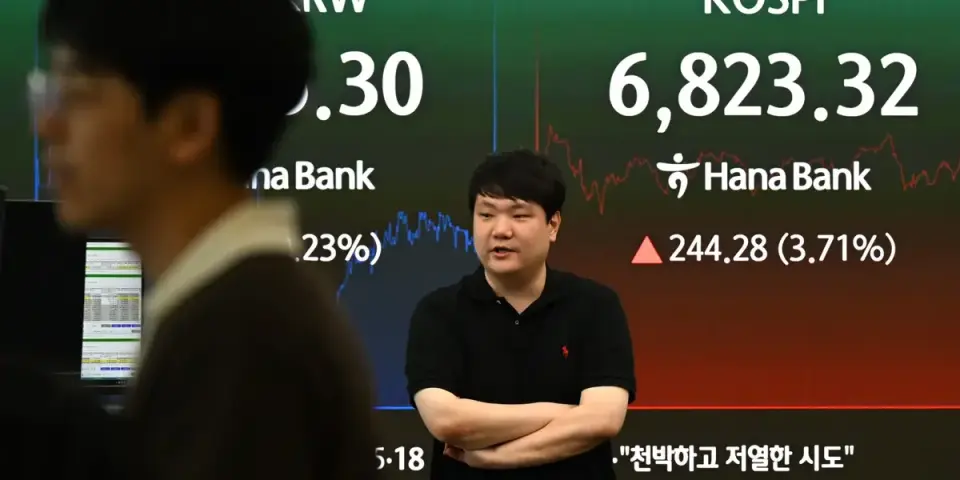
South Korea's Kospi index has reversed from the world's best-performing market in early 2026 to its worst performer in the second half, dropping approximately 24% after a volatile summer. Despite remaining up over 50% for the year, the index faces a sharp rotation of capital toward Taiwan's broader AI hardware supply chain. Samsung Electronics recently forecast a nearly ninefold increase in quarterly operating profit, yet its shares fell for two consecutive sessions, indicating that blockbuster earnings no longer guarantee investor enthusiasm. The market's heavy reliance on memory-chip giants like Samsung and SK Hynix, which account for more than half of the Kospi, has left it vulnerable to shifts in the AI trade. Trading turnover has dropped 70% from its late-May peak, and foreign investors continue to withdraw capital. Meanwhile, Taiwan's Taiex index has climbed about 7% in the second half, reaching year-to-date gains of approximately 70%, as investors diversify into advanced manufacturing and infrastructure beyond memory chips.
Key points
- The Kospi index fell about 24% in the second half of 2026, making it the worst-performing major market, despite being the best-performing in the first half.
- Samsung Electronics and SK Hynix, which together represent over half of the Kospi, have seen investor interest wane despite strong earnings forecasts.
- Samsung forecast a nearly ninefold increase in quarterly operating profit, but its shares declined for two straight trading sessions following the announcement.
- Taiwan's Taiex index outperformed the Kospi by more than 23 percentage points in the third quarter, gaining nearly 4% while South Korea's index plunged over 19%.
- Trading turnover in South Korea dropped 70% from its late-May peak, and foreign investors have continued pulling money from Korean equities.
- The Kospi experienced extreme volatility in July, plunging 22% before rebounding 18% on the final trading day, triggering multiple market-wide circuit breakers.
Background
In September 2026, Asian markets faced pressure from concerns about slower AI development and rising oil prices, which fueled inflation fears and expectations of tighter monetary policy. The Kospi had already tumbled 3.3% during that period, reflecting early signs of the volatility that would characterize the second half of the year. Global equities also retreated in early September as a bond sell-off pushed yields higher and the U.S. dollar weakened, signaling cautious trading amid shifting rate expectations. These broader market dynamics set the stage for the sharp reversal in South Korea's AI-driven rally.
Why it matters
The shift in investor preference from South Korea's memory-chip giants to Taiwan's broader AI hardware supply chain signals a potential redefinition of the AI trade's beneficiaries. As the Kospi's performance deteriorates despite strong earnings, it highlights the risks of market concentration in a single semiconductor segment. The rotation toward Taiwan suggests that investors are seeking more durable growth prospects tied to advanced manufacturing and process expertise, rather than cyclical memory-chip price increases. This divergence could have lasting implications for global capital flows and the valuation of AI-related assets in Asia.
What to watch
Investors will likely continue to monitor the rotation of capital from South Korea to Taiwan and other parts of the AI hardware supply chain. The performance of Samsung and SK Hynix in the coming quarters will be critical in determining whether the Kospi can regain momentum or if the shift to broader AI infrastructure plays will persist. Regulatory changes regarding leveraged single-stock exchange-traded funds in South Korea may also influence market stability and investor behavior in the near term.
Want the full story? Read the original reporting
Read on Business Insider