
Record US income masks widening gap as bottom 10% see no gains
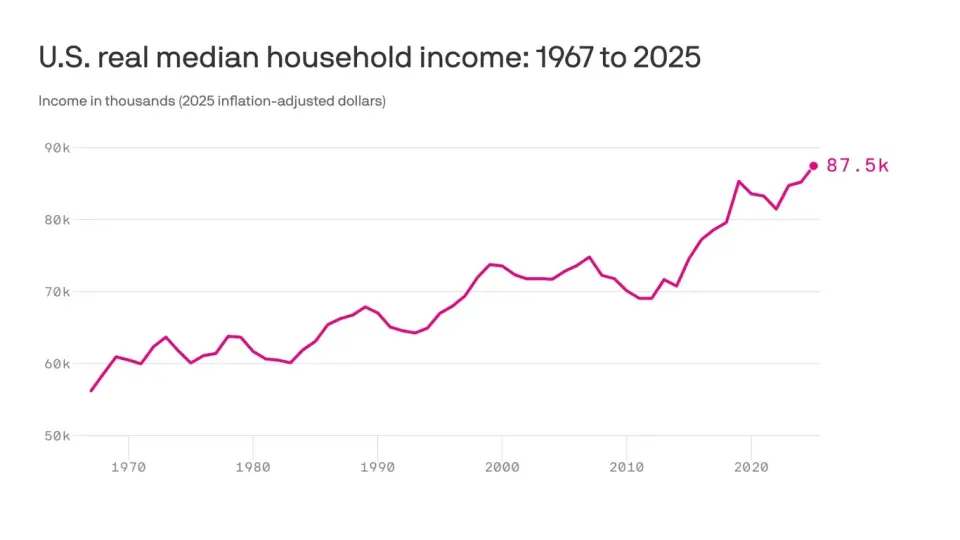
U.S. household income reached a record high in 2025, but the gains were concentrated among the wealthy, leaving the lowest earners with no significant change. While the official poverty rate fell to 10.2%, broader measures of financial hardship remained elevated, and senior poverty rose for a fifth consecutive year.
Key points
- Real median household income rose 2.6% to $87,460 in 2025, the highest inflation-adjusted level since 1967.
- The bottom 10% of households saw no significant change in income, while the top 10% saw a 1.7% increase.
- The official poverty rate dropped to 10.2%, but the Supplemental Poverty Measure, which accounts for medical costs, held steady at 13.1%.
- Senior poverty (ages 65+) rose to 15.4% for the fifth straight year, the highest among all age groups.
- The 2025 data does not yet reflect the safety-net cuts from the 'One Big Beautiful Bill' signed in July 2025.
Background
This report follows earlier data from Bank of America in September 2026, which suggested a narrowing wage gap as lower-income workers saw faster wage growth (4.7%) than higher earners (3.5%). However, the Census data indicates that despite these wage trends, overall household income gains did not trickle down to the bottom decile. The current data also precedes the full impact of the 'One Big Beautiful Bill,' which is expected to reduce Medicaid and food stamp coverage in coming years.
How outlets are covering it
Axios and CNN both highlight the record median income but emphasize the lack of gains for the bottom 10% and the persistent affordability crisis. CNN notes that median earnings for full-time workers did not change significantly, despite the rise in household income, and points to the S&P 500's 16.39% rise in 2025 as a factor benefiting investors but not wage earners. USA Today focuses on the rising poverty rate among seniors, linking it to the impending insolvency of the Social Security trust fund by late 2032. While Axios and CNN view the 2025 data as a pre-crisis benchmark, USA Today frames the senior poverty rise as an immediate consequence of eroding safety nets and rising costs.
Why it matters
The divergence between record median income and stagnant low-end earnings highlights a 'split-screen' economy where top-line metrics mask deepening inequality. As the 'One Big Beautiful Bill' cuts take effect, the Supplemental Poverty Measure is likely to rise, potentially pushing millions more into hardship. The rising senior poverty rate also puts pressure on Congress to address Social Security insolvency before the trust fund depletes in 2032.
What to watch
Future Census data will reflect the impact of the 'One Big Beautiful Bill' on Medicaid and food stamp coverage. Congress must decide whether to reform Social Security before the retirement trust fund is depleted in late 2032, which would trigger a 22% benefit cut. Analysts expect the Supplemental Poverty Measure to rise as medical expenses and reduced benefits affect lower-income households.
- Americans' income hits record, but lower earners lose ground Axios
- American Incomes Hit Record Last Year as Women Gained Ground WSJ
- Poverty Rate Was Stable Before Trump’s Safety Net Cuts Gained Force The New York Times
- Median US income rises to highest on record even as Americans feel affordability pinch CNN
- Senior poverty climbs just as Social Security future is in question USA Today
Want the full story? Read the original reporting
Read on Axios