
Video reveals Muni operator asleep before July crash in San Francisco
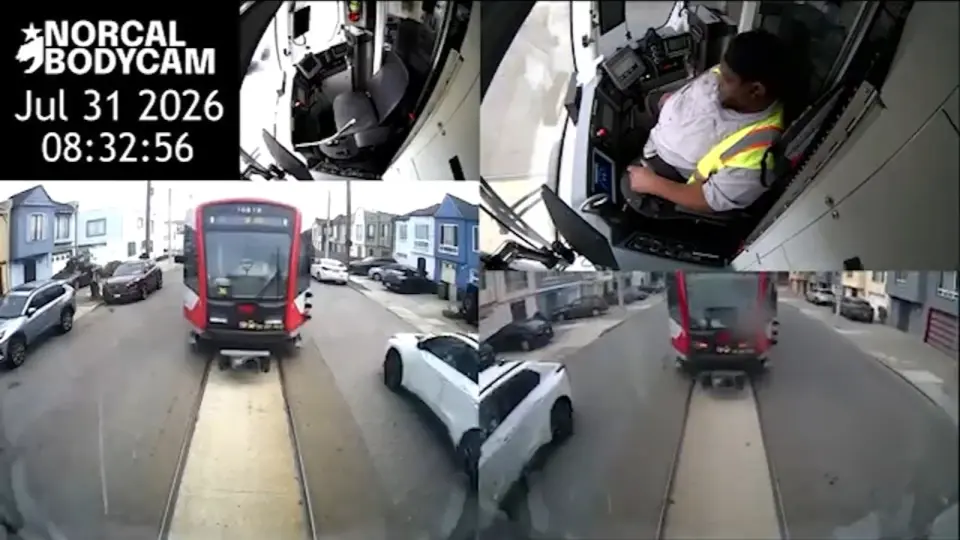
Bodycam footage shows a San Francisco Muni operator falling asleep before a July 31 collision between two empty light rail trains. The SFMTA attributes the crash to operator fatigue, marking the second such incident in a year. No injuries were reported, but the event has intensified scrutiny of the agency's fatigue management policies and safety protocols for surface-running trains.
Key points
- Video obtained by NorCal Bodycam shows an L Taraval operator dozing off for approximately 20 seconds before crashing into a stopped train near 47th Avenue and Wawona Street on July 31, 2026.
- The SFMTA stated that vehicle and infrastructure issues were ruled out, with the initial cause determined to be operator error due to fatigue.
- No injuries were reported in the July 31 crash, though the front windshield of the moving train shattered upon impact.
- This incident follows a similar event in September 2025, where an N Judah operator fell asleep while the train accelerated to 50 mph, prompting a fatigue-awareness education campaign.
- The operator involved in the July crash has been placed on non-driving status pending the completion of the formal investigation.
Background
This incident occurs against a backdrop of ongoing concerns regarding operator fatigue in San Francisco's transit system. A 2013 municipal audit had previously flagged chronic operator shortages and high absenteeism, noting that the agency relied heavily on unscheduled overtime. Additionally, a 2019 report indicated that a significant portion of operators commuted from outside the city, with some reporting exhaustion that prevented safe travel home after shifts. Following the September 2025 incident, the California Public Utilities Commission opened a formal review of SFMTA's fatigue-management policies to determine if scheduling issues were systemic.
How outlets are covering it
ABC7 and ABC7 Bay Area reported that both trains were empty at the time of the crash, citing fire officials. In contrast, KTVU reported that two passengers were aboard the train at the time of the crash, though they exited without injury. All sources agree that the SFMTA attributed the cause to operator fatigue. SFist highlighted the lack of automated train control on surface segments like the L Taraval, noting that operators must manually control the train and use physical deadman switches, unlike underground Metro lines. KTVU also noted that the incident is raising safety concerns as San Francisco voters prepare to consider a parcel tax to help fund the transit agency.
Why it matters
The recurrence of operator fatigue incidents raises serious questions about the safety of San Francisco's public transit system. The SFMTA's reliance on manual controls for surface-running trains, combined with potential staffing and scheduling issues, could lead to more severe accidents in the future. The ongoing investigation and potential policy changes by the CPUC may impact how the agency manages operator hours and fatigue in the coming years.
What to watch
The SFMTA is continuing its formal investigation into the July 31 crash. The agency has stated that it will move quickly to take appropriate action based on the final determination. The California Public Utilities Commission's review of SFMTA's fatigue-management policies is also ongoing, which could lead to new regulations or guidelines for operator scheduling and rest periods.
- Video appears to show San Francisco train driver asleep before 2 empty trains crash ABC7 Los Angeles
- Video appears to show SF Muni operator nodding off before crash KTVU
- Video appears to show San Francisco Muni driver asleep before 2 trains crash ABC7 Bay Area
- Video appears to show Muni operator nodding off moments before S.F. train crash San Francisco Chronicle
- Another Muni Operator Appears to Fall Asleep at Controls, Crashes Into Empty Train SFist
Want the full story? Read the original reporting
Read on ABC7 Los Angeles