
Justin Sun Launches Decentralized Math Prize Amid AI Verification Controversy
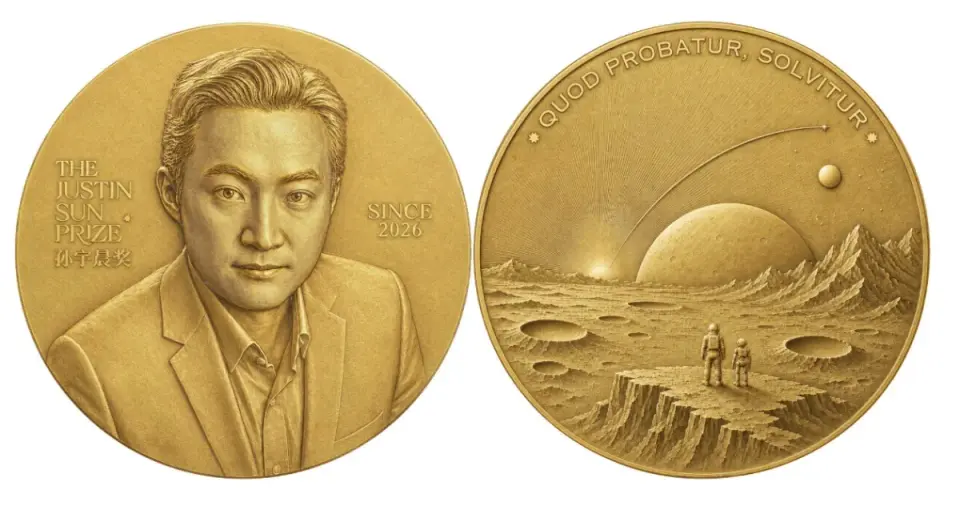
Justin Sun has established a new academic bounty system offering up to $1 million for machine-verified mathematical proofs. The initiative follows recent controversies surrounding OpenAI’s claimed solution to the Navier-Stokes problem, aiming to replace traditional credential-based awards with open, on-chain verification.
Key points
- Sun announced the Justin Sun Prize on September 16, 2026, in Geneva, offering up to $1 million for the first verified solution to specific mathematical problems.
- The prize relies on a 'problem list' where challenges are locked in permanently; once added, they cannot be removed, and funds are never clawed back.
- The inaugural award was given to OpenAI for its formalized proof of the Navier-Stokes Existence and Smoothness problem, a Millennium Prize challenge.
- Payouts are made in USDT on TRON or USDC on Ethereum, with all verification materials and disbursement records published on GitHub and the blockchain.
- Sun stated the prize aims to be the 'Nobel Prize of the AI Era,' emphasizing that his wealth originated from mathematics and should return to it.
Background
This development follows a series of AI-driven mathematical breakthroughs in 2026 that have strained trust within the academic community. In August and September, OpenAI and Anthropic announced solutions to long-standing problems, including Fermat’s Last Theorem formalization and the Navier-Stokes equations. These announcements sparked disputes over credit, with mathematicians like Tristan Buckmaster alleging that AI labs rushed to claim solutions based on human work. The Justin Sun Prize introduces a decentralized alternative to traditional academic recognition, responding to these tensions by prioritizing machine-verifiable proofs over institutional prestige.
How outlets are covering it
The Block presents the Justin Sun Prize as a neutral, decentralized mechanism designed to democratize scientific discovery, highlighting Sun’s philanthropic intent and the technical rigor of on-chain verification. In contrast, WIRED frames the broader AI math landscape through the lens of human displacement, quoting mathematician Steven Strogatz, who describes the current era as a 'horror movie' where human expertise is rapidly rendered obsolete. Strogatz argues that while AI accelerates answers, it undermines the human struggle that defines mathematical progress. Gizmodo focuses on the reputational fallout for OpenAI, noting that the company is now cautious about announcing further solutions, such as the Hodge Conjecture, to avoid further alienating the math community. While The Block emphasizes the prize’s structural openness, WIRED and Gizmodo highlight the anxiety and skepticism surrounding AI’s role in defining mathematical truth.
Why it matters
The Justin Sun Prize represents a shift in how scientific breakthroughs are recognized, moving away from traditional academic gatekeeping toward a model based on verifiable, machine-checked proofs. This could accelerate the pace of mathematical discovery but also intensify debates over the value of human insight versus computational speed. By linking rewards to on-chain records, Sun’s initiative attempts to create a transparent, immutable standard for scientific achievement, potentially influencing how future AI-driven research is validated and funded.
What to watch
The Justin Sun Prize will continue to update its problem list, adding new challenges without removing existing ones. OpenAI is reportedly preparing to announce a solution to the Hodge Conjecture, though it is seeking to collaborate with the math community to mitigate backlash. As AI capabilities in mathematics expand, the tension between rapid computational breakthroughs and human verification will likely define the next phase of scientific research.
- Justin Sun Establishes the Justin Sun Prize: “My Wealth Came from Mathematics and Will Return to Mathematics” The Block
- OpenAI Is Close To Solving Another Millennium Prize Math Problem The Information
- Top mathematicians are outraged by OpenAI’s methods The Economist
- ‘I’m Really Terrified’: A Mathematician Grapples With AI’s Recent Breakthroughs WIRED
- OpenAI Reportedly Trying to Solve Hodge Conjecture Amid Feud With Math Community Gizmodo
Want the full story? Read the original reporting
Read on The Block