
Global Survey: AI Job Fears Outpace Optimism in 34 Nations
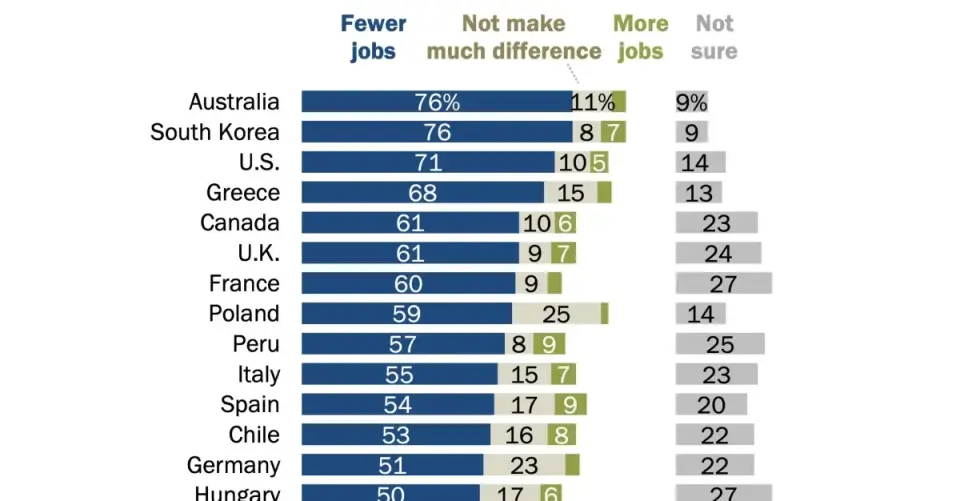
A major Pew Research survey reveals that in 34 of 37 countries, the public fears AI will eliminate jobs rather than create them. While older generations remain cautious, younger workers in wealthy nations are experiencing a sharp rise in anxiety about economic displacement and inequality. This sentiment aligns with recent Gallup data showing U.S. tech displacement fears have reached record highs, though actual job losses remain modest so far.
Key points
- Pew Research surveyed 42,151 people across 37 countries between February and May 2026, finding that a majority in 34 nations expect AI to cause job losses over the next 20 years.
- Concern is highest in wealthy nations, with Australia and South Korea at 76% and the U.S. at 71%, reflecting fears that AI will widen the gap between rich and poor.
- Younger adults (ages 18-34) in countries like Sweden, Poland, and the U.S. are becoming significantly more anxious about AI than older generations, a trend noted by both Pew and Gallup.
- Gallup reports that 27% of U.S. workers now fear technology will make their jobs obsolete, a figure that has doubled since 2017 and surpasses traditional worries like layoffs for those under 45.
- Despite widespread fear, global sentiment is mixed; a median of 41% of respondents feel equally concerned and excited about AI, while only 13% are primarily excited, indicating a complex public mood.
Background
This surge in public anxiety follows a period of rapid AI advancement and high-profile warnings from industry leaders. In 2025, Anthropic CEO Dario Amodei warned that AI could eliminate half of entry-level white-collar jobs, a claim that likely contributed to the rising concerns measured in the 2026 surveys. Previous Pew data from 2024 showed lower levels of concern, particularly among younger Americans, suggesting a rapid shift in public perception over the last two years.
How outlets are covering it
The Verge highlights the global scale of the fear, emphasizing that the Pew survey was conducted before recent 'apocalyptic' warnings, suggesting the anxiety is deeply rooted. Pew Research provides the granular data, noting that while high-income countries show the most fear, middle-income nations have high levels of uncertainty. Business Insider focuses on the psychological impact, quoting a Menlo Ventures partner who describes 'off-the-charts' anxiety among tech workers regarding their career viability and purpose. Gallup corroborates the U.S. trend, noting that while fear is rising, actual employment data remains stable with a 4.1% unemployment rate, highlighting a gap between perceived and actual risk.
Why it matters
The data indicates a fundamental shift in how the global workforce views its future. As fear of technological displacement becomes the top job worry for younger Americans and a majority view in most wealthy nations, policymakers and businesses face increasing pressure to address economic inequality and provide retraining. The divergence between public anxiety and current employment statistics suggests potential for significant social unrest or policy intervention if the gap widens.
What to watch
Watch for further shifts in public opinion as AI capabilities expand, particularly in entry-level roles. Monitor U.S. employment data for signs of actual displacement in AI-exposed sectors, as current hiring remains solid but entry-level hiring shows weakness. Expect increased political debate in wealthy nations, where left-leaning voters are particularly concerned about AI-driven inequality, potentially influencing regulatory approaches to AI development and deployment.
- AI is feared globally as the destroyer of jobs The Verge
- Opinion | College Grads vs. the AI Job Apocalypse WSJ
- Globally, More People Expect AI to Cause Job Loss Than Growth Pew Research Center
- AI is fueling 'off-the-charts' anxiety among tech workers, says Menlo Ventures partner Business Insider
- More U.S. Workers Fear Losing Their Jobs to Technology Gallup News
Want the full story? Read the original reporting
Read on The Verge