
IBM scales quantum roadmap with 520-qubit Nighthawk r3 and dual-chip link
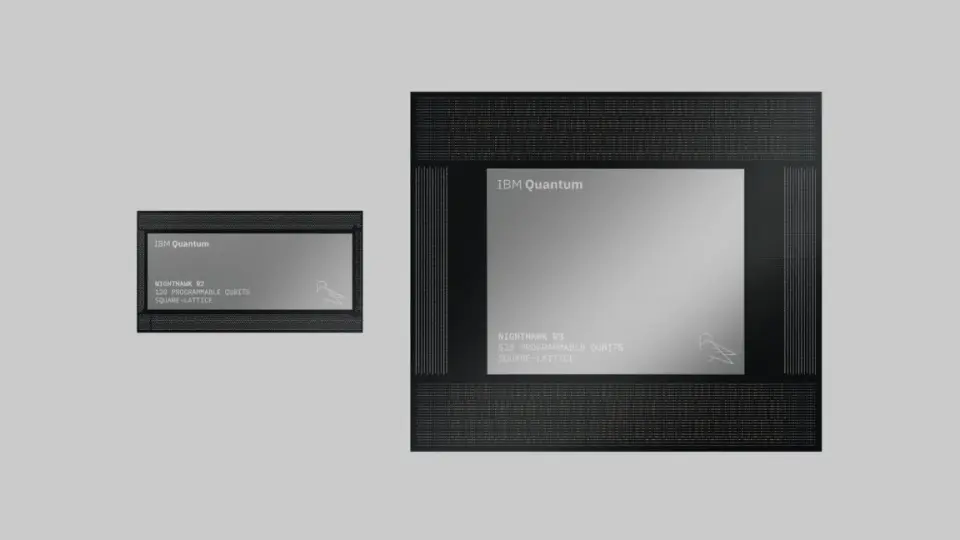
IBM announced its Nighthawk r3 processor at QDC 2026, targeting 520 programmable qubits and 10,000 operations by 2027. The company will link two r3 chips to reach 1,040 qubits, replacing a previous plan for nine linked units. This shift prioritizes larger single-chip performance over multi-chip scaling to accelerate the path to fault-tolerant quantum computing.
Key points
- IBM will link two Nighthawk r3 processors in 2027 to create a 1,040-qubit system, abandoning a prior plan to link nine 120-qubit chips.
- The Nighthawk r3 processor targets 520 programmable qubits and 10,000 operations, up from 120 qubits and 7,500 operations in the current r2 model.
- IBM achieved 99.4% state transfer fidelity using four l-couplers to link two Nighthawk r1 processors, approaching a 99.9% target.
- The company aims to deliver its first fault-tolerant quantum computer, IBM Quantum Starling, by 2029.
- IBM Quantum Nighthawk r2 reached 100,000 samples per second, a 25x throughput gain over the previous Heron processor.
Background
IBM has been developing parallel roadmaps for technical error correction and public-facing general-purpose processors. The current Nighthawk r2 generation, released in September 2026, introduced hardware-based qubit resets to improve speed. This follows IBM's 2026 achievement of quantum advantage, where researchers ran computations beyond classical methods with verifiable results. The company is also collaborating with AMD and Oak Ridge National Laboratory to co-design quantum error correction algorithms.
How outlets are covering it
Ars Technica highlights the strategic shift from linking nine chips to two, suggesting potential challenges in chip-to-chip communications, though IBM executives denied this. SiliconANGLE emphasizes the technical specifications of the r3 processor and the successful demonstration of l-couplers. IBM's official release frames 2026 as the 'year of advantage,' focusing on practical applications and the path to Starling. Quantum Zeitgeist focuses on the practical impact, noting that materials science simulations run 12x faster on Nighthawk r2 compared to Heron r3, with Q-CTRL's Fire Opal software achieving 3,000x speedups over classical software.
Why it matters
The shift to larger single-chip processors and dual-chip linking accelerates IBM's path to fault-tolerant quantum computing, which is essential for running useful algorithms. The demonstrated speedups in materials science and chemistry suggest that quantum computing is moving from proof-of-concept to practical applications, potentially impacting drug discovery, energy optimization, and materials science.
What to watch
IBM plans to release the Nighthawk r3 processor in 2027 and link two units to create a 1,040-qubit system. The company is also working on Backend v3, which will allow developers to express full quantum programs, and is expanding its managed workflows for hybrid quantum-classical computing. The first fault-tolerant quantum computer, IBM Quantum Starling, is targeted for 2029.
- IBM to offer access to a dual-processor quantum system in 2027 Ars Technica
- IBM Quantum announces upcoming Nighthawk r3 processor designed to execute 10,000 operations SiliconANGLE
- The year of advantage—and what comes next IBM
- Materials Science Simulations Run 12x Faster On IBM Nighthawk Quantum Zeitgeist
- IBM (IBM) to Scale Quantum Computing Beyond 1,000 Qubits in 2027 GuruFocus
Want the full story? Read the original reporting
Read on Ars Technica