
Intel Launches D-Series AI Accelerator with 480GB LPDDR5X for Agentic Inference
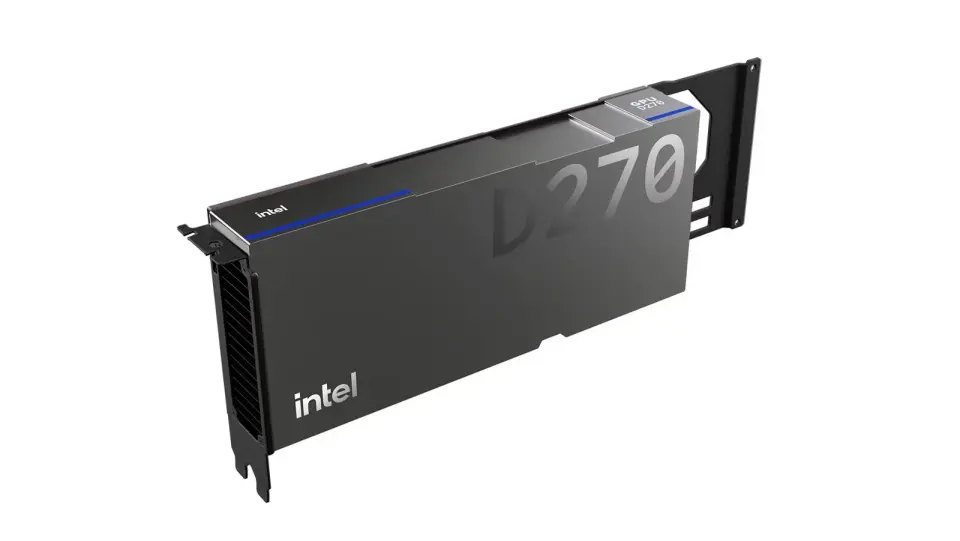
Intel has officially launched its D-Series GPU, codenamed 'Crescent Island,' at the Open Compute Project Global Summit. The new accelerator, designated as the D270, is designed for AI inference workloads and features up to 480GB of LPDDR5X memory, 1.5TB/s bandwidth, and 1.3 petaflops of FP8 compute within a 350W power envelope. Unlike high-bandwidth HBM-based competitors, this card prioritizes memory capacity and cost-efficiency for long-context and agentic AI tasks. Customer sampling is underway, with support from major OEMs and software partners, though pricing and general availability remain undisclosed.
Key points
- Intel unveiled the D-Series GPU (D270) at the OCP Global Summit, targeting AI inference with 480GB LPDDR5X memory and 1.3 PFLOPS FP8 performance.
- The card uses a 350W air-cooled PCIe design, allowing deployment in standard server racks without liquid cooling, contrasting with HBM-based competitors.
- Intel’s Xe3P architecture features 16-deep XMX engines and supports FP4/FP8 formats, with no graphics processing elements, focusing purely on AI workloads.
- A single D270 can handle models up to 300 billion parameters, while an eight-GPU cluster supports trillion-parameter models.
- Intel showcased Xeon 6+ rack systems exceeding 46,000 cores per rack to support agentic AI workflows, emphasizing open infrastructure and software portability.
Background
Intel had previously detailed the Crescent Island architecture at OCP 2025 and Hot Chips in August 2026, but the D-Series product name and specific performance metrics were revealed only recently. This launch follows earlier speculation about Intel’s return to the AI accelerator market after previous projects stalled. The move positions Intel as a competitor to NVIDIA and AMD in the data center AI space, particularly for cost-sensitive inference workloads.
How outlets are covering it
TechPowerUp emphasizes the technical specifications, noting the 16-deep XMX engine redesign and the absence of graphics processing elements, highlighting the card’s pure AI focus. StorageReview.com focuses on the economic argument, stressing that Intel prioritizes memory capacity and cost-per-token over peak bandwidth, which is critical for decode-heavy serving. Intel’s official announcement frames the launch within a broader strategy of 'open infrastructure' for agentic AI, highlighting the integration of Xeon CPUs and GPU D-series through common software foundations. Yahoo Finance’s coverage is limited to market context, noting the competitive landscape against NVIDIA, but lacks specific technical details.
Why it matters
The D-Series GPU offers a cost-effective alternative to high-end HBM-based accelerators for enterprises focused on inference rather than training. Its high memory capacity and air-cooled design reduce infrastructure costs and complexity, potentially disrupting the market dominated by NVIDIA. The emphasis on open software and standards-based systems may accelerate adoption in diverse AI workloads, including robotics and multi-tenant services.
What to watch
Intel has begun customer sampling with OEMs, ODMs, and neoclouds, but pricing and general availability dates have not been disclosed. Independent performance benchmarks are pending. The company’s focus on software maturity and cost-per-token will determine the D-Series’ competitiveness against established AI platforms. Further details on the Xeon 6+ rack systems and OCP Open Adapter Card standards are expected in the coming months.
- Intel "Crescent Island" GPU Gets D-Series Name, Supports Up to 480 GB of LPDDR5X TechPowerUp
- Intel aims to boost AI turnaround with new GPU chips to take on Nvidia Yahoo Finance
- Intel GPU D-Series Packs 480GB LPDDR5X and 1.3 PFLOPS FP8 into a 350W PCIe Card StorageReview.com
- Intel Accelerates Open Infrastructure for the Agentic AI Era Intel
- Intel's Crescent Island AI accelerator officially powers new GPU D-Series products — chip delivers 1.3 peak PFLOPS of FP8 compute and 1.5 TB/s of memory bandwidth Tom's Hardware
Want the full story? Read the original reporting
Read on TechPowerUp