
Microsoft commits to in-house Maia 300 chips for AI inference by 2027
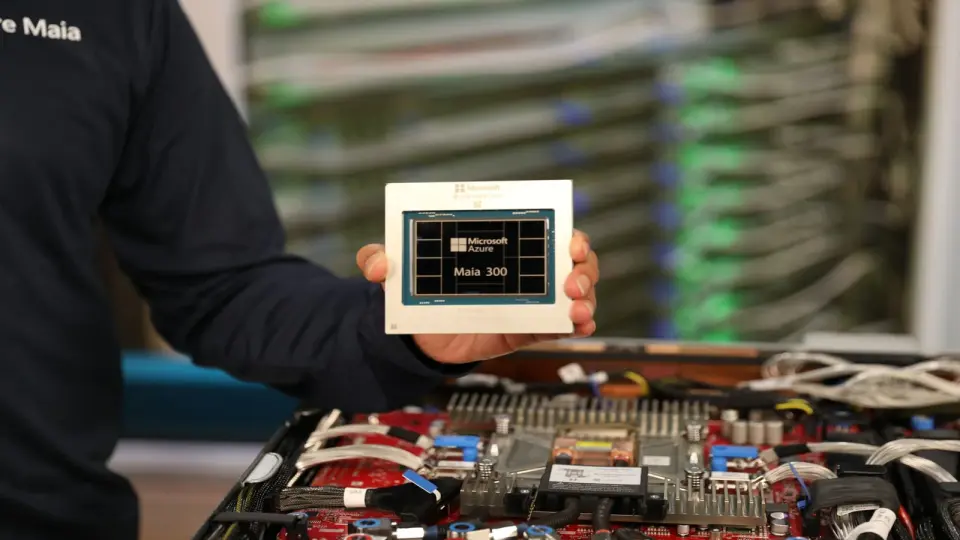
Microsoft has unveiled its third-generation Maia 300 AI accelerator, which will enter production in 2027 and serve as the primary architecture for AI inference across its cloud services. The chip is designed to significantly reduce reliance on Nvidia GPUs by offering higher efficiency and lower power consumption for running AI models.
Key points
- Microsoft will use the Maia 300 as its primary AI inference system, aiming to reduce dependence on Nvidia and AMD.
- The Maia 300 is scheduled to enter production in 2027, with large-scale deployments planned for multi-gigawatt data centers.
- The new chip offers up to 7x more token throughput per rack and 40% more tokens per megawatt compared to current GPU-based systems.
- Microsoft plans to pack 96 Maia 300 chips into each data center rack, double the density of the previous Maia 200 generation.
- Despite the shift, Microsoft will continue to partner with Nvidia and AMD for AI model training and other workloads.
Background
Microsoft has been developing its own AI chips since 2023, with the Maia 100 and Maia 200 introduced in 2023 and 2026, respectively. The company has been gradually shifting its AI workloads to its in-house silicon to improve margins and reduce reliance on external suppliers like Nvidia. This move is part of a broader trend among tech giants, including Google and Amazon, to design custom AI chips to meet growing demand and improve efficiency.
How outlets are covering it
CNBC emphasizes Microsoft's strategic shift to in-house chips to bolster its AI stack and reduce dependence on Nvidia, highlighting the efficiency gains of the Maia 300. GeekWire frames the move as Microsoft's 'biggest bet yet' on its own silicon, noting the potential to save billions and reduce reliance on Nvidia, while also pointing out that Microsoft remains a partner with Nvidia for training and other workloads. Microsoft's own technical documentation focuses on the architectural innovations of the Maia 300, such as its software-defined dataflow architecture and optimized memory hierarchy, which enable higher performance per watt and dollar. Evercore ISI analysts estimate that Maia will account for about 10% of Microsoft's AI chip spending by early 2027, indicating a gradual but significant shift.
Why it matters
Microsoft's move to prioritize its in-house Maia 300 chips for AI inference could significantly impact the AI chip market, reducing demand for Nvidia GPUs and potentially affecting Nvidia's market share. It also signals Microsoft's commitment to improving the efficiency and cost-effectiveness of its AI services, which could enhance its competitive position in the cloud and AI markets. The shift may also influence the broader trend of tech giants developing custom AI chips to meet growing demand and improve efficiency.
What to watch
Microsoft plans to share more details about the Maia 300 and its AI strategy at its Ignite conference in San Francisco next month. The company will continue to deploy the Maia 300 in its data centers, with large-scale deployments expected in 2027. Microsoft will also continue to partner with Nvidia and AMD for AI model training and other workloads, maintaining a balanced approach to its AI infrastructure.
- Microsoft to rely more on homegrown AI chips, reducing dependence on Nvidia CNBC
- Microsoft reveals Maia 300 AI chip as it works to reduce dependence on Nvidia, AMD Yahoo Finance
- Deep dive into Azure Maia 300 architecture Microsoft Azure
- Microsoft plans huge deployment of its own AI chips, with an eye on saving costs Reuters
- Microsoft makes ‘biggest bet yet’ on its own silicon, unveils new AI chip to reduce reliance on Nvidia GeekWire
Want the full story? Read the original reporting
Read on CNBC