
US Agencies Advise 'Poisoning' AI Responses to Counter Chinese Distillation
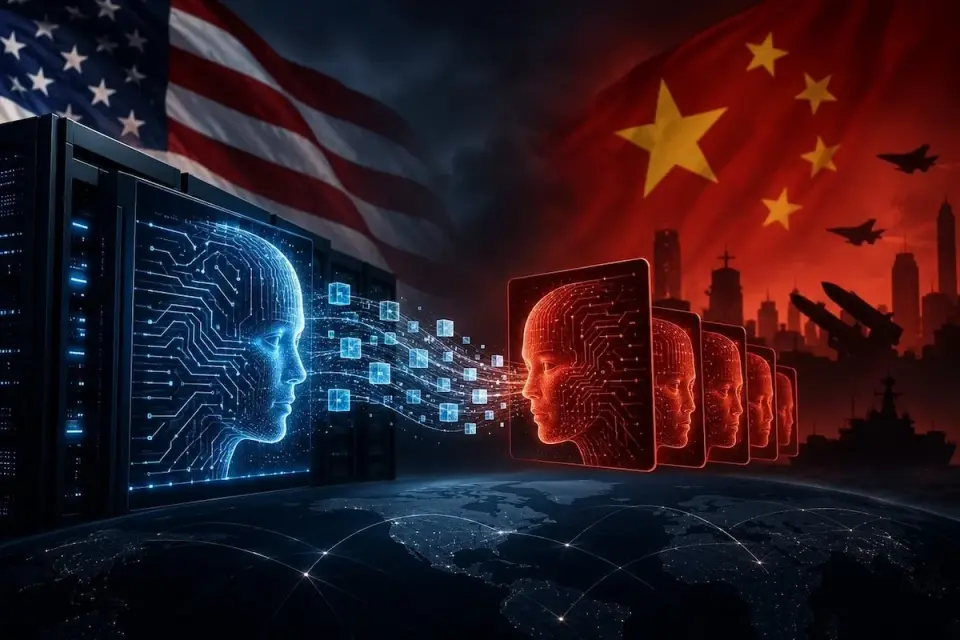
US federal agencies have issued a joint advisory urging American AI firms to actively degrade outputs for suspected Chinese users to counter industrial-scale model distillation. The strategy involves injecting errors or using inferior models without alerting the target, a move Beijing has condemned as protectionist. This dispute escalates ahead of high-level US-China AI safety talks.
Key points
- FBI, NSA, and CISA advise US AI companies to 'poison' responses for suspected Chinese distillers by introducing hallucinations or downgrading model quality.
- The advisory names six Chinese firms—DeepSeek, Moonshot AI, Alibaba, MiniMax, StepFun, and Z.AI—accusing them of extracting billions of tokens from US models since late 2024.
- Officials warn that informing suspected users of the degraded service would allow them to adjust their evasion tactics, so secrecy is required.
- Chinese officials reject the claims, labeling distillation a standard global practice and accusing the US of using national security as a pretext to maintain industrial monopoly.
- The controversy arises weeks before scheduled US-China AI safety talks and a broader summit between Presidents Trump and Xi in September.
Background
This dispute follows a series of US-China AI tensions in 2026. In July, Treasury Secretary Bessent threatened sanctions after discovering watermarks from American models in Chinese systems. Earlier in September, the same agencies issued initial warnings about the distillation campaigns, framing them as a core component of Chinese AI development strategy. Previous coverage also noted debates within the US tech sector regarding open-weight models, with some arguing that blanket bans on distillation could hinder innovation, while others emphasized the need for targeted safeguards against intellectual property theft.
How outlets are covering it
The US government and security agencies view the distillation campaigns as a systematic theft of proprietary capabilities that threatens national security and economic dominance. They emphasize the need for aggressive countermeasures, including the controversial tactic of 'poisoning' data, to protect American intellectual property. In contrast, Chinese officials and commentators argue that distillation is a neutral, widely used technical method essential for cost-effective development. They accuse the US of hypocrisy, noting that American firms have also utilized Chinese open-source models, and frame the US actions as an attempt to enforce an industrial monopoly. Garry Tan of Y Combinator offers a third perspective, suggesting that regulators should focus on balancing open-weight and frontier models rather than banning distillation, arguing that the current debate distracts from more immediate risks like cybersecurity breaches and bioweapon research.
Why it matters
The advisory represents a significant escalation in the US-China AI rivalry, moving from passive monitoring to active sabotage of data integrity. If implemented, these tactics could set a precedent for state-sponsored interference in global AI development. The outcome of the upcoming diplomatic talks will determine whether these measures lead to a trade war in technology or a framework for coexistence, with potential implications for global AI innovation, supply chains, and international norms regarding intellectual property in machine learning.
What to watch
Senior officials from the US and China are expected to meet for AI safety talks in the coming weeks, likely led by US Treasury Secretary Bessent. These discussions will focus on preventing AI-related security incidents and may address the distillation accusations. A broader summit between President Trump and President Xi is scheduled for September 24 in Washington, where the AI dispute could become a central topic. US AI firms are expected to begin implementing the recommended detection and response strategies, while Chinese developers may continue to rely on distillation despite the risks, viewing it as a necessary shortcut to bypass US chip export controls.
- US calls for AI poisoning to sabotage China’s model distillation Asia Times
- How Chinese AI Firms Tried to Clone U.S. AI Models wsj.com
- Anthropic claims Moonshot, DeepSeek secretly diverted user requests to Claude South China Morning Post
- Y Combinator’s Garry Tan says 'do nothing' about distillation as AI giants accuse China of copying their tech cnbc.com
- Anthropic details distillation campaigns from Alibaba, Moonshot AI, and DeepSeek TechCrunch
Want the full story? Read the original reporting
Read on Asia Times