
2026 National Book Awards Honor Assadi and Rushdie Amid Visa Controversy
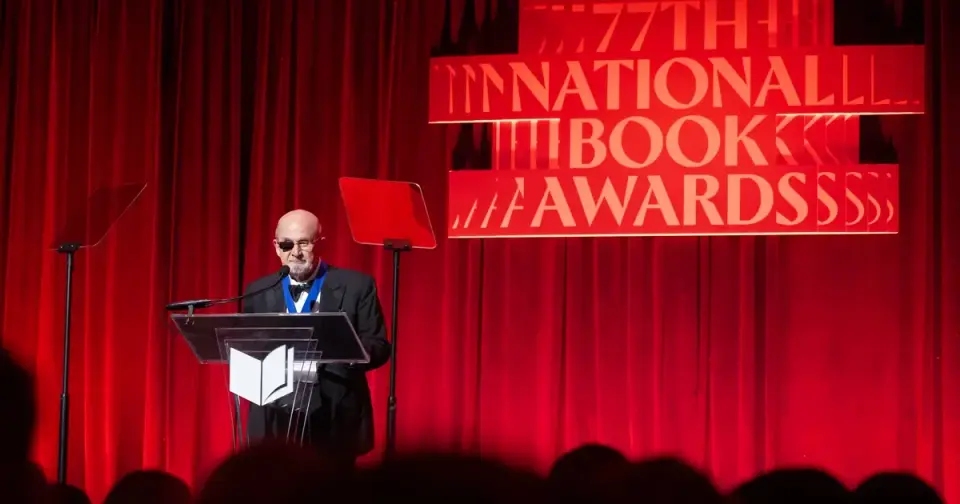
Hannah Lillith Assadi won the 2026 National Book Award for Fiction for 'Paradiso 17,' while Abdelrahman ElGendy won the Nonfiction prize for 'Huna' despite being barred from the ceremony by a visa denial. Salman Rushdie received the Medal for Distinguished Contribution to American Letters, and the event highlighted themes of displacement and political imprisonment.
Key points
- Hannah Lillith Assadi won the Fiction prize for 'Paradiso 17,' a novel inspired by her father’s experience fleeing the 1948 Nakba, which judges described as a visionary portrait of rupture and endurance.
- Abdelrahman ElGendy won the Nonfiction prize for 'Huna,' a memoir about his imprisonment in Egypt, but could not attend the ceremony after the U.S. denied his visa; his editor Helen Thomaides accepted the award on his behalf.
- Salman Rushdie received the Medal for Distinguished Contribution to American Letters, receiving a standing ovation and thanking Ursula K. Le Guin for supporting his early work.
- Syrian writer Samar Yazbek, a nominee in the translated literature category, was also denied a visa, prompting criticism from the National Book Foundation and her publisher.
- Brenda Hillman won the Poetry prize for 'Still House in the Desert,' and David Levithan and Gabriel Duckels won the Young People’s Literature prize for 'The Fight of Our Lives: AIDS in America.'
Background
The 2026 National Book Awards, held at Cipriani Wall Street in New York City, are among the most prestigious literary prizes in the United States, established in 1950. Previous coverage noted that the 2024 rule changes expanded eligibility to non-U.S. citizens, a factor central to the current controversy regarding ElGendy’s participation. The ceremony was hosted by actor and author Kyle MacLachlan, with musical performances by Michelle Zauner.
How outlets are covering it
Vulture emphasized the festive atmosphere and the contrast between solemn speeches and industry banter, noting that the visa denials for ElGendy and Yazbek were a major point of contention for attendees. The New York Times highlighted the eligibility debate, reporting that it found ElGendy may not have met residency requirements, a claim the National Book Foundation disputed. The Guardian focused on the thematic resonance of the winners, describing Assadi’s novel as a study of the psychic toll of displacement and noting the State Department’s defense of the visa denials as standard enforcement. Literary Hub provided a straightforward summary of the winners and judging panels, confirming the official results without editorializing on the visa issues.
Why it matters
The 2026 awards underscore the intersection of literary excellence and political reality, as the recognition of works dealing with displacement, imprisonment, and authoritarianism coincided with the exclusion of two finalists due to immigration policies. The controversy over ElGendy’s eligibility and visa denial highlights the tension between the National Book Foundation’s expanded international scope and U.S. immigration enforcement, while the recognition of Assadi and Rushdie affirms the continued relevance of personal and collective grief in contemporary literature.
What to watch
The National Book Foundation is expected to continue advocating for the inclusion of international authors, while the State Department maintains its stance on visa enforcement. Publishers and literary agents may face increased scrutiny regarding the eligibility of non-resident authors for major U.S. awards. The winners will likely receive increased media attention and sales, particularly Assadi and ElGendy, whose works address current geopolitical issues.
- The Furious, Festive Scene at the 2026 National Book Awards Vulture
- National Book Award for Nonfiction Goes to Writer Denied Visa to Attend The New York Times
- 'Huna' wins National Book Award, but author denied visa to attend ceremony PBS
- Hannah Lillith Assadi wins US National book award for ‘visionary’ novel Paradiso 17 The Guardian
- Here are the winners of the 2026 National Book Awards. Literary Hub
Want the full story? Read the original reporting
Read on Vulture