
Paul Devlin’s 1981 Harvard Rejection Rebuttal Resurfaces as Cultural Artifact
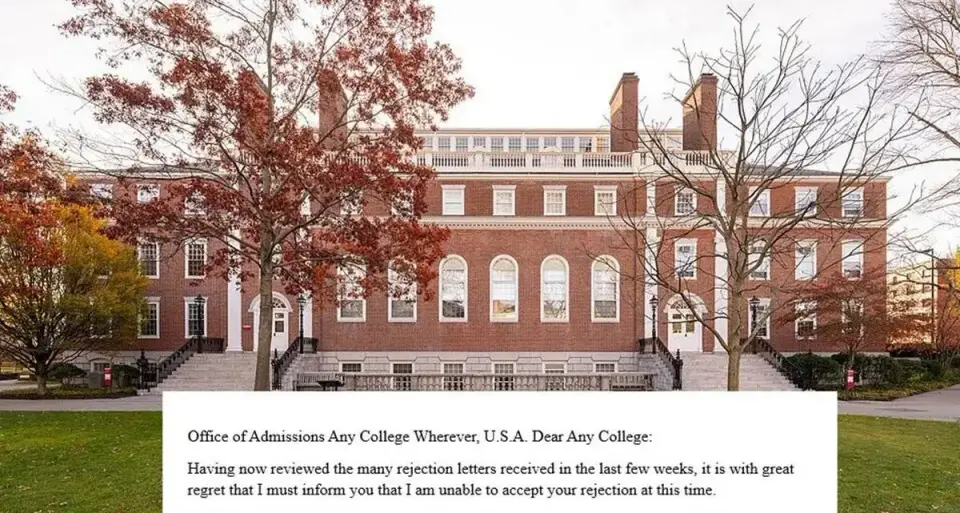
Paul Devlin, rejected by Harvard in 1981, responded by formally rejecting their rejection letter due to a grammatical error. The letter, published in The New York Times, became a viral cultural artifact, recently read by actor Himesh Patel. Devlin went on to win nine Emmy awards, illustrating how humor can reframe academic setbacks.
Key points
- Harvard’s current admission rate is 3.6%, accepting roughly 2,000 students annually from 50,000 applicants.
- In 1981, Paul Devlin noticed a grammatical error in his Harvard rejection letter and wrote a formal rebuttal rejecting the rejection.
- Devlin’s mother sent the letter to The New York Times, where it was published in the New Jersey section on May 31, 1981.
- Actor Himesh Patel performed a dramatic reading of the letter at the Letters Live event at the Royal Albert Hall in 2022.
- Devlin has since won nine Emmy awards and is working on a scripted series titled Castner’s Cutthroats.
Background
This story highlights the enduring cultural impact of academic rejection and the power of humorous rebuttals. While recent news cycles have focused on regulatory transparency, such as the FDA’s resumption of posting drug rejection letters, Devlin’s 1981 letter serves as a historical example of individual agency in response to institutional decisions. The archive notes that FDA rejection letters are now publicly disclosed, but Devlin’s case predates such transparency efforts, relying instead on personal initiative and media publication to gain visibility. The contrast between modern regulatory disclosure and historical personal rebuttals underscores how individuals have long sought to challenge or reframe institutional outcomes through creative means.
Why it matters
The story illustrates how humor and resilience can transform a negative outcome into a memorable cultural moment. Devlin’s response not only gained public attention but also demonstrated that setbacks can be reframed through wit. His subsequent success, including nine Emmy awards, suggests that institutional rejection does not necessarily define an individual’s potential. The letter’s continued relevance, including its 2022 performance, shows how such narratives can inspire future generations facing similar challenges in competitive environments.
What to watch
Devlin is currently developing Castner’s Cutthroats, a scripted series about a group that freed Alaska from Japanese control during World War II. The letter’s legacy continues through periodic cultural references, such as the 2022 Royal Albert Hall reading, indicating its ongoing resonance in discussions about education and perseverance. No further developments are expected, as the story is historical, but its impact persists in media and educational contexts.
Want the full story? Read the original reporting
Read on Upworthy