
MSKCC Study Links TP53 Mutations and Blood Biomarkers to Cancer Cachexia Risk
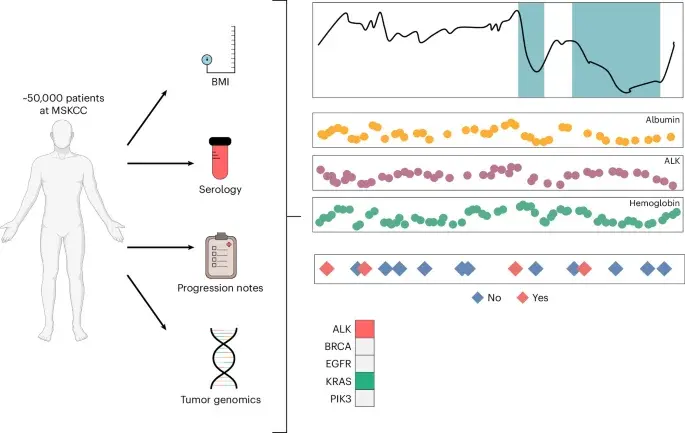
Researchers at Memorial Sloan Kettering Cancer Center (MSKCC) analyzed data from over 52,000 patients to map the trajectory of cancer cachexia, a wasting syndrome affecting half of all cancer patients. The study found that cachectic weight loss episodes cluster around disease progression and are linked to poor outcomes across nearly all cancer types. A consistent serologic signature, including low albumin and hemoglobin, was identified alongside specific tumor genotypes, particularly TP53 mutations, which increase the risk of cachexia. A predictive model developed for lung, colorectal, and prostate cancer was validated in an external cohort at Dana-Farber Cancer Institute, demonstrating that routine clinicogenomic data can be used to forecast weight loss risk.
Key points
- Analysis of 52,236 patients from the MSK-IMPACT cohort (2010–2024) revealed that cachectic weight loss episodes are temporally linked to disease progression events.
- Cachexia was associated with inferior survival outcomes in 17 of 18 cancer types analyzed, with glioblastoma being the only exception.
- A consistent serologic signature across diverse malignancies included lower albumin and hemoglobin levels, along with higher liver enzyme concentrations.
- Somatic tumor genotypes, specifically TP53 mutations, were significantly associated with a higher frequency of cachectic episodes.
- A multivariate predictive model for impending weight loss risk in lung, colorectal, and prostate cancer was validated using an independent cohort of 5,785 patients from Dana-Farber Cancer Institute.
Background
Cancer cachexia is a paraneoplastic metabolic syndrome characterized by progressive, unintentional weight loss and muscle wasting, affecting approximately 50% of cancer patients. It is associated with reduced quality of life, premature termination of therapy, and increased mortality. Previous research has focused on animal models and molecular mechanisms, but there has been a gap in understanding the manifestation and molecular underpinnings in human patients due to heterogeneous clinical definitions and a focus on malignant tissue rather than non-malignant compartments. This study addresses that gap by repurposing longitudinal clinicogenomic data from routine care to define episode-resolved trajectories of cachexia.
Why it matters
The findings provide a scalable resource for discovering the drivers of cancer cachexia using routine clinicogenomic data. By identifying specific biomarkers and genetic mutations associated with weight loss, clinicians can potentially predict and intervene earlier in the disease course. This could lead to improved management of cachexia, which is currently a major contributor to morbidity and mortality in cancer patients.
What to watch
The predictive models developed for lung, colorectal, and prostate cancer may be integrated into clinical practice to identify patients at high risk for cachexia. Further research may explore the application of these models to other cancer types and investigate therapeutic interventions targeting the identified molecular drivers.
Want the full story? Read the original reporting
Read on Nature