
Deep mutational scanning reveals RSV antibody resistance patterns and confirms high efficacy of nirsevimab
New research maps how respiratory syncytial virus (RSV) mutations affect antibody neutralization, while real-world data confirms nirsevimab reduces infant ICU admissions by 97%.
Key points
- Researchers used deep mutational scanning to map how nearly all amino acid mutations in the RSV F protein affect cell entry and neutralization by nirsevimab and clesrovimab.
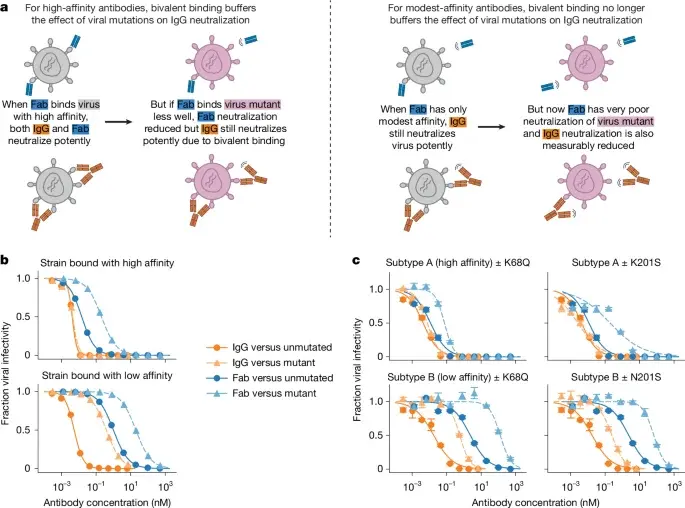
- Nirsevimab resistance is more common in RSV subtype B than A because bivalent IgG binding buffers mutations in subtype A due to higher affinity.
- Real-world data from Canada shows nirsevimab reduced infant hospitalizations by 79% and ICU admissions by 97% during the 2024-2025 season.
- Surveillance indicates resistant strains are currently rare, comprising less than 1% of sequenced RSV samples, but monitoring is critical for public health.
Background
RSV is a leading cause of infant hospitalization in the USA and mortality globally. Nirsevimab and clesrovimab were recently licensed for infant prevention. Previous studies identified limited resistance mutations through lab passaging, but lacked comprehensive data on all possible mutations. Regeneron’s suptavumab failed a phase 3 trial in 2015-2017 due to subtype B escape mutations.
How outlets are covering it
Nature emphasizes the biophysical mechanisms of resistance, noting that nirsevimab’s lower affinity for subtype B allows mutations to escape IgG buffering, unlike in subtype A. University of Calgary highlights real-world effectiveness, reporting 79% protection against hospitalization and 97% against ICU admissions in Ontario and Quebec. Distilledpost focuses on the UK’s national immunization program, noting a 50% drop in infant ICU admissions, while attributing success to logistical coordination rather than just medical knowledge. Yahoo News mirrors the Canadian findings but provides no additional unique data points.
Why it matters
Understanding mutation constraints helps design more resilient antibodies and improves surveillance for viral escape. The high efficacy data supports universal immunization programs, reducing the burden on pediatric healthcare systems and preventing severe disease in healthy infants.
What to watch
Researchers will continue monitoring RSV sequences for rare resistant strains using new surveillance platforms. Future antibody development will aim for higher Fab potency to overcome bivalent buffering limitations. Public health officials will assess the durability of immunization programs as supply chains and uptake rates evolve.
- Mutational constraints on RSV F and its neutralization by antibodies Nature
- Immunization to prevent RSV in infants reduced ICU admissions by 97 per cent University of Calgary
- Study supports effectiveness of RSV preventive antibodies for infants, offers new way to monitor viral resistance Medical Xpress
- RSV: Transmission, High-Risk Groups, and the Impact of National Immunisation Programmes distilledpost.com
- RSV immunization reduces infant ICU admissions by 97%, study says ca.news.yahoo.com
Want the full story? Read the original reporting
Read on Nature