
Nor'easter uncovers 1884 Warren Sawyer shipwreck on Nantucket's shifting shore
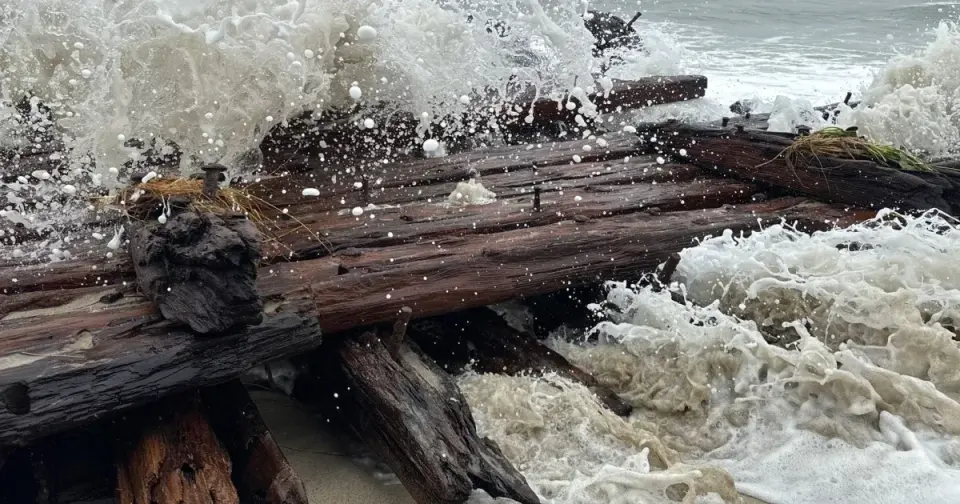
A powerful September nor'easter stripped away sand on Nantucket's south shore, exposing wooden timbers likely belonging to the 1884 schooner Warren Sawyer. While the discovery offers a rare glimpse into 19th-century maritime history, experts warn the exposed artifacts are highly vulnerable to rapid decay and may be buried again by shifting tides.
Key points
- Jason Graziadei, editor of the Nantucket Current, spotted the wooden remnants on the island's south shore on Saturday, September 27, 2026.
- The fragments are believed to be from the Warren Sawyer, a three-masted schooner that wrecked near Miacomet Beach on December 22, 1884.
- The vessel was traveling from New Orleans to Boston carrying 1,115 bales of cotton and 28 tons of scrap metal when it ran aground.
- Previous fragments from the same wreck were discovered in December 2022 and February 2023, but this is the first resurfacing since then.
- The Massachusetts Board of Underwater Archaeological Resources confirmed in a 2023 report that the wreckage was 'most likely' from the Warren Sawyer based on archival and archaeological evidence.
Background
Nantucket has a long history of maritime accidents due to its location on treacherous shipping lanes. Our archive notes that similar deep-sea discoveries, such as the 16th-century Camarat 4 off France, highlight how routine surveys or natural events can reveal submerged history. However, unlike deep-sea wrecks, Nantucket's coastal finds are subject to constant erosion. The Warren Sawyer itself was lost during a winter storm in 1884, and its crew was rescued using a breeches buoy before the hull disintegrated.
How outlets are covering it
NBC News and The Economic Times both emphasize the fragility of the discovery, noting that the exposed wood is highly susceptible to decay and may be buried again by shifting sands. The Economic Times highlights the 'shifting archive' nature of Nantucket's coastline, where storms act as natural excavators but also destroyors. In contrast, The Inquirer and Mirror provided no substantive coverage of the shipwreck, focusing instead on the storm's broader transportation impacts. While NBC News cites the Massachusetts Board of Underwater Archaeological Resources as confirming the identification, Jascin N. Leonardo Finger of the Maria Mitchell Association noted that 'more investigation is necessary' to definitively confirm the origin of the new remnants.
Why it matters
This event illustrates the dynamic relationship between coastal erosion and historical preservation. While storms can uncover valuable artifacts, they also threaten to destroy them permanently. The discovery underscores the need for rapid documentation and protection of maritime heritage in vulnerable coastal areas like Nantucket, where the line between archaeological site and beach debris is constantly shifting.
What to watch
Experts and local authorities are expected to monitor the exposed timbers to prevent further decay. The Egan Maritime Institute and the Massachusetts Board of Underwater Archaeological Resources may conduct further assessments to confirm the identity of the fragments and determine if any preservation measures are necessary before the next storm buries the wreck again.
- Nor’easter unearths fragments of 19th-century shipwreck on Nantucket NBC News
- Likely Piece of 1884 Shipwreck Washes Ashore in Nantucket During Nor’easter The New York Times
- Weekend nor’easter shows signs of moving on The Inquirer and Mirror
- Nantucket fire chief talks safety measures on the island during nor'easter Boston 25 News
- In 1884, a ship disappeared near Nantucket after a powerful winter storm. More than a century later, anoth The Economic Times
Want the full story? Read the original reporting
Read on NBC News