
Dolores Huerta, UFW Co-Founder and Civil Rights Icon, Dies at 96
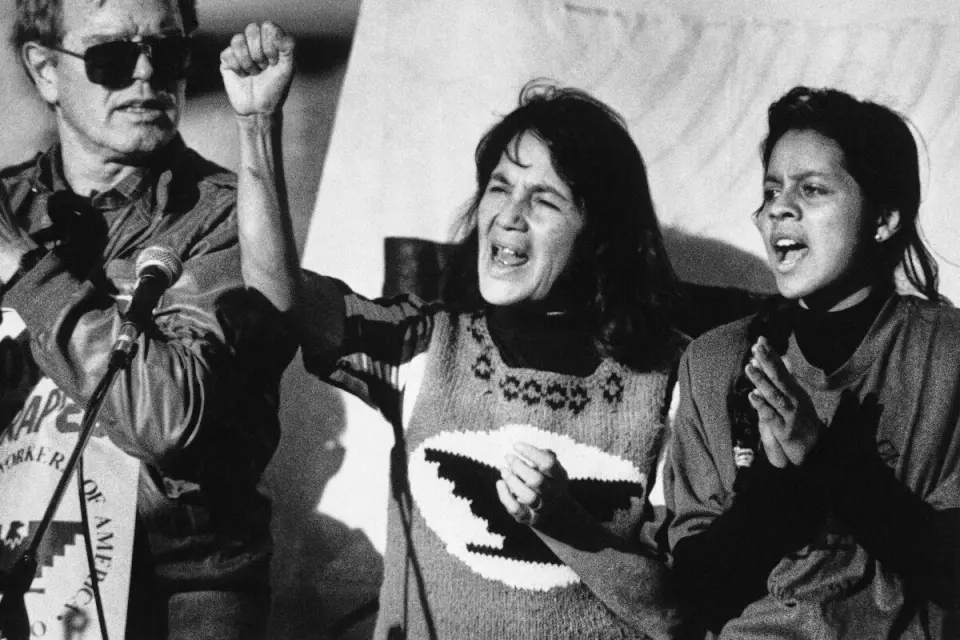
Dolores Huerta, the co-founder of the United Farm Workers and creator of the slogan 'Sí, se puede,' has died at age 96 from cancer. She passed away at her home in Bakersfield, California, surrounded by family. Huerta was a pivotal labor leader who negotiated key contracts for farmworkers and advocated for civil rights, women's rights, and LGBTQ+ equality. Her legacy is complex, marked by her 2026 revelation that she was sexually abused by her longtime partner, Cesar Chavez, a secret she kept for 60 years.
Key points
- Dolores Huerta died of cancer on Wednesday at her home in Bakersfield, California, at the age of 96.
- She co-founded the National Farm Workers Association in 1962, which later became the United Farm Workers of America, alongside Cesar Chavez.
- Huerta coined the Spanish-language rallying cry 'Sí, se puede' (Yes, it can be done), which was later adopted by President Barack Obama for his 2008 campaign.
- In 2026, Huerta publicly revealed that she was sexually abused by Chavez in the 1960s, resulting in two children, a secret she had kept for six decades.
- She received the Presidential Medal of Freedom in 2012 and was the first Latina inducted into the National Women’s Hall of Fame.
- Huerta was jailed 22 times for union demonstrations and suffered severe injuries, including a pulverized spleen, during a 1988 protest against George H.W. Bush.
Background
Dolores Huerta was born in 1930 in Dawson, New Mexico, and moved to California as a child. She began her career as an elementary school teacher in the San Joaquin Valley before transitioning to labor organizing. Her partnership with Cesar Chavez began in the early 1960s, leading to the formation of the UFW. She played a crucial role in the Delano Grape Strike and helped secure the first health and benefit plans for farmworkers. Huerta also campaigned for various Democratic presidents, including Bill Clinton, Barack Obama, and Joe Biden. Her 2026 disclosure of abuse by Chavez sparked significant discussion within the Latino community and re-evaluations of her legacy.
Why it matters
Huerta's death marks the end of an era for the U.S. labor and civil rights movements. Her life's work empowered the Latino community and farmworkers, securing significant legal and economic protections. However, her recent revelations about sexual abuse by Chavez have complicated her legacy, prompting broader conversations about power dynamics in activist movements and the importance of accountability. Her continued activism into her 90s underscores her enduring commitment to justice and social change.
What to watch
The United Farm Workers and other labor organizations will likely hold memorial events to honor Huerta's contributions. Her foundation in Bakersfield will continue its work on race, poverty, and LGBTQ+ rights. The 2026 documentary 'Seeds of Change: The Life and Legacy of Dolores Huerta' may see increased viewership as people seek to understand her complex legacy. Discussions about the intersection of labor rights and personal accountability in activist movements are expected to continue.
Want the full story? Read the original reporting
Read on AP News