
Red-State Senate Races Turn Competitive, Sparking Debate Over 2028 Map
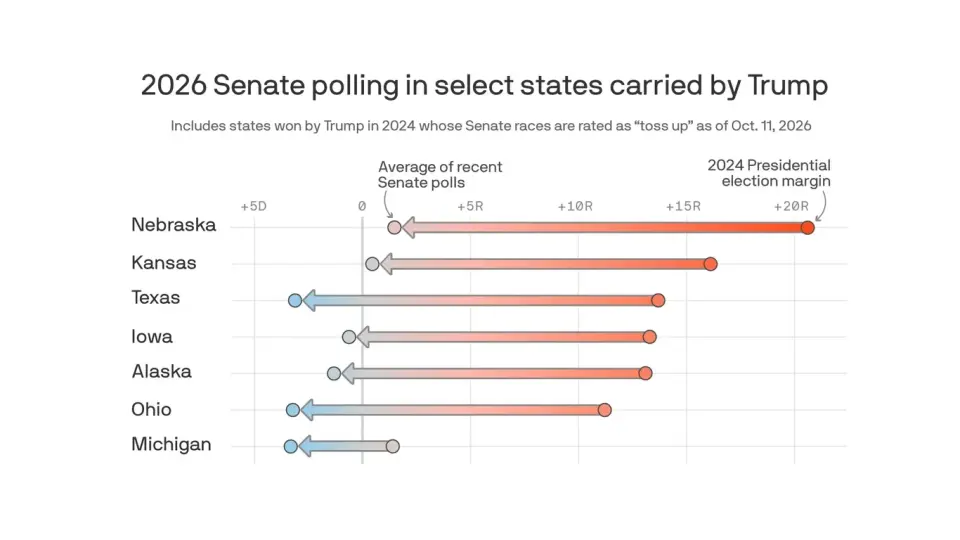
Democratic candidates are performing unexpectedly well in traditionally Republican states, prompting analysts to reassess the 2028 presidential map. While some races in Kansas, Ohio, and Texas are now tied or leaning Democratic, Republicans argue this is a temporary backlash against President Trump rather than a permanent shift. The Cook Political Report has moved several ratings toward Democrats, suggesting a potential Senate majority shift, though polling accuracy remains a concern.
Key points
- Senate races in Kansas, Ohio, Nebraska, and Texas are currently tied or within margin of error, defying historical red-state trends.
- The Cook Political Report has revised its estimates, moving Kansas to Toss Up and New Hampshire to Lean Democrat, projecting Democrats could gain two to six seats.
- Republican operatives describe the current competitiveness as a 'one-off' driven by high prices and dissatisfaction with Trump, not a new swing-state reality.
- Democratic success in these states is attributed to candidates like James Talarico in Texas and Adam Hamilton in Kansas, who emphasize religious values and local engagement.
- Axios notes that while these results create an 'opening' for Democrats in 2028, there is no guarantee of a permanent shift without a candidate who can build trust with center-right voters.
Background
This development follows earlier reports of intra-party friction among Democrats, such as the 2026 push to challenge Sen. John Fetterman in Pennsylvania, and the 2026-10-03 observation that VP JD Vance’s red-state rallies faced voter frustration over economic issues. These current Senate results reflect a broader national mood where economic grievances are overriding traditional party loyalty in conservative states.
How outlets are covering it
Axios emphasizes the potential for a long-term shift in the 2028 presidential map, citing David Axelrod’s view that Democrats are successfully engaging rural voters through direct conversation rather than lecturing. In contrast, Republican consultants dismiss the idea of new swing states, arguing that the current competitiveness is a temporary defensive reaction to Trump’s unpopularity and high costs of living, not a structural change. The Cook Political Report provides a neutral but bullish assessment for Democrats, noting that while Republicans have a financial edge, Trump’s approval ratings are dragging down candidates even in deep red states. The sources agree on the current tightness of the races but diverge on whether this signals a permanent realignment or a transient electoral anomaly.
Why it matters
The outcome of these Senate races will determine whether Democrats can secure a majority in the 2026 midterms, which would significantly influence the political landscape leading into the 2028 presidential election. If Democrats can hold or gain seats in states like Texas and Kansas, it validates a new strategy of appealing to center-right voters in rural areas, potentially reshaping the national map for the next presidential cycle. Conversely, if Republicans hold these seats, it suggests that the current competitiveness is merely a temporary backlash against the administration rather than a fundamental shift in voter alignment.
What to watch
The focus will now turn to the November 3 election results to see if the polling trends hold. Analysts will monitor whether the Democratic gains in red states translate into a Senate majority and how this impacts the 2028 presidential primary. Additionally, the accuracy of current polls will be scrutinized, given recent historical misses in election forecasting. The performance of candidates like James Talarico and Adam Hamilton will serve as case studies for future Democratic strategies in conservative regions.
- Dems' red-state showings raise prospect of a bigger 2028 map Axios
- Hottest 2026 Midterm Races—Jackson Leads In Maine, Hinson Ahead In Iowa (Updated Daily) Forbes
- The races that will decide control of the US Senate Reuters
- The Senate races most likely to flip less than a month from Election Day The Hill
- A Senate Majority is Squarely in Democrats’ Sights as Kansas Moves to Toss Up; Two Other Races Shift Left Cook Political Report
Want the full story? Read the original reporting
Read on Axios