
Midterm Vote Counts: From Instant Calls to 29-Day Delays
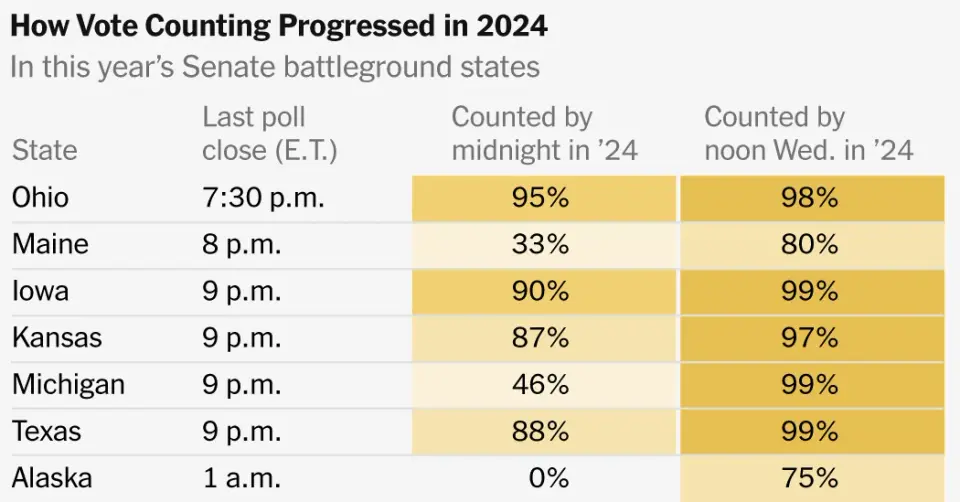
The 2026 midterm election results will emerge at varying speeds across the United States, with some states declaring winners immediately while others face weeks-long delays. Fast-counting states like Florida, Georgia, and Texas will likely have 99% of votes tallied by midnight, allowing for immediate calls. Conversely, mail-heavy states such as California, Washington, and Oregon may take up to 29 days to finalize results. Ranked-choice voting in Alaska, Maine, and the District of Columbia introduces further delays, with second tabulations scheduled for November 18. The Associated Press will determine final outcomes based on these state-specific timelines, which are influenced by mail ballot processing and early voting trends.
Key points
- Polls close between 6 p.m. and 11 p.m. Eastern Time, with Florida and Georgia closing earliest at 7 p.m.
- Fast-counting states like Florida, Georgia, and Texas report 99% of votes by midnight, enabling immediate race calls.
- Mail-heavy states like California, Washington, and Oregon may take up to 29 days to finalize results due to extended ballot processing.
- Ranked-choice voting in Alaska, Maine, and the District of Columbia delays results, with second tabulations scheduled for November 18 if no candidate secures 50%.
- The Associated Press will determine final outcomes based on state-specific timelines, which are influenced by mail ballot processing and early voting trends.
Background
This briefing follows earlier coverage of President Trump’s conditional acceptance of midterm results, which has heightened scrutiny over vote certification processes. The administration’s legal challenges in states like Alaska and Washington, along with threats to veto legislation from a potential Democratic-controlled Congress, underscore the political stakes of delayed or contested results. The 2024 midterm data, referenced in the primary source, provides a baseline for current expectations, showing that mail-heavy and ranked-choice states consistently experience longer counting periods.
Why it matters
The timing of vote counting directly impacts public confidence in election outcomes, especially amid political disputes over result integrity. Delays in mail-heavy and ranked-choice states may prolong uncertainty, potentially fueling misinformation or legal challenges. Understanding these timelines helps voters and officials anticipate when final results will be available, reducing speculation and ensuring transparency in a politically charged environment.
What to watch
Election night will begin with early results from fast-counting states like Florida and Georgia, followed by gradual updates from mail-heavy states. Ranked-choice voting states will release initial results on November 3, with second tabulations on November 18. The Associated Press will call races as thresholds are met, with final outcomes in slow-counting states potentially emerging weeks after the election. State officials will monitor ballot processing to ensure compliance with deadlines, while political actors may challenge results in contested races.
- When to Expect Midterm Results in Each State on Election Night The New York Times
- When will we know 2026 midterm election results? It may take some time, but that's normal PBS
- When will we know who won the midterms? ABC10
- What To Watch For As Networks Cover Midterm Election Night: More Data, More Coverage & More Competition Deadline
- When will the midterm election results be announced? The key timings The Times
Want the full story? Read the original reporting
Read on The New York Times