
Mississippi Senate Race Becomes Midterm Flashpoint as Trump and Harris Rally in Deep-Red State
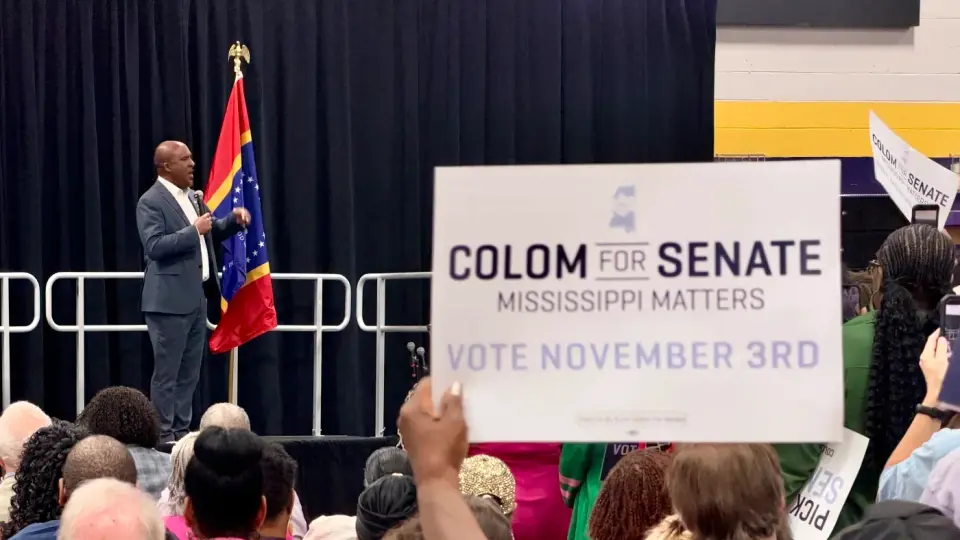
The 2026 U.S. Senate race in Mississippi has emerged as a critical battleground, with President Trump and former Vice President Kamala Harris both holding rallies in the deep-red state. Incumbent Republican Cindy Hyde-Smith faces Democrat Scott Colom in a contest that has attracted millions in national spending despite Mississippi’s historical conservative leanings. While Trump visited to ensure his ally votes, Harris framed the election as a chance to replace an unpopular administration. The race hinges on Black voter turnout and economic discontent, though structural barriers remain significant for the Democratic challenger.
Key points
- President Trump held a rally in Corinth, Mississippi, on Oct. 26, urging voters to turn out for Hyde-Smith despite her strong polling, while Kamala Harris rallied for Colom in Columbus on Oct. 22.
- Democrats have spent approximately $5 million in Mississippi this month, outpacing Republicans’ $3.2 million, with national groups pouring funds into the race for the first time in decades.
- Colom, a district attorney, is challenging Hyde-Smith, who previously blocked his federal judicial nomination during the Biden administration, framing the race as a fight against a 'betrayed' state.
- Hyde-Smith’s campaign has spent over $1.3 million on an ad calling Colom 'the most radical Senate candidate,' while Colom’s campaign leverages a viral 'pick another protein' ad referencing Hyde-Smith’s comments on beef prices.
- Black voters, comprising nearly 40% of Mississippi’s population, are central to the race, with increased turnout and anti-incumbent sentiment driving Democratic optimism despite historical Republican dominance.
Background
Mississippi has not elected a Democratic U.S. Senator since 1982, and the last Black statewide winner was during Reconstruction. Recent archive coverage notes that Trump’s mid-October rallies in Mississippi and South Carolina highlighted GOP vulnerabilities in red states, while Georgia’s race hinged on defections from former Trump supporters. The current contest is part of a broader trend where national economic discontent and high early voter turnout are challenging Republican incumbents in traditionally safe seats.
How outlets are covering it
NPR emphasizes the 'betrayed' narrative of Mississippi Democrats and the symbolic importance of Black voter turnout, noting that the state was long ignored by national Democratic spending. The New York Times highlights the 'tantalizing' nature of the race, questioning if Mississippi is truly in play despite its conservative base, and details the viral 'protein' ad strategy. The Washington Post frames the race as part of a broader trend where 'safe' Republicans are forced to campaign due to Trump’s unpopularity and economic conditions, comparing Hyde-Smith’s struggles to other incumbents in Kansas and Colorado. AP News focuses on the influx of national money and star surrogates, signaling a shift in the competitive landscape for the South. Outlets disagree on the likelihood of a Democratic upset, with The New York Times and The Washington Post expressing skepticism about a full victory but acknowledging a tightening race, while NPR and AP News highlight the unprecedented level of investment and voter engagement.
Why it matters
The Mississippi Senate race serves as a bellwether for the power of Black voters in the South and the impact of economic discontent on Republican incumbents. A Democratic victory would be a historic first since the 1980s, while a Republican win would confirm the resilience of GOP structures despite national unpopularity. The outcome also influences future redistricting efforts, as Republicans in Mississippi have signaled plans to redraw state legislative and judicial maps after the midterms, potentially impacting local and state elections.
What to watch
Voting concludes on Nov. 3, 2026. Both parties are expected to continue heavy spending and outreach in the final days, with a focus on mobilizing Black voters and addressing economic concerns. The results will determine the balance of power in the U.S. Senate and influence the trajectory of national policy, particularly regarding healthcare, tariffs, and foreign policy. Post-election, Mississippi Republicans may pursue redistricting changes to solidify their control over state-level elections.
- Can Black voting power and Trump fatigue break Mississippi's red wall? NPR
- A Tight Senate Race in Mississippi? Trump and Others Seem to Think So. The New York Times
- Analysis | A tough environment forces ‘safe’ Republicans to actually campaign The Washington Post
- Senate Democrats launch first ad in Mississippi as their midterm optimism spreads in the South AP News
- Democrats aim for deep-red Mississippi Senate seat as Scott Colom argues he can unseat Republican incumbent ABC News - Breaking News, Latest News and Videos
Want the full story? Read the original reporting
Read on NPR