
Nevada Governor Lombardo Faces Existential Threat from Trump's Unpopularity
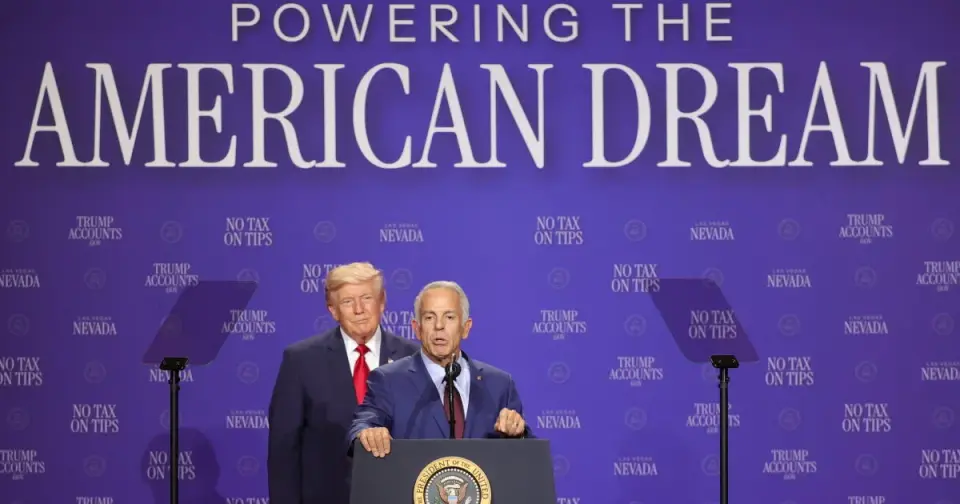
Nevada Governor Joe Lombardo is fighting to retain his office as his Democratic opponent, Aaron Ford, successfully links his administration to President Trump’s unpopular policies. With less than a week until the November 3 election, the race remains a toss-up despite Lombardo’s financial advantages. Ford is leveraging high fuel prices and cost-of-living concerns to portray Lombardo as subservient to the White House, while Lombardo emphasizes state-level successes in job growth and crime reduction. The outcome will likely depend on the strength of the national Democratic wave and voter frustration with federal economic conditions.
Key points
- Nevada Governor Joe Lombardo is facing a critical reelection challenge against Attorney General Aaron Ford, with over 335,000 ballots already cast in a closely contested race.
- Ford’s campaign strategy centers on tying Lombardo to President Trump’s unpopular policies, particularly regarding inflation, high fuel prices, and foreign policy, arguing that the governor prioritizes Washington over Nevada.
- Lombardo, who avoided MAGA-style culture wars during his first term, is struggling to distance himself from the president despite occasional disagreements on issues like Medicaid cuts and energy projects.
- Lombardo’s campaign highlights achievements in job growth, education funding, and crime reduction, while attacking Ford’s record on clemency and out-of-state travel, but these arguments may be overshadowed by national economic sentiment.
- The race is viewed as a bellwether for the 2028 presidential cycle, with Democrats hoping to capitalize on voter dissatisfaction with Trump’s administration to win back the state.
Background
This race follows a broader trend of Republican governors distancing themselves from President Trump ahead of the 2026 midterms, as seen in Florida and other swing states. Our earlier coverage noted that Trump’s approval rating has dropped to 30%, creating a 'red undertow' that threatens GOP candidates. Additionally, Lombardo recently signed an executive order imposing cost rules on data centers, an attempt to address voter anxiety over infrastructure impacts, but this has not fully mitigated the damage from national economic frustrations.
How outlets are covering it
The Los Angeles Times emphasizes the structural disadvantage Lombardo faces due to Trump’s unpopularity, noting that the governor’s fate is largely beyond his control. In contrast, Politico frames the Nevada race as a critical test for Democrats’ ability to win back blue-collar workers, with Ford explicitly stating that the 2028 presidential cycle begins in 2026. Magzter, which republishes the Los Angeles Times content, highlights the visual and rhetorical contrast between Lombardo’s defense of billionaires and Ford’s focus on affordability. While all sources agree on the tightness of the race, the LA Times and Magzter focus on the 'anvil' of Trump’s influence, whereas Politico highlights the strategic implications for the Democratic Party’s future.
Why it matters
The outcome of the Nevada gubernatorial race will signal the strength of the Democratic wave in the 2026 midterms and provide early indicators of voter sentiment heading into the 2028 presidential cycle. As a pivotal swing state, Nevada’s political direction will influence national party strategies and resource allocation for future elections.
What to watch
Voters will cast ballots on November 3, with results likely to be close given the current polling. The outcome will determine whether Democrats can make a significant gain in a traditionally purple state and will shape the narrative for the 2028 presidential campaign. Lombardo’s ability to survive the 'Trump undertow' will be a key indicator of Republican resilience in swing states.
- Commentary: Is this purple state about to go blue? Nevada's GOP governor faces an anti-Trump backlash Los Angeles Times
- Swing State Republican in a Razor-Thin Race Tries to Outrun Trump The New York Times
- Why you should pay attention to Nevada Politico
- Commentary: Your 2026 Nevada Republican marquee candidates: Lombardo and Flippo Nevada Current
- ‘Trump hangs like an anvil on Nevada governor Magzter
Want the full story? Read the original reporting
Read on Los Angeles Times