
Sampson Leads Historic 3-Member GOP Senate Caucus Amid Democratic Supermajority
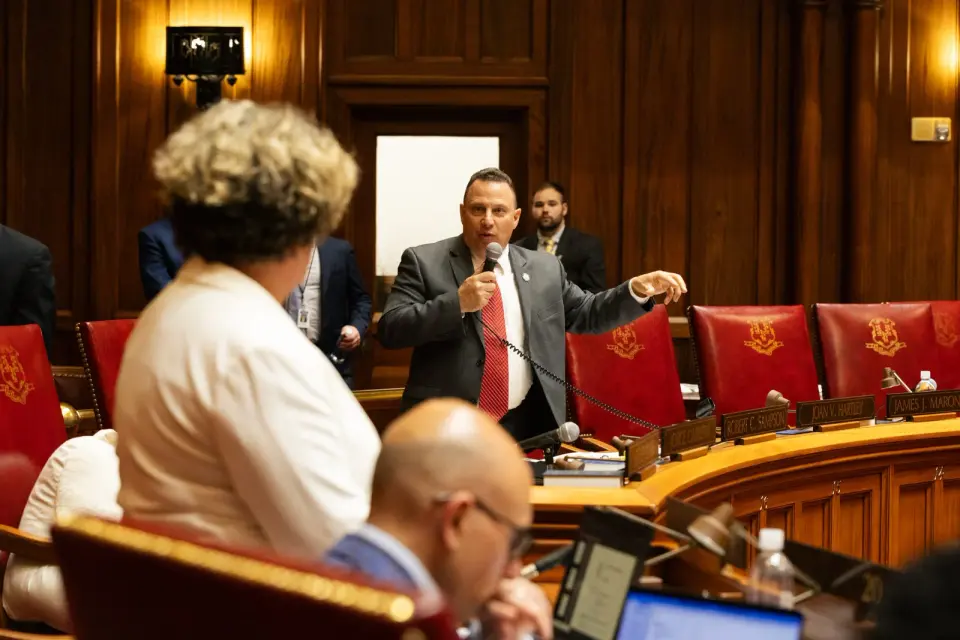
Rob Sampson was elected minority leader of the Connecticut Senate, heading a historic three-member Republican caucus. Facing a 33-3 Democratic advantage, Sampson plans to rely on public protests and committee coordination rather than floor debates. Democrats, led by new President Bob Duff, emphasize their mandate to address affordability, while Republicans criticize the party's decline and warn against tax hikes on the wealthy.
Key points
- Sampson, a Wolcott resident, leads the smallest GOP Senate caucus in history with only three members: Sampson, Eric Berthel, and Henri Martin.
- The 2026 midterms resulted in eight Republican losses, leaving Democrats with a 33-3 advantage in the Senate and 116-35 in the House.
- Sampson acknowledges that floor filibusters are no longer effective with only three members and will instead focus on mobilizing public protests and coordinating with the House.
- Democratic leaders, including new Senate President Bob Duff, assert a mandate to tackle high costs of living, while Republicans argue against raising taxes on the wealthy.
- Sampson and Berthel criticized former GOP leaders for failing to present a clear contrast to voters, while Duff warned that cooperation depends on good-faith partnership.
Background
Connecticut Republicans have faced steady electoral declines since 2016, culminating in the 2026 midterms where they lost all statewide offices and congressional seats. The party now holds no statewide constitutional offices, making Sampson the highest-ranking Republican officeholder in the state. This follows a broader national trend of Republican losses in 2026, though Connecticut’s situation is particularly severe due to the party’s inability to retain even a handful of legislative seats.
How outlets are covering it
CT Mirror emphasizes Sampson’s strategic pivot from floor debates to public mobilization, noting his willingness to cooperate with Democrats on some bills. WTNH highlights Sampson’s reputation as a legislative brawler and his potential to appoint outgoing leader Steve Harding to a staff role. Hartford Business Journal focuses on the fiscal implications, noting that Democrats now have the leverage to pursue tax hikes on the wealthy, a move Republicans and conservative think tanks oppose. While CT Mirror and WTNH focus on the leadership transition, the Business Journal frames the story within the broader budget crisis, highlighting the tension between Democratic affordability pledges and Republican tax-cut demands.
Why it matters
The 3-33 Senate split fundamentally alters Connecticut’s legislative dynamics, limiting Republican influence to committee coordination and public pressure. This supermajority allows Democrats to advance their agenda on affordability and federal policy challenges, while Republicans must rely on external mobilization to counter Democratic initiatives. The outcome of the 2027 session will test whether the new Democratic majority can balance tax hikes with spending cuts, a debate that will define the state’s fiscal future.
What to watch
The 2027 legislative session begins on January 6, where Democrats will likely push for tax reforms and spending increases. Sampson’s caucus will focus on organizing public protests and coordinating with the House to monitor committee activity. The outcome of the federal debate on human services cuts will also influence state budget decisions, as Connecticut seeks to replace lost federal funding.
- Sen. Rob Sampson to lead smallest GOP caucus in CT history CT Mirror
- CT will only have 3 Republican state senators. It could mean staffing cuts, committee problems CT Insider
- Opinion: CT Republicans cannot afford more of the same CT Mirror
- Staunch conservative will lead Connecticut’s Senate Republicans WTNH.com
- With historic majorities, CT Democrats eye new leverage in tax debate Hartford Business Journal
Want the full story? Read the original reporting
Read on CT Mirror