
Senate passes 62-33 vote on sweeping permitting overhaul, sending energy bill to House
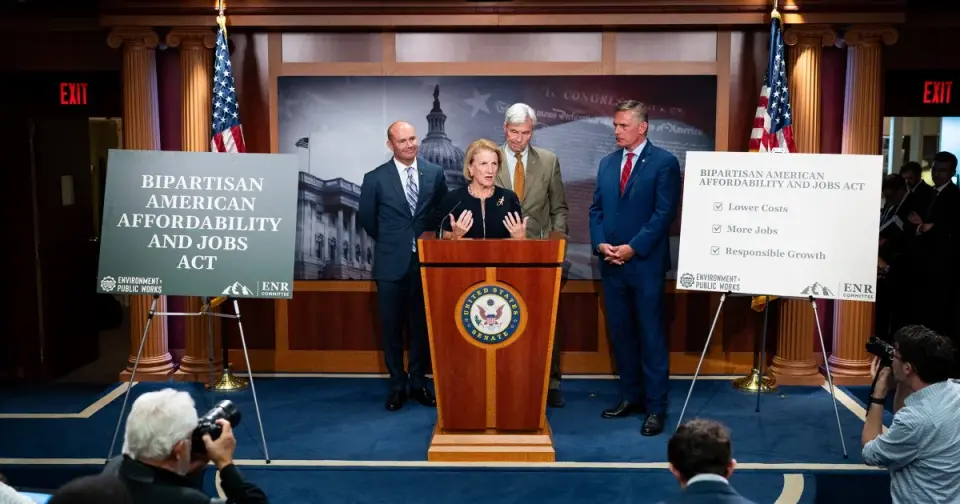
The US Senate passed the Bipartisan American Affordability and Jobs Act (BAAJA) on November 19, 2026, by a 62-33 vote. The legislation aims to streamline federal permitting for energy, infrastructure, and data center projects by imposing tighter deadlines on environmental reviews and limiting judicial challenges. It now moves to the House, where passage is uncertain due to Democratic opposition and procedural hurdles before the new Congress convenes in January.
Key points
- The bill, authored by Sens. Mike Lee, Shelley Moore Capito, Sheldon Whitehouse, and Martin Heinrich, received 62 votes in favor and 33 against.
- Key provisions include restricting federal agencies from revoking existing permits, accelerating electricity transmission, and requiring large data centers (20MW+) to pay for incremental infrastructure costs.
- The measure amends the National Environmental Policy Act (NEPA) to prevent courts from halting projects during inadequate reviews, a change critics call a significant weakening of environmental safeguards.
- Opposition came primarily from Democrats, environmental groups, and Native American tribes, who cited concerns over fossil fuel expansion, tribal consultation rights, and data center impacts.
- The bill faces a tight timeline in the House, with Republicans urging quick passage and Democrats debating whether to accept the Senate version or demand changes before the lame-duck session ends.
Background
The BAAJA bill had been advancing through the Senate for months, clearing procedural hurdles in late November 2026. Earlier archive coverage noted that the 400+ page bill aimed to reduce transmission line construction times from over a decade to five or six years. The legislation emerged from closed-door negotiations between bipartisan senators, responding to long-standing complaints about regulatory delays in projects like the Mountain Valley Pipeline and large wind farms in New Mexico.
How outlets are covering it
Supporters, including Republicans and some Democrats like Sen. Martin Heinrich, framed the bill as a necessary step to lower energy costs and address affordability concerns, citing the need to expand grid capacity for clean energy and data centers. Conservatives emphasized cutting bureaucracy and regulatory uncertainty, while liberals focused on enabling clean energy projects and reducing emissions. Opponents, including environmental groups like the Natural Resources Defense Council and Sierra Club, and Democratic Senators like Ron Wyden and Jeff Merkley, argued the bill weakens environmental protections, favors fossil fuel interests, and undermines tribal consultation rights. Some Democrats, such as Rep. Jared Huffman, warned that the bill could allow the Trump administration to approve fossil fuel projects while blocking renewables. The vote highlighted deep divisions within the Democratic Party, with 15 Democrats supporting the bill and 31 opposing it, reflecting tensions between affordability priorities and environmental safeguards.
Why it matters
The BAAJA represents the most significant change to US environmental permitting laws in decades, potentially accelerating the construction of energy and infrastructure projects. Its passage could lower energy costs for consumers and expand clean energy capacity, but it also raises concerns about environmental degradation and reduced public input in permitting processes. The bill’s fate in the House and its potential impact on future energy policy and climate goals make it a pivotal moment in US legislative history.
What to watch
The bill must now pass the House, where Republicans are optimistic about quick approval, but Democrats are divided. House leadership faces a tight timeline before the new Congress convenes in January, with potential conflicts over grid reliability and environmental provisions. President Trump has indicated he would sign the bill if it reaches his desk, but its final outcome depends on House negotiations and amendments.
- Senate passes sweeping bill simplifying permitting rules to build in America NBC News
- Senate passes BAAJA permitting reform bill backed by AI, energy sectors CNBC
- Senate Passes Major Permitting Bill to Speed Up Energy Projects The New York Times
- Senate passes bipartisan permitting reform bill designed to boost energy projects CBS News
- Senate Democrats Greenlight Environmental Catastrophe By Advancing Permitting Reform Center for Biological Diversity
Want the full story? Read the original reporting
Read on NBC News