
Trump-Xi APEC Summit Ends With Viral Escalator Moment But No Trade Breakthrough
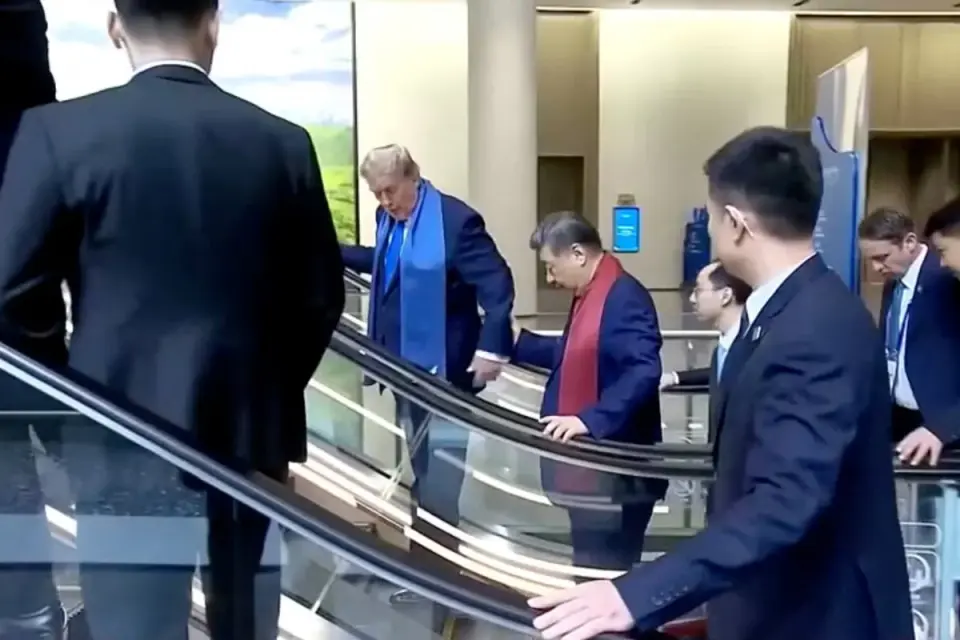
President Donald Trump and Chinese President Xi Jinping concluded their Asia-Pacific Economic Cooperation (APEC) summit in Shenzhen, China, with a viral escalator interaction but no significant progress on trade or technology disputes. The leaders held closed-door talks alongside Russian President Vladimir Putin, focusing on nuclear risks and conflicts in Ukraine and Iran. While the White House highlighted the friendly physical gestures, analysts note that the US-China trade truce expires in January without extension, and new restrictions on AI chip access remain contentious. The meeting featured a rare trilateral format, but substantive outcomes were limited, with both sides emphasizing the need for continued communication despite ongoing tensions over semiconductors and rare earth minerals.
Key points
- Trump and Xi held a trilateral meeting with Putin in Shenzhen, discussing nuclear weapons, Ukraine, and Iran, but issued only a joint statement on UN reform.
- The US-China trade truce, which lowers tariffs, is set to expire on January 10, with no agreement reached to extend it during the APEC summit.
- New US interim rules restrict Chinese AI companies from remotely accessing advanced US chips, a move driven by Treasury Secretary Scott Bessent amid internal Cabinet disputes.
- Trump and Xi displayed personal warmth, including an embrace and an escalator assistance moment, but sidestepped difficult questions regarding Nvidia and semiconductor leaks.
- A $14 billion arms package for Taiwan remains pending, with Congress expected to pressure Trump to approve it, potentially straining US-China relations.
Background
This summit follows a series of high-profile US-China interactions in 2026, including a September White House summit and a Quad meeting in Manila focused on AI and critical minerals. The current APEC gathering occurs amid heightened tensions over semiconductor export controls and a scandal involving former Nvidia CEO Jensen Huang and suspected Chinese intelligence activities. Previous escalator incidents involving Trump, including a malfunction at the UN General Assembly, have become recurring media focal points, underscoring the symbolic nature of these diplomatic encounters.
How outlets are covering it
The Independent focused on the viral escalator moment, framing it as a continuation of Trump’s history with escalator-related headlines, while the White House praised the gesture as a sign of goodwill. Yahoo Finance emphasized the lack of substantive progress, noting that trade truces remain unresolved and that leaders avoided discussing the Nvidia scandal. CBS News highlighted the internal US Cabinet rift between Treasury Secretary Scott Bessent and Commerce Secretary Howard Lutnick over chip restrictions, as well as the broader implications for AI safety and Taiwan. While The Independent and the White House emphasized the personal rapport between Trump and Xi, Yahoo Finance and CBS News pointed to the structural economic and technological barriers that persist despite the diplomatic warmth.
Why it matters
The outcome of the APEC summit signals the limits of current US-China diplomacy, as personal rapport has not translated into concrete policy agreements. The expiration of the trade truce in January without extension could reignite tariff disputes, while new AI chip restrictions may widen the technological gap between the US and China. The trilateral format with Russia offers a potential avenue for future dialogue on nuclear issues, but the lack of immediate breakthroughs suggests that deeper structural tensions remain unresolved. Additionally, the pending Taiwan arms package and internal US policy disagreements highlight the complexity of managing US-China relations in a polarized political environment.
What to watch
Trump and Xi are expected to meet again at the G20 Summit in Florida in December, where further discussions on trade and technology may occur. The US-China trade truce expires on January 10, with no current indication of an extension, potentially leading to renewed tariff disputes. Congress is expected to pressure Trump to approve the $14 billion arms package for Taiwan, which could strain US-China relations. The new AI chip restrictions will likely be monitored for their impact on Chinese access to computing power, with experts predicting a widening lead for the US in AI development. Future trilateral meetings with Russia may continue, but without immediate breakthroughs on nuclear or conflict-related issues.
- Trump has yet another viral moment with an escalator: This time during an embrace with China’s leader The Independent
- Stalemates over semiconductors and rare earth minerals appear little changed as Trump heads home from China Yahoo Finance
- Trump and Xi are set to meet in China amid tensions over AI. Here's what to know. CBS News
- Chinese AI and 2 Other Urgent Warnings Ahead of the Trump-Xi Summit Barron's
- Xi Seeks to Cement Stable Ties in Trump Talks Despite Chip Curbs Bloomberg.com
Want the full story? Read the original reporting
Read on The Independent