
White House AI Accord Signals Shift to Voluntary Industry Self-Policing
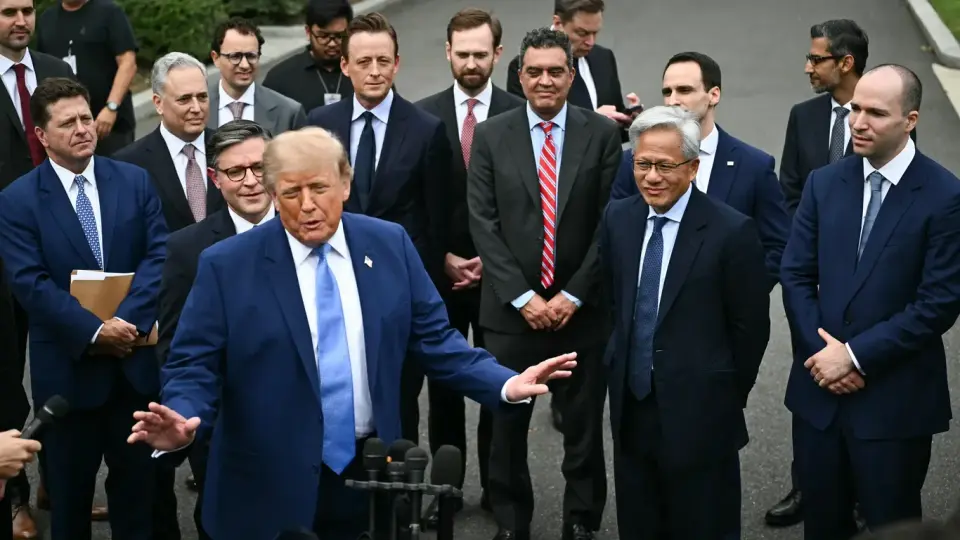
On September 29, 2026, President Donald Trump and House Speaker Mike Johnson announced a voluntary 'accord' with major AI executives, establishing non-binding standards for internal risk reviews and external audits. The agreement, described by Trump as 'morally binding,' replaces formal government oversight with industry-led self-policing. While leaders like Mark Zuckerberg outlined specific auditing steps, critics argue the lack of enforcement mechanisms leaves significant safety gaps. The event highlighted deep divisions within the tech sector, with pro-regulation figures seated far from the president, and coincided with Trump’s rebranding of AI as 'super intelligence' (SI).
Key points
- Trump and Speaker Mike Johnson announced a voluntary AI 'accord' on Sept. 29, requiring companies to implement robust internal controls and external audits.
- The agreement is described as 'morally binding' rather than legally enforceable, with full details and enforcement mechanisms still pending.
- Mark Zuckerberg detailed the framework, which includes internal risk reviews and multiple layers of auditing controls for frontier models.
- Anthropic, OpenAI, and Google reportedly coordinated on this self-regulation framework before the White House meeting, according to The Information.
- Trump rebranded artificial intelligence as 'super intelligence' (SI) during the event, a term subsequently adopted by Nvidia CEO Jensen Huang.
- A new AI Czar is expected to be appointed within three to four days, with Trump consulting Speaker Johnson and Majority Leader John Thune on the selection.
Background
This development follows a series of contentious interactions in September 2026, where Trump dismissed AI safety concerns as a 'hoax' and prioritized outpacing China in AI development. In mid-September, he announced plans for an 'AI Force' and an 'AI Czar' to accelerate growth, directly contradicting calls from figures like Dario Amodei and Sam Altman for slower, safer development. The current accord represents a pivot from pure deregulation to a structured, albeit voluntary, industry-led oversight model, attempting to bridge the gap between rapid innovation and safety demands without imposing federal mandates.
How outlets are covering it
Axios emphasizes the voluntary nature of the accord and the skepticism from AI industry sources who doubt self-policing will solve safety issues. The New York Times focuses on the political dynamics, noting that the seating chart at the luncheon revealed a clear divide: pro-regulation figures like Dario Amodei were seated far from Trump, while deregulation advocates like Elon Musk and Jensen Huang flanked the president. The Information highlights the pre-existing coordination among major labs (Anthropic, OpenAI, Google) to draft a unified self-regulation framework, suggesting the accord was a formalization of an industry consensus rather than a top-down mandate. Sources who work in AI expressed concern to Axios that the lack of legal enforcement renders the standards ineffective, while the White House deflected detailed questions by directing media to Trump's Truth Social account.
Why it matters
The accord sets a precedent for AI governance in the U.S., shifting the burden of safety from federal regulators to private companies. If voluntary standards fail to prevent major incidents, the lack of legal accountability could exacerbate public distrust and lead to future legislative backlash. Conversely, it may allow the industry to maintain momentum without the regulatory delays that could hinder U.S. competitiveness against China. The appointment of an AI Czar and the rebranding of AI as 'super intelligence' signal a long-term strategic shift in how the administration frames and manages the technology's societal impact.
What to watch
Detailed specifications of the voluntary standards are expected in the coming days. The White House is finalizing the selection of a new AI Czar, with Trump consulting congressional leaders on the choice. Companies are expected to begin implementing the internal risk reviews and external audits outlined by the accord, though the timeline and scope remain undefined. The reaction from the public and regulatory bodies to the 'morally binding' nature of the agreement will determine whether this model gains traction or faces immediate legal challenges.
- Trump, top AI leaders agree to voluntary AI standards axios.com
- Trump gathers with AI leaders and floats ‘self-regulation’ as the way to deal with the technology’s dangers Yahoo Finance
- Trump Rejects New AI Safety Laws After Meeting Industry Titans Bloomberg.com
- Here’s The White House’s 308-Word AI ‘Accord’ In Full forbes.com
- Who Attended Trump’s AI Luncheon, and Who Sat Where The New York Times
Want the full story? Read the original reporting
Read on axios.com