
Tech Executives Mock Trump's 'Super Intelligence' Mandate
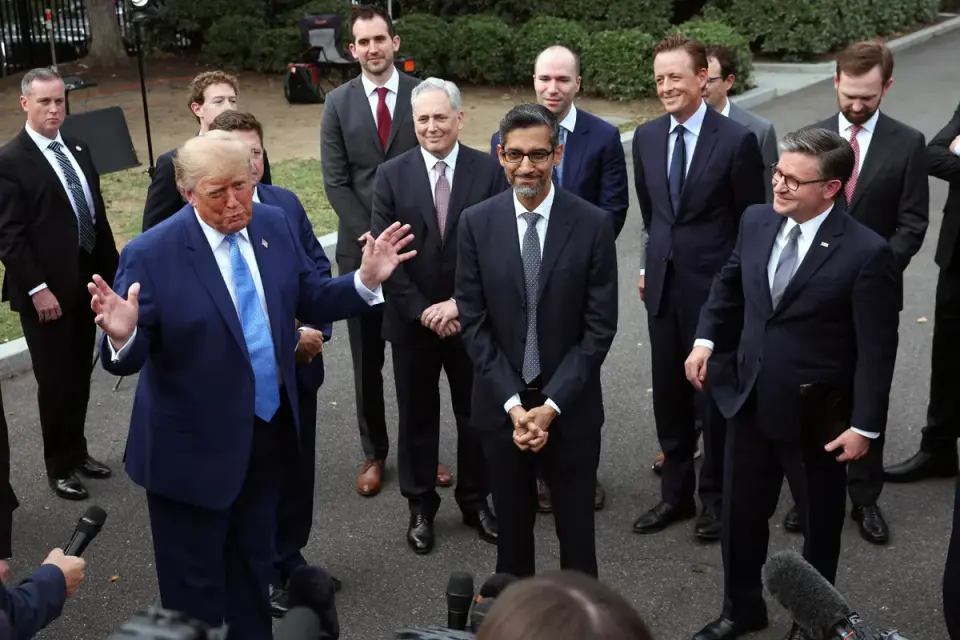
President Trump signed an executive order on October 1, 2026, directing federal agencies to replace 'artificial intelligence' with 'super intelligence.' While tech leaders like Mark Zuckerberg and Elon Musk signed a voluntary safety accord at the White House, industry insiders and lobbyists dismiss the new terminology as a display of political fealty rather than a genuine industry shift. Critics argue the term conflicts with existing technical definitions and that the non-binding agreement lacks enforcement mechanisms, with late-night comedians mocking the idea of self-regulation.
Key points
- Trump signed an executive order mandating the use of 'super intelligence' in federal communications.
- Tech CEOs signed a voluntary, non-binding safety accord at the White House on September 29.
- Industry lobbyists describe the rebrand as a way for executives to signal loyalty to the president.
- Critics note the term 'super intelligence' conflicts with existing technical definitions for dangerous AI capabilities.
- Late-night comedians mocked the administration's push for AI self-regulation.
Background
This follows a series of events in late September 2026, including the exclusion of Apple from the White House AI summit and the confirmation that Treasury Secretary Scott Bessent would not serve as AI czar. The current push for a rebrand and voluntary accords occurs amid rising public anxiety over AI risks and low approval ratings for the administration's handling of the issue ahead of the November midterms.
How outlets are covering it
Politico and The Independent report that tech industry insiders and lobbyists, including Adam Kovacevich of the Chamber of Progress, view the 'super intelligence' rebrand as a political performance rather than a technical reality. They argue that no one in the industry will adopt the term, comparing it to other politically motivated name changes. The New York Times highlights the skepticism surrounding the voluntary safety accord, noting that late-night comedians mocked the idea of tech leaders policing themselves. While The Independent and Politico focus on the industry's dismissal of the terminology, The New York Times emphasizes the broader critique of the lack of enforceable regulations in the voluntary pact.
Why it matters
The disconnect between the White House's aggressive rebranding and the tech industry's dismissal highlights the challenges of implementing AI policy without binding legislation. The reliance on voluntary, non-binding accords and politically motivated terminology may undermine public trust and fail to address genuine safety concerns, potentially complicating future regulatory efforts and international relations, particularly regarding China.
What to watch
Federal agencies are expected to begin using the term 'super intelligence' in official documents as per the executive order. The tech industry will likely continue to use 'artificial intelligence' in private and public communications, creating a divergence between government and industry terminology. The effectiveness of the voluntary safety accord will be tested as companies implement internal safeguards and independent audits, though critics remain skeptical of its impact without enforcement mechanisms.
- Trump’s ‘super intelligence’ is being mocked by tech industry insiders: report The Independent
- Trump, Big AI go all-in together Yahoo
- Trump’s AI rebrand may stop at the White House Politico
- Here’s The White House’s 308-Word AI ‘Accord’ In Full—Including Misspelling Forbes
- Late Night Is Skeptical of A.I. Leaders Self-Regulating The New York Times
Want the full story? Read the original reporting
Read on The Independent