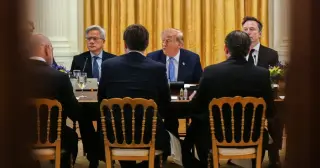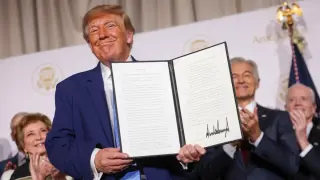
Trump pulled the draft AI executive order after citing “many” concerns it could inhibit innovation; officials expect a rewrite focused on cyber safeguards while weighing industry feedback, with mixed responses from tech leaders about the approach.
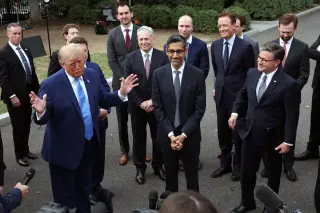
The White House is expected to issue an AI executive order soon, directing federal agencies to create a voluntary AI vulnerability-clearinghouse and to establish a benchmark process for 'covered frontier models,' with invitations sent to CEOs for tomorrow’s event. At Google I/O, Google unveiled a wave of AI offerings—Gemini Omni, Spark, Universal Cart, and an AI-enabled search redesign—underscoring a consumer-first, ecosystem-driven AI strategy that could reshape shopping and platform dynamics, while raising antitrust considerations in ongoing DOJ litigation.
The White House is preparing an AI safety and cybersecurity executive order that would create a voluntary framework requiring AI labs to share new frontier models with the government about 90 days before public release and provide access to critical infrastructure providers, while also outlining national-security cyber protections and review processes for frontier models; the plan reflects a cautious push for oversight amid ongoing AI risk debates.
A University of Washington student created an open, self-updating interactive map that tracks where data centers are being built and how AI policy is evolving around the world, using Epoch AI data and automated news summaries; the project highlights a patchwork of responses—from water and energy concerns to tax breaks—and argues that greater transparency could empower communities to negotiate benefits like jobs, tax revenue, and environmental monitoring.
Japan is negotiating access to Anthropic’s Mythos AI to bolster national cyber defenses amid rising AI-enabled threats linked to China and Russia; officials have ordered reviews of cyber strategy, plan deployment if access is granted, and are coordinating with the United States as part of a broader AI security effort.
Amid a China summit and rising AI competition, the Trump administration is split over shifting AI model testing to the intelligence community, proposing a large ODNI center to vet models while Commerce argues for its own voluntary testing program, fueling a broader fight over mandatory versus voluntary oversight and signaling potential executive action on AI security.
OpenAI unveiled a major update to its guiding principles, shifting away from a heavy emphasis on artificial general intelligence (AGI) in 2018 toward a broader focus on AI capabilities and iterative deployment. The new guidance signals a more competitive stance with rival labs, moving away from a stance of collaboration and restraint. It also softens commitments, offering more suggestions to the tech ecosystem rather than strict, company-bound promises, while framing AI governance as a democratic and societal concern that may require new economic structures and substantial AI infrastructure.
Ars Technica has published a reader-facing policy detailing how AI is used in its editorial workflow: AI will not author, illustrate, or produce video content, and human editors retain ultimate decision-making. AI tools may assist with editing, research, and workflow under supervision, but all AI-generated material that is used in reporting must be disclosed and verified. Visual content is created by humans or vetted providers, with synthetic media clearly identified when relevant. Every author who uses AI must disclose it, and accountability for accuracy rests with human editors. The policy, last updated April 22, 2026, emphasizes that journalism remains human-authored and that policy changes will be noted publicly.
The White House and Anthropic are discussing access to Mythos Preview for federal use despite the Pentagon labeling Anthropic a supply-chain risk and barring Pentagon contracts; civilian agencies like Energy and Treasury want to test the model to shore up cyber defense of critical infrastructure, with the discussions continuing in coming weeks even as litigation between Anthropic and the Pentagon persists.
After an attack on OpenAI CEO Sam Altman, anti-AI groups distanced themselves from violence and reaffirmed their commitment to peaceful, policy-driven efforts to pause or slow AI development, pushing back on claims they are linked to violence.
China’s state-backed CAST is boycotting NeurIPS 2026 over a policy that would bar researchers from certain Chinese institutions; NeurIPS later apologized and narrowed the ban, but CAST says funding for attendees will be redirected and NeurIPS papers discounted in evaluations. The dispute highlights a growing split in AI research between the US and China, with China already leading AI publications and authorship at NeurIPS, and analysts saying the move signals China’s intent to pursue AI more independently if Western venues are not welcoming, though it remains unclear how many researchers will actually withdraw.
OpenAI publishes a sweeping, pro-welfare economic vision—calling for a public wealth fund, higher taxes on the rich, expanded public funding for health care and education, and more worker influence in corporate governance—to share prosperity in the AI age. Critics view the plan as laudable in theory but hypocritical given OpenAI leaders’ political donations and opposition to welfare policies, arguing the proposals are vague, politically infeasible in the near term, and detached from the firm’s real-world political actions.
OpenAI backs Illinois SB 3444 to shield frontier AI developers from liability for “critical harms” like mass casualties or $1B+ property damage, as long as they don’t act intentionally or recklessly and publish safety, security, and transparency reports; frontier models would be defined by more than $100 million in compute. Supporters say the bill reduces a patchwork of state rules and helps preserve innovation while moving toward federal standards, though critics warn it could reduce accountability and its chances of passage remain uncertain.
David Sacks will continue shaping Trump's AI policy from outside the White House as co-chair of PCAST, lifting some conflict-of-interest restrictions while staying a central adviser; he launched a new $100 million Innovation Council Action to push the Trump AI agenda, even as GOP critics warn that his deregulatory stance may clash with voter concerns and the administration navigates policy tensions with China and Big Tech setbacks.
Johnson faces mounting pressure as Zuckerberg meets congressional leaders over online-kids safety rules, while ParentsSOS argues he should prioritize meeting grieving families. The House version of KOSA omits the Senate’s duty-of-care provision, adding to GOP internal debate amid a broader AI-policy and state-preemption context. Court rulings in California and New Mexico have tempered enthusiasm for preemption, and Johnson’s office did not comment as Zuckerberg also met with Jeffries.